[pageLogInLogOut]

#Research & Development

Commissioning of the FRS 1800 high-temperature rheometer at the ITM
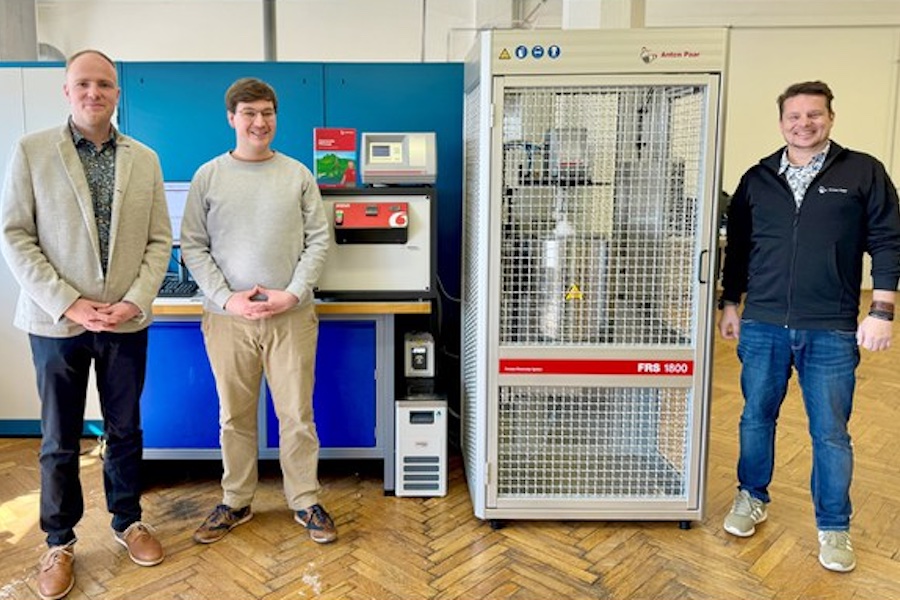
In March 2025, the new Furnace System 1800 (FRS 1800) high-temperature rheometer from Anton Paar was put into operation at the Institute of Textile Machinery and High Performance Material Technology (ITM) at TU Dresden. The installation was carried out by Fabian Barth and Peter Brandes from Anton Paar in collaboration with Florian Pötzsch and Dr. Dilbar Aibibu from the ITM.
Fabian Barth, Hendrik Florian Pötzsch and Peter Brandes © 2025 ITM Dresden


The FRS 1800, which is unique in Germany, enables precise rheological tests on high-performance materials up to 1800 °C. It combines a high-resolution, air-bearing rheometer head with a specially developed laboratory furnace for measuring the viscosity of melts - e.g. glasses, ceramics or metals that are processed at temperatures above 1000 °C. The FRS 1800 can be used to reliably determine key material properties such as melt viscosity or the complex shear modulus. This not only strengthens the quality of research at the ITM, but also opens up new possibilities in the development of temperature-resistant materials.

Thanks to modern functions such as normal force control, oscillation mode and the possibility of measurements in an inert gas atmosphere, thermal and mechanical properties can be analyzed under realistic conditions. The system meets international industry standards such as ASTM C965 and ISO 7884-2.

This project is co-funded by the European Union and co-financed from tax revenues on the basis of the budget adopted by the Saxon State Parliament.

More News from Institute of Textile Machinery and High Performance Material Technology (ITM)

#Research & Development

Teaching Award for the Day Of The Faculty of mechanical science and engineering 2025

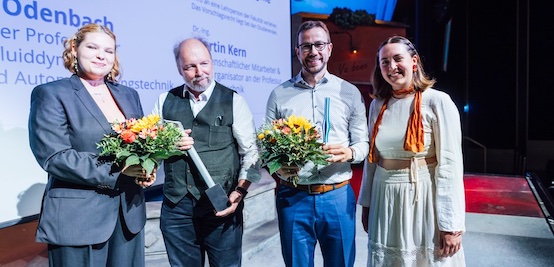
On June 28, 2025, almost 300 guests celebrated the Day of the Faculty of Mechanical Science and Engineering at the Boulevardtheater Dresden. At this year's ceremony, over 60 graduates from the Mechanical Engineering, Process Engineering and Natural Materials Technology and Material Science degree programs were given a ceremonial send-off into professional life, 9 doctoral graduates were congratulated on the successful completion of their dissertations and prizes worth a total of 13,500 euros were awarded.

#Research & Development

Award at the SAMPE Germany Symposium 2025 for outstanding dissertation

Hung Le Xuan was awarded the Innovation Prize at the SAMPE Germany Symposium 2025 last week for his dissertation "Novel textile reinforcements with integrated textile-based in-situ sensors for the reinforcement of existing concrete structures against short-term dynamic events".

#Research & Development

TU Dresden’s ITM and KOTMI sign MOU to promote research into recycled fibers and industrial textile applications

The Institute of Textile Machinery and High Performance Material Technology (ITM) at TU Dresden and the Korea Textile Machinery Convergence Research Institute (KOTMI) have signed a Memorandum of Understanding (MOU) to strengthen their collaboration in recycled fiber applications for industrial textile products. The agreement marks a significant step in fostering joint research and development in sustainable textile technologies.

#Research & Development

Wood wool instead of crude oil: Scientists at TU Dresden develop sustainable biocomposites

In the "Lignowool_2" project, TUD researchers are developing a composite material made of wood wool and biodegradable, textile plastic fibers. The so-called lignowool composites represent a sustainable alternative to petroleum-based plastics. In future, they are to be used in the automotive industry for door panels and trunk floors, for example. This is a technical application of wood wool and promotes the use of natural materials.

More News on Research & Development

#Research & Development

Textile cascade filter for removing microplastics from wastewater

Microplastics are now found almost everywhere, even in remote regions of Antarctica. They enter the human body through the food chain. Studies indicate that microplastics may have negative effects on the human health.

#Research & Development

Fraunhofer IAP paves the way for "Green" carbon fibers

A new pilot plant in Guben is set to enable the production of bio-based carbon fibers. The plant is part of the Carbon Lab Factory Lausitz and will make an important contribution to the transformation of the Lausitz region—from a traditionally raw material- and basic industry-oriented region to a hub for innovative high-performance materials. The German federal government and the state of Brandenburg are providing the Fraunhofer Institute for Applied Polymer Research IAP with 53.3 million euros for this purpose.

#Research & Development

Hof University develops sustainable textile coating for the fashion of tomorrow from mushrooms

Clothing is often treated as disposable: T-shirts for events, general merchandise, or short-term campaigns frequently end up in the trash after only a few uses. This is particularly problematic given that their production still largely relies on fossil-based materials. This is precisely where a new research project at Hof University of Applied Sciences comes in.

#Research & Development

Textilfabrik 7.0 launched: Mönchengladbach becomes a real-world lab for sustainable textile production

With the official kick-off event of the Textilfabrik 7.0 (T7), a major transformation project for the German textile and apparel industry has been launched in the Monforts Quarter in Mönchengladbach. At the “Textile Roundtable,” an event format organized by the Zukunftsagentur Rheinisches Revier, representatives from industry, research, politics, and the regional economy came together to jointly lay the foundation for CO₂-neutral, circular, and economically viable textile production in Germany.

Latest News

#Techtextil 2026

AI, Start-ups, Research: Techtextil and Texprocess bring together players in the textile industry

From start-ups to universities and research institutes: at Techtextil and Texprocess, the world’s leading innovation trade fairs in Frankfurt am Main, exhibitors present future-oriented concepts for the global textile industry. With the international Campus & Research area, a strong participation from start-ups and the latest AI applications for textile processing, both trade fairs showcase current developments in the textile industry. By bringing together innovation, research and application, they enable new partnerships across the textile value chain.

#Techtextil 2026

IVGT joint stand brings innovation and networking to Techtextil 2026

At Techtextil 2026 and the parallel Texprocess 2026, key transformation topics such as artificial intelligence, digitalisation, sustainability, recycling and the circular economy will be reflected across the show. Against this backdrop, the IVGT, together with 16 member companies, will present its joint stand in Hall 12.1 (Stand D62) as a platform for exchange and networking.

#Man-Made Fibers

Indorama Ventures supports Southeast Asia’s textile customers with reliable regional supply and global innovative portfolio

Indorama Ventures, one of the leading global polyester fiber and filament yarn suppliers globally, will participate in Indo Intertex 2026 in Jakarta this April, making its diverse global portfolio available to apparel, home textile, and hygiene customers across Southeast Asia.

#Raw Materials

New study shows low environmental impact by Cotton made in Africa Organic Cotton from Tanzania

Today, the Aid by Trade Foundation (AbTF) is announcing the results of a comprehensive life-cycle analysis (LCA) for cotton produced in Tanzania under the Cotton made in Africa Organic (CmiA Organic) standard. The study emphasises the small ecological footprint of CmiA Organic verified cotton. This can largely be traced back to the absence of synthetic pesticides, artificial fertilisers, and artificial irrigation. Consequently, CmiA Organic cotton can help the textile industry meet regulatory requirements as well as science-based targets. The results also show that the consequences of climate change threaten the livelihoods of these cotton farmers, even though the type of agriculture they practise barely contributes to climate change.

TOP