[pageLogInLogOut]

#Research & Development

Wood wool instead of crude oil: Scientists at TU Dresden develop sustainable biocomposites
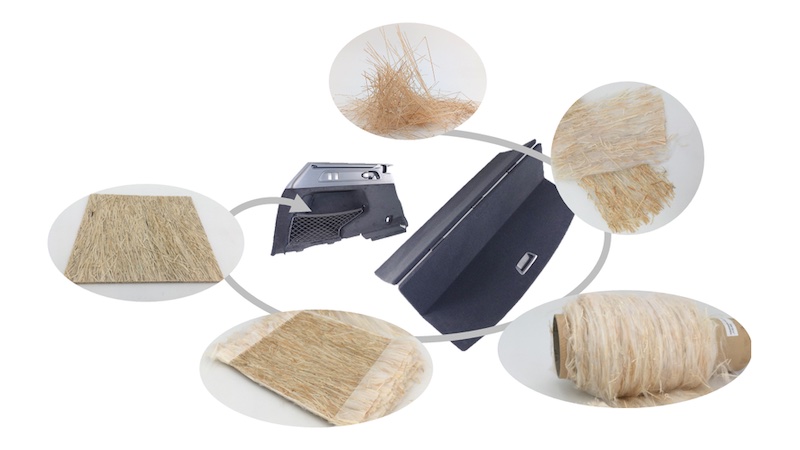
In the "Lignowool_2" project, TUD researchers are developing a composite material made of wood wool and biodegradable, textile plastic fibers. The so-called lignowool composites represent a sustainable alternative to petroleum-based plastics. In future, they are to be used in the automotive industry for door panels and trunk floors, for example. This is a technical application of wood wool and promotes the use of natural materials.
Process chain for processing technical wood wool (lignowool composites) at TU Dresden, © Sebastian Siwek


Wood wool is used in everyday areas, for example as a cushioning filling and padding material in packaging, as an ignition aid, but also in horticulture and animal husbandry. It also has a load-bearing function in lightweight panels.

Due to its lack of malleability and low strength, conventional wood wool is currently not used beyond the areas mentioned. With the production of lignowool composites, the TUD scientists at the Chair of Wood Machinery and High Performance Materials Technology, together with the Institute of Textile Machinery and Fiber Materials Technology (ITM) and various practice partners, want to open up a new field of application for wood wool. In the first phase of the project, the technological feasibility of the composite materials was demonstrated. Now the knowledge gained is being implemented. Technical wood wool with previously unattained properties is created from solid wood by means of incisions made in a targeted manner and precise cutting. This is then combed with biopolymer fibers in a carding machine and thus structured. Further textile-technical process steps lead to pressable blanks, the so-called wood wool thermoplastic tapes. In the project, these are processed into prototypes for the above-mentioned automotive applications.

"The technical wood wool we process retains its typical wood properties. It is more stable than the previously established wood wool and has a high formability. It is also reproducible and can be processed using textile technology," explains project manager Sebastian Siwek. "By developing composites, we are closing a gap in the field of wood-based materials and increasing resource efficiency through a more holistic utilization of wood."

The project team is planning an industry-oriented pilot plant to test the process for broad application, further develop the wood wool manufacturing process and improve the combination of the various processing steps.

"Lignowool_2" will run for two and a half years and is funded by the Federal Ministry of Food and Agriculture. The project sponsor is the Agency for Renewable Resources (Fachagentur für Nachwachsende Rohstoffe e.V.).
More News from Institute of Textile Machinery and High Performance Material Technology (ITM)

#Research & Development

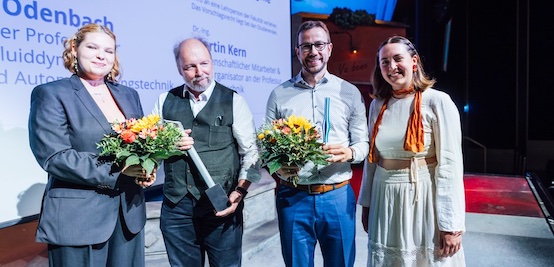
Teaching Award for the Day Of The Faculty of mechanical science and engineering 2025

On June 28, 2025, almost 300 guests celebrated the Day of the Faculty of Mechanical Science and Engineering at the Boulevardtheater Dresden. At this year's ceremony, over 60 graduates from the Mechanical Engineering, Process Engineering and Natural Materials Technology and Material Science degree programs were given a ceremonial send-off into professional life, 9 doctoral graduates were congratulated on the successful completion of their dissertations and prizes worth a total of 13,500 euros were awarded.

#Research & Development

Award at the SAMPE Germany Symposium 2025 for outstanding dissertation

Hung Le Xuan was awarded the Innovation Prize at the SAMPE Germany Symposium 2025 last week for his dissertation "Novel textile reinforcements with integrated textile-based in-situ sensors for the reinforcement of existing concrete structures against short-term dynamic events".

#Research & Development

Commissioning of the FRS 1800 high-temperature rheometer at the ITM

In March 2025, the new Furnace System 1800 (FRS 1800) high-temperature rheometer from Anton Paar was put into operation at the Institute of Textile Machinery and High Performance Material Technology (ITM) at TU Dresden. The installation was carried out by Fabian Barth and Peter Brandes from Anton Paar in collaboration with Florian Pötzsch and Dr. Dilbar Aibibu from the ITM.

#Research & Development

TU Dresden’s ITM and KOTMI sign MOU to promote research into recycled fibers and industrial textile applications

The Institute of Textile Machinery and High Performance Material Technology (ITM) at TU Dresden and the Korea Textile Machinery Convergence Research Institute (KOTMI) have signed a Memorandum of Understanding (MOU) to strengthen their collaboration in recycled fiber applications for industrial textile products. The agreement marks a significant step in fostering joint research and development in sustainable textile technologies.

More News on Research & Development

#Research & Development

Bio-based fibers with good flame retardancy

Fibers made from bio-based plastics reduce dependence on fossil raw materials and promote the circular economy. The covalent bonding of flame-retardant additives can open the way for these fibers to enter the mass market.

#Research & Development

Exchange data between textile companies openly, securely and cost-effectively without a central platform – ITA makes it possible

The Institut für Textiltechnik (ITA) of RWTH Aachen University has launched a new demonstrator for an open and secure data space in the textile industry at the Digital Innovation Centre Europe (DICE). For the first time, the demonstrator shows directly and clearly how companies can share their data securely with each other without the need for a central platform. Data exchange is based on shared, freely usable technical foundations.

#Research & Development

Sustainable athletic wear made from bio-based Polyethylene

Conventional sports textiles made from petroleum-based synthetic fibres are to be replaced in the future by sustainable, bio-based, cooling textiles. Polyethylene, previously used mainly in the packaging industry, is thus qualified for use in textiles and, as a bio-based drop-in solution, offers a cost-effective, sustainable alternative for the future.

#Research & Development

Innovation center for textile circular economy inaugurated

Just over eight months after the foundation stone was laid, the new Innovation Center for Textile Circular Economy was officially inaugurated today at TITK Rudolstadt. Thuringia's Minister President Mario Voigt, TITK Director Benjamin Redlingshöfer, and other guests of honor cut the ribbon to the modern building complex and viewed the premises, which are now ready for occupancy. The “DICE – Demonstration and Innovation Center for Textile Circular Economy” is TITK's largest single investment to date. The Free State of Thuringia supported the total cost of €11.5 million with €8 million in GRW and FTI funding.

Latest News

#Knitting & Hosiery

SHIMA SEIKI to exhibit at GMMSA Expo India

Leading Japanese computerized flat knitting technologist SHIMA SEIKI MFG., LTD. of Wakayama, Japan, together with its Indian sales representative Universal MEP Projects & Engineering Services, Ltd., will participate in the upcoming Garments Machinery Manufacturers & Suppliers Association (GMMSA) Expo India 2026 exhibition to be held in Ludhiana, India next month. Through its lineup at GMMSA, SHIMA SEIKI aims to further strengthen its presence within the Indian market with an exhibit that caters to diverse needs, consisting of seam-free WHOLEGARMENT® knitting technology as well as a brand-new shaping machine with high productivity and excellent cost performance.

#Nonwovens

ENDURANCE Program: Driving operational sustainability at Magnera

As Magnera enters a new year, the company is reflecting on a key sustainability milestone from 2025: the launch of ENDURANCE, its global, employee-led initiative focused on waste reduction and sustainable innovation. Launched on Earth Day 2025, this initiative has generated more than 250 improvement submissions from team members across Magnera’s global operations, demonstrating strong engagement and shared accountability for sustainability across the organization.

#Digital Printing

Maximising print efficiency exploring ink saving features for modern print production

In today’s print industry, balancing quality, efficiency, and environmental responsibility is a growing priority. With increasing pressure on margins and sustainability, solutions that streamline production without sacrificing results are more relevant than ever.

#Knitting & Hosiery

KARL MAYER opens a new TEXTILE INNOVATION CENTRE – a new era of textile innovation begins

KARL MAYER is opening its new TEXTILE INNOVATION CENTRE (TIC), sending a strong signal that it is driving textile innovation forward and opening up new perspectives for the textile industry. The TIC brings together the latest developments in Warp Knitting, Technical Textiles and Warp Preparation – KARL MAYER’s core areas of expertise.

TOP