[pageLogInLogOut]

#Research & Development

Returned items, sustainability and smart textiles are the focus at the Textile Logistics Forum
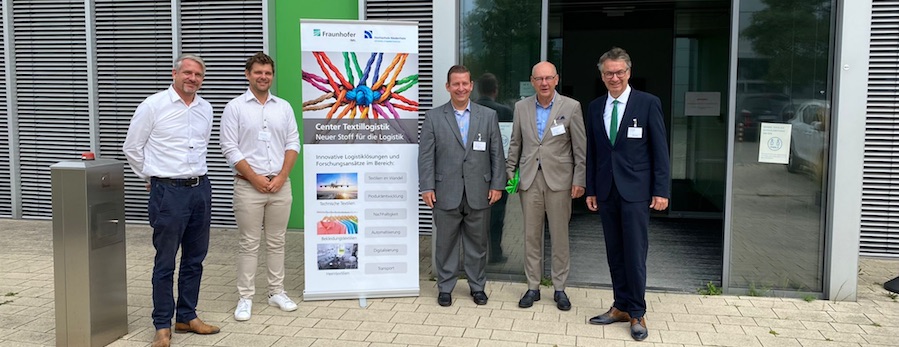
From left to right: Christian Prasse (Fraunhofer IML), Benjamin Dietrich (Interroll Fördertechnik GmbH), Markus Muschkiet (CTL), Thomas Grünewald (President HSNR) and Uwe Clausen (Institute Director Fraunhofer IML). (c) 2022 Fraunhofer IML/HS Niederrhein
Representatives of the textile and logistics industry exchanged ideas at the Fraunhofer Institute for Material Flow and Logistics IML in Dortmund on Wednesday. The 4th Textile Logistics Forum addressed current topics in textile logistics, such as trends, legal regulations and opportunities in the areas of returns, sustainability and smart textiles.

Dr Thomas Grünewald, President of the Niederrhein University of Applied Sciences, emphasised in his presentation the close ties between Fraunhofer IML and the university and outlined the joint development of the textile industry in Mönchengladbach.

"We see great potential for logistics through digitalisation and automation. In order to be able to use them in textile logistics as well, the specific requirements and dynamics of the textile industry must be considered at an early stage in both science and business and sustainability must be taken into account," said Prof. Uwe Clausen, Institute Director at Fraunhofer IML.

The industry and association representatives then addressed the current topics using examples and projects from their work. Among other things, they discussed the challenges of textile processing in returns management, increasing sustainability and establishing textile cycles, the change in the fashion industry due to the automation of conveyor technology, and the question of how workwear becomes sustainable smart textiles.


Dr. Uwe Mazura, Managing Director of the German Textile and Fashion Industry Association (Gesamtverband der deutschen Textil- und Modeindustrie e. V.), provided a critical view with his lecture "Are we regulating ourselves to death? European legislation from the perspective of textiles + fashion".

Professor Dr.-Ing. Markus Muschkiet, Head of the Center Textillogistik (CTL) in Mönchengladbach, took stock at the end of the event: "I am extremely pleased that we were once again able to cover a wide range of current topics at the 4th Textillogistik Forum, but also to provide an outlook on how the work of the CTL supports the industry."

Fraunhofer IML and Niederrhein University of Applied Sciences have already been working together within the CTL since 2018. Together, two teams at the locations in Mönchengladbach and Dortmund are developing solutions for both industries under the motto "Logistics for textiles - textiles for logistics". The Textile Logistics Forum is held annually, alternating between the two locations.
More News from Hochschule Niederrhein

More News on Research & Development

#Research & Development

Pellet press enables thermomechanical textile recycling on a pilot scale at ITA

Since the end of 2025, the technical centre of the Institut für Textiltechnik (ITA) of RWTH Aachen University has been equipped with a pellet press from the manufacturer Amandus Kahl GmbH & Co. KG, Reinbek, Germany. This press can efficiently compact shredded synthetic textiles at a throughput of up to 25 kg/h and process them into pellets with a diameter of 4 mm.

#Composites

STFI at JEC

The Sächsisches Textilforschungsinstitut e.V. (STFI) will present composites for aviation made from recycled carbon fibres and natural fibres, as well as printed lightweight elements for surface heating in electric vehicles at JEC World in Paris.

#Research & Development

Fabolose: Fabricating vegan and circular leather alternatives from bio-tech-derived cellulose

Fabulose is an EU funded project coordinated by the German Institutes of Textile and Fiber Research (DITF). Its consortium consists of leading research institutes, biotech innovators, and industry stakeholders who aim to create high-performance, biobased and recyclable leather-like fabrics, using efficient biotech production routes for bacterial cellulose, cyanophycin and bacterial pigments

#Research & Development

New DIN SPEC assesses environmental impact of textile fragments in soil

Textile products made from synthetic fibres, finished fabrics or dyed materials release fibre fragments into the environment at every stage of their life cycle. With the new DIN SPEC 19296, Hohenstein has developed a standardised testing method to analyse how these fragments behave in soil under natural conditions. Until now, little was known about their environmental behaviour or potential ecological effects once released.

Latest News

#Recycled_Fibers

Selenis to double capacity in Portugal by Q3 2027 - Accelerating the Global transition to circular and low-carbon polyesters

Selenis, a global leader in high-performance specialty polyesters and part of the IMG Group, has announced a transformational expansion of its industrial headquarters in Portalegre, Portugal. This strategic investment is set to double the site’s production capacity by the third quarter of 2027, significantly accelerating the industrial scale-up of bio-based, medical-grade, and circular co-polyesters.

#Technical Textiles

Independent testing confirms no detectable PFAS in Milliken firefighter turnout gear fabrics

Independent laboratory testing has confirmed that Milliken fabrics used in the manufacturing of firefighter turnout gear contain no detectable PFAS, based on third-party analysis conducted by Forever Analytical, an independent laboratory specializing in screening products and environmental samples for the presence of per- and polyfluoroalkyl substances (PFAS).

#Home Textiles

Intertextile Shanghai Home Textiles returns in August as global sourcing hub and trend barometer for home textiles industry

Following the conclusion of Heimtextil last month, the flagship fair in Messe Frankfurt’s global home and contract textiles portfolio, Intertextile Shanghai Home Textiles – Autumn Edition will return 18 – 20 August 2026 at the National Exhibition and Convention Center (Shanghai). Building on the momentum generated in Frankfurt, the Shanghai fair will reinforce its position as the foremost home and contract textile platform in Asia – successfully bridging the gap between East and West, and connecting global product trends, supply-chain shifts, and buyer demand in one marketplace.

#Digital Printing

Express Print boosts production using an expanded fleet of Mimaki technologies

Express Print, a fast-growing Bulgarian provider of visual communication and soft signage solutions, has significantly enhanced its production workflow with a comprehensive portfolio of Mimaki digital printing systems. Based in Varna and active for more than 10 years, the company maintains a strong focus on the advertising sector. Over the years, it has steadily expanded its operations, driven by a clear vision to bring the full spectrum of large-format printing services in-house, avoiding outsourcing and ensuring complete control over production quality.

TOP