[pageLogInLogOut]

#Research & Development

More sustainable textile production in Indonesia - mid-term review
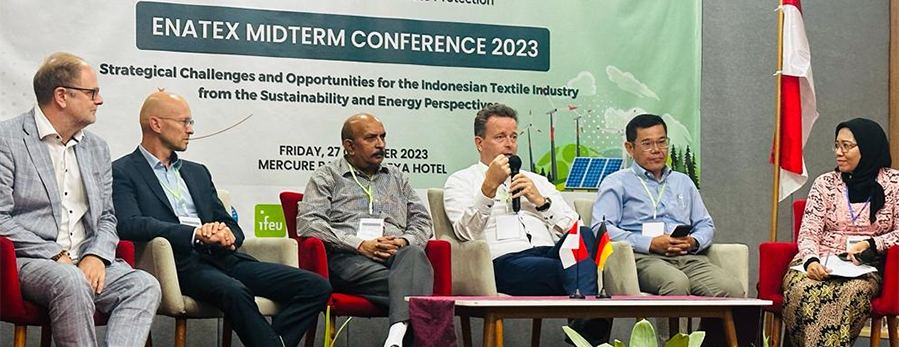
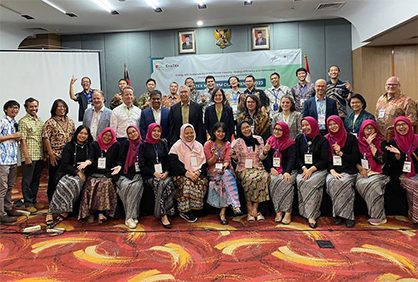
The mid-term conference took place in Bandung, Indonesia. The first results of the ENATEX joint project, in which the HSNR is involved, were also presented there. © 2023 Hochschule Niederrhein
At the mid-term conference in Bandung, the project partners took stock at the halfway point of the funding period of the project Enatex.

How can energy consumption in the processing of textiles be reduced and production in the Indonesian textile industry made more sustainable? The Enatex research project is getting to the bottom of this question. At the mid-term conference in Bandung, the project partners, in the presence of around 130 guests from industry, politics and various organizations, gave an interim assessment at the halfway point of the funding period.
© 2023 Hochschule Niederrhein


Enatex is managed by the Institute for Future Energy and Material Flow Systems (IZES) and funded by the Federal Ministry of Education and Research with 1.9 million euros. The Hochschule Niederrhein, with its FTB and AUGE institutes, is contributing almost 992,000 euros. The aim is to save at least 15 percent of primary energy and switch completely to regional, renewable energies in textile finishing.

Many partners are on board to drive forward this move away from fossil fuels for electricity and heat supply in Indonesia. Six scientific institutions and four corporate partners from Germany alone are participating and deriving potential for improvement from the study of production processes there. In Indonesia, two universities and two large textile companies are involved. "This project is a real eye-opener," praises research partner Ajai Mishra from Sritex, for example.


Together, the project participants are examining, for example, how drying energy can be saved with minimal application or what efficiency potential can be expected from the new ultrasonic technology. However, many other aspects are also being considered: Regenerative energy sources such as photovoltaics, improved energy management, the optimal use of all systems through to the installation of heat exchangers. All investigations are accompanied by occupational safety measures and holistic sustainability management.

"The interim results show how theCO2 footprintof textile production can be reduced through a combination of efficient process management on the one hand and a gradual expansion of renewable energy on the other," summarize Prof. Dr. Maike Rabe, head of the project at The Hochschule Niederrhein, and Prof. Dr. Monika Eigenstetter. The researchers Evelyn Lempa and Aslihan Memisoglu add: "The results that we are working on as a model with our Indonesian partners will be very easy to transfer to other textile countries."

More News from Hochschule Niederrhein

More News on Research & Development

#Research & Development

New DIN SPEC assesses environmental impact of textile fragments in soil

Textile products made from synthetic fibres, finished fabrics or dyed materials release fibre fragments into the environment at every stage of their life cycle. With the new DIN SPEC 19296, Hohenstein has developed a standardised testing method to analyse how these fragments behave in soil under natural conditions. Until now, little was known about their environmental behaviour or potential ecological effects once released.

#Research & Development

Solid Air Dynamics wins second place at RWTH Innovation Award

On 30 January, RWTH spin-off Solid Air Dynamics was awarded second place in the RWTH Innovation Awards for its research in the field of aerogel fibres. Manufactured from renewable raw materials, aerogel fibres offer outstanding thermal insulation, are extremely lightweight and completely biodegradable, and can consist of over 90 per cent air.

#Research & Development

Testing and research laboratory ensures safe and more sustainable products worldwide

For 80 years, Hohenstein has stood for independent testing, scientific expertise and practical solutions. Today, the testing and research service provider supports manufacturers and brands worldwide in making textiles, hardlines and medical devices safe, more sustainable and market-ready – thereby building trust among consumers. With an international presence and interdisciplinary expertise, Hohenstein supports its customers from production through to market launch, helping them navigate an environment of growing regulatory and societal demands.

#Research & Development

Award-winning research for sustainable carbon fibre cycles

Sustainable recycling of carbon fibres is possible through targeted electrochemical surface modification, which makes the sizing of carbon fibres resistant to solvolysis. ITA PhD student Sabina Dann was awarded the MSW Award from RWTH Aachen University for her master's thesis on this development. The award ceremony took place on 12 November 2025 in Aachen.

Latest News

#Textiles & Apparel / Garment

VIATT 2026 to debut German Pavilion, strengthening European participation alongside key Asian textile hubs

Vietnam’s textile and garment sector continues to be a major contributor to the country’s economic growth, with export revenues expected to reach USD 46 billion in 2025, a 5.6% increase from 2024 . From 26 – 28 February, the Vietnam International Trade Fair for Apparel, Textiles and Textile Technologies (VIATT) is set to contribute to economic growth opportunities by accelerating digital transformation and green transition across the entire textile value chain. The upcoming edition will respond to the rising demand for advanced technologies and sustainable materials with the introduction of the German Pavilion, alongside strong exhibitor participation from key Asian sectors, as well as several high-profile fringe events.

#Sustainability

Ying McGuire becomes new CEO of Cascale

Cascale today announced the appointment of Ying McGuire as Chief Executive Officer, effective June 1, 2026.

#Technical Textiles

Sustainable, lightweight, and sound absorbing: Polyester-based front trunk solution for BEVs

As car manufacturers look to further reduce their carbon footprint, Autoneum has developed an innovative front trunk solution for battery electric vehicles (BEVs), made entirely from polyester-based textile. The Ultra-Silent Frunk offers significant weight reduction, improved acoustic and thermal insulation, and uses up to 70 percent recycled material, supporting sustainable and efficient vehicle design. Autoneum, global technology leader in acoustic and thermal management for vehicles, has already received orders for the new frunk from three major OEMs in Asia and Europe to be built in three BEV models. Series production for two BEVs has been underway in China and Germany since last year.

#Raw Materials

Modern testing methods for raw cotton

The 38th International Cotton Conference Bremen will take place from 25 to 27 March 2026 at the Bremen Parliament. This conference has traditionally stood for in-depth expertise and international exchange. The program will focus on technical innovations, market trends, and regulatory frameworks across the entire value chain – from agriculture to the circular economy. With high-profile speakers, the conference is regarded as the key meeting point for the global cotton industry. Today’s focus: Cotton quality and testing methods.

TOP