[pageLogInLogOut]

#Research & Development

Prof. Thomas Gries on "The Recycling Problem of Clothes" at "Uni am Rathaus".
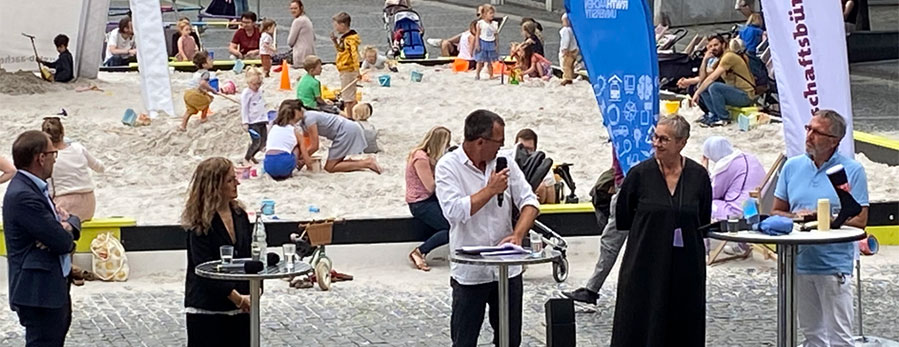
The discussion participants at the Katschhof in Aachen, Germany, far right Prof. Thomas Gries © 2022 ITA
On 20 July, Prof. Thomas Gries joined Sibylle Keupen, Mayor of the City of Aachen, Heiko Thomas, Councillor for Climate and Environment, Municipal Operations and Buildings of the City of Aachen, and Professor Marzia Traverso, Head of the Institute for Sustainability in Construction at RWTH Aachen University, at a panel discussion on "Textiles in the Circular Economy: Are our clothes becoming a problem?" at the Katschhof from 6 pm. (see picture, Prof. Gries is on the far right, source: ITA).

Textiles are - after food - the second most important consumer product in Germany: 20 to 25 kilogrammes are consumed per capita annually. Of this, 75 per cent is clothing, the rest is, for example, nappies, carpets or household textiles. However, the recycling rate is only one percent. How can this problem be solved? What can cities and municipalities do, what can science do? Is it possible to produce regionally produced clothing on a large scale again in Germany? Structural change also opens up opportunities for change in the textile industry.

Prof. Gries showed current projects on these topics and, among other things, how new textiles are produced at ITA from old blankets. The process addresses one of the main problems of recycling, the processing of mixed waste. With the process developed at ITA, pure acrylic fibres could be recovered from mixed waste and knitted into a cushion cover presented there.


The Citizens' Forum RWTHextern („Bürgerforum RWTH Extern“) and the City of Aachen had invited to this panel discussion. The event was moderated by Jens Tervooren from WDR.




More News from Institut für Textiltechnik of RWTH Aachen University (ITA)

#Research & Development

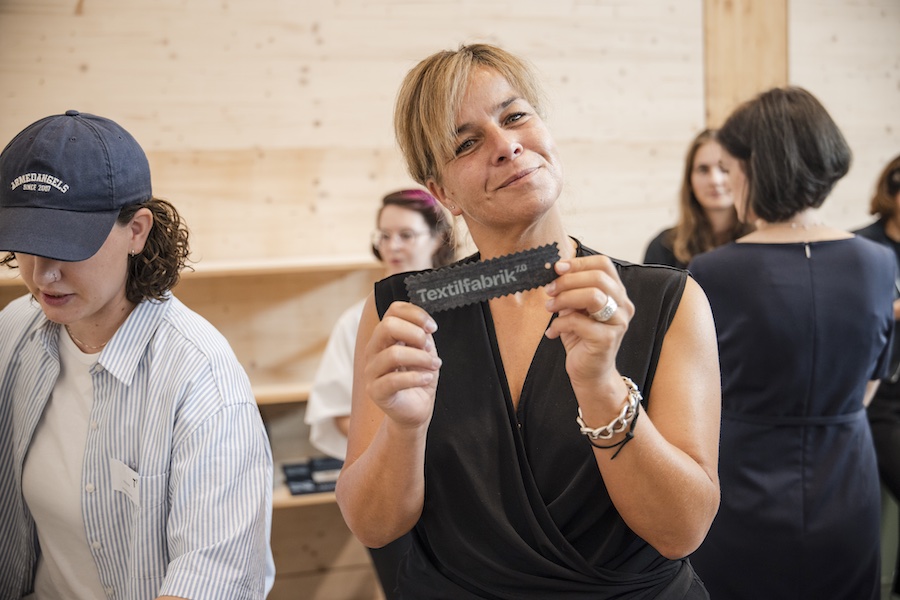
Textilfabrik 7.0 launched: Mönchengladbach becomes a real-world lab for sustainable textile production

With the official kick-off event of the Textilfabrik 7.0 (T7), a major transformation project for the German textile and apparel industry has been launched in the Monforts Quarter in Mönchengladbach. At the “Textile Roundtable,” an event format organized by the Zukunftsagentur Rheinisches Revier, representatives from industry, research, politics, and the regional economy came together to jointly lay the foundation for CO₂-neutral, circular, and economically viable textile production in Germany.

#Composites

More affordable, environmentally friendly hydrogen pressure tanks at ITA-JEC booth

As a highlight of the JEC, the Institut für Textiltechnik (ITA) of RWTH Aachen University will be presenting hydrogen pressure tanks manufactured using multifilament winding processes at the NRW joint booth in Hall 5, Stand G65.

#Research & Development

Pellet press enables thermomechanical textile recycling on a pilot scale at ITA

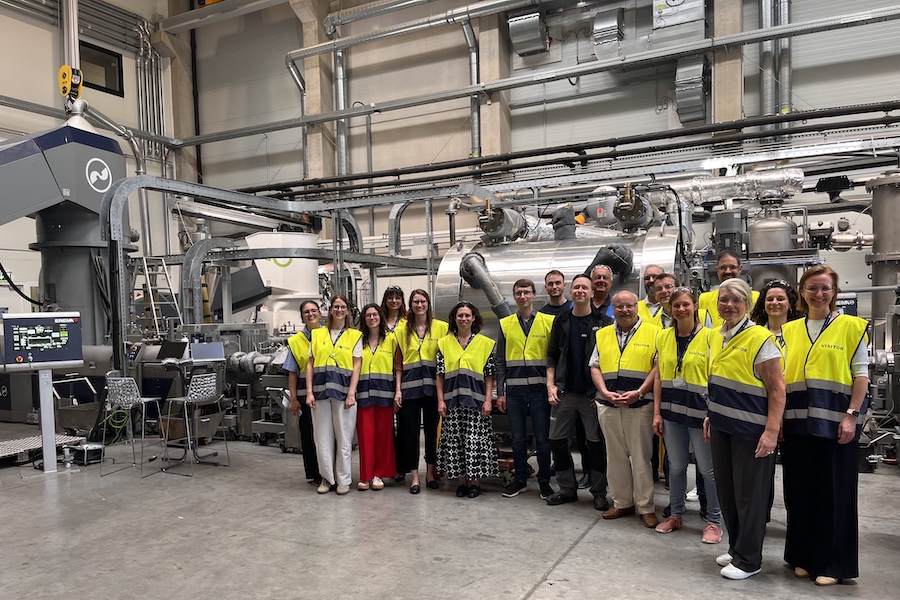
Since the end of 2025, the technical centre of the Institut für Textiltechnik (ITA) of RWTH Aachen University has been equipped with a pellet press from the manufacturer Amandus Kahl GmbH & Co. KG, Reinbek, Germany. This press can efficiently compact shredded synthetic textiles at a throughput of up to 25 kg/h and process them into pellets with a diameter of 4 mm.

#Research & Development

Solid Air Dynamics wins second place at RWTH Innovation Award

On 30 January, RWTH spin-off Solid Air Dynamics was awarded second place in the RWTH Innovation Awards for its research in the field of aerogel fibres. Manufactured from renewable raw materials, aerogel fibres offer outstanding thermal insulation, are extremely lightweight and completely biodegradable, and can consist of over 90 per cent air.

More News on Research & Development

#Research & Development

Hohenstein publishes 2025 Sustainability Report

The testing and research service provider Hohenstein has published its latest sustainability report, outlining key progress and strategic initiatives. The report focuses on ambitious CO₂ reduction targets, the company’s new mission statement and the systematic expansion of sustainable services for customers worldwide.

#Techtextil 2026

ITM presents cutting-edge textile research at Techtextil

From April 21 to 24, 2026, the Chair of Textile Machinery and High Performance Material Technology (ITM) at TUD Dresden University of Technology will be presenting its current research at Techtextil, the leading international trade fair for technical textiles and nonwovens. In Hall 12.0, Stand D41, the team will be demonstrating how it combines high-performance fibers, AI-supported digital development tools and innovative machine technologies to develop textile solutions for lightweight construction, construction, medical technology and sustainable production from atom to product.

#Research & Development

Textile cascade filter for removing microplastics from wastewater

Microplastics are now found almost everywhere, even in remote regions of Antarctica. They enter the human body through the food chain. Studies indicate that microplastics may have negative effects on the human health.

#Research & Development

Fraunhofer IAP paves the way for "Green" carbon fibers

A new pilot plant in Guben is set to enable the production of bio-based carbon fibers. The plant is part of the Carbon Lab Factory Lausitz and will make an important contribution to the transformation of the Lausitz region—from a traditionally raw material- and basic industry-oriented region to a hub for innovative high-performance materials. The German federal government and the state of Brandenburg are providing the Fraunhofer Institute for Applied Polymer Research IAP with 53.3 million euros for this purpose.

Latest News

#Techtextil 2026

SAHM Winding Solutions and Vandewiele Automation present integrated automation solution for winding processes

For the first time at the Techtextil trade fair in Frankfurt am Main, Germany (21 - 26 April), SAHM Winding Solutions (Hallo 12.0. / Booth 95) and Vandewiele Automation will be showcasing their combined automation expertise for industrial winding processes. Under the motto “Combining Automation. Maximizing Flow”, the two companies will demonstrate how automated package handling and robot-assisted yarn knotting can be integrated into a continuous production flow.

#Recycled Fibers

UNIFI celebrates recycled and circular Innovation with ninth annual REPREVE® Champions of Sustainability Awards

Unifi, Inc. (NYSE: UFI), the makers of REPREVE® and one of the world’s leading innovators in recycled and synthetic yarns, today announced the winners of its ninth annual REPREVE Champions of Sustainability Awards, recognizing brands and mills that are advancing circularity and responsible manufacturing across the global textile industry.

#Man-Made Fibers

Teijin Frontier announces new Stretch Polyester yarn offering exceptional compatibility with high-performance Polyester materials

Teijin Frontier Co., Ltd. announced today that it has developed a new stretch polyester yarn that offers new opportunities to create comfortable, all- polyester fabrics for sports and outdoor wear. The new polyester yarn demonstrates exceptional compatibility with high-performance polyester materials. Further, Teijin Frontier’s proprietary polymer design and spinning technology impart excellent elasticity to the new yarn. In turn, this yarn adds stretchability and recovery to the advanced functionality and excellent texture of high-performance polyester materials.

#Man-Made Fibers

Lenzing commissions 14 MW power‑to‑heat facility, strengthening grid stability and heat management

The Lenzing Group has successfully commissioned a new power‑to‑heat (P2H) facility with an electrical capacity of 14 megawatts. The installation converts renewable electricity directly into process heat, is fully integrated into the existing heat network at the industrial site, and represents a key building block for a fossil‑free heat supply. As project partner, VERBUND was responsible for the energy‑market integration and will operate the facility for balancing energy marketing, enabling it to respond flexibly to short‑term fluctuations in the power grid.

TOP