[pageLogInLogOut]

#Research & Development

Efficient roll-to-roll production technologies for more climate neutrality

For a climate-neutral economy, every opportunity must be exploited to reduce energy requirements and use resources efficiently. Highly efficient industrial processes are a key element in this. To this end, in the R2R-Net network, 18 European partners from industry and research are further developing reel-to-reel systems and processes that are used in production in a variety of ways. Companies benefit from the expertise, the support during scale-up and ramping up of the production, and the technical exchange.

On September 7, 2021, the partners will present current developments, success stories and novel production equipment in a workshop. The network is open to additional partners.

Roll-to-roll (R2R) processes, are used to coat or modify flexible materials such as polymer films, membranes, textiles, ultra-thin glass or metal strips. Their surface properties are often crucial for the function of a wide variety of products. To make industrial production processes even more efficient, researchers in the European Network for Roll-to-Roll Surface Technologies, R2R-Net, are developing technologies that modify the relevant surfaces during the continuous R2R process.

"All partners in the network have one thing in common: they use roll-to-roll processes. However, the challenges and application areas are extremely diverse. In the network, we use these synergies and generate novel solutions. In addition, we support companies in implementing the technology in the production process," explains the coordinator of the R2R-Net, Prof. Christian Oehr from the Fraunhofer Institute for Interfacial Engineering and Biotechnology IGB.

Dr. Andreas Holländer, surface expert at the Fraunhofer Institute for Applied Polymer Research IAP adds, "Using efficient coating and modification processes for roll-to-roll processes can save time, material and energy during production - even when parts are cut out at the end to be incorporated into the product."

"Roll-to-Roll technologies at work - for functionalized surfaces" workshop

At the workshop "Roll-to-Roll technologies at work - for functionalized surfaces" on September 7, 2021, the partners will provide a comprehensive overview of the state of the art and latest developments in R2R processes. Company representatives will provide insights into successful implementations of the technology in their production. Other program items include equipment demonstrations and a panel discussion. The event will be held at Coatema GmbH in Dormagen, Germany, likely as a hybrid event. Registration for the workshop is available on the network's website: www.r2r-net.eu.
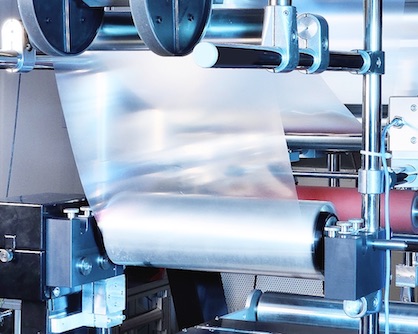


Roll-to-roll processes are used in a wide variety of production processes. In the R2R-Net network, partners from research and industry are driving forward the climate-friendliness of the processes © Fraunhofer IAP, Photo: Armin Okulla


The R2R-Net network

Similar technologies are used in the functionalization of surfaces of polymer films, membranes, textiles, nonwovens and fibers, as well as glass and metals. However, the substrate materials and application areas differ considerably. By joining forces of different players, new opportunities arise that go beyond the capabilities and capacities of the individual partners.

The R2R-Net network bundles competencies of different actors. Companies that manufacture equipment and tools, use the technologies and apply them in the production of goods are involved. Research institutions contribute with technology development and bring in their machinery for developments and pilot production.

In the scale-up from laboratory to production, the network partners provide a wide range of technologies at all levels. This enables pilot production of new products with state-of-the-art R2R equipment and technologies.

www.iap.fraunhofer.de
More News from Fraunhofer-Gesellschaft zur Förderung der angewandten Forschung e.V.

More News on Research & Development

#Research & Development

Pellet press enables thermomechanical textile recycling on a pilot scale at ITA

Since the end of 2025, the technical centre of the Institut für Textiltechnik (ITA) of RWTH Aachen University has been equipped with a pellet press from the manufacturer Amandus Kahl GmbH & Co. KG, Reinbek, Germany. This press can efficiently compact shredded synthetic textiles at a throughput of up to 25 kg/h and process them into pellets with a diameter of 4 mm.

#Composites

STFI at JEC

The Sächsisches Textilforschungsinstitut e.V. (STFI) will present composites for aviation made from recycled carbon fibres and natural fibres, as well as printed lightweight elements for surface heating in electric vehicles at JEC World in Paris.

#Research & Development

Fabolose: Fabricating vegan and circular leather alternatives from bio-tech-derived cellulose

Fabulose is an EU funded project coordinated by the German Institutes of Textile and Fiber Research (DITF). Its consortium consists of leading research institutes, biotech innovators, and industry stakeholders who aim to create high-performance, biobased and recyclable leather-like fabrics, using efficient biotech production routes for bacterial cellulose, cyanophycin and bacterial pigments

#Research & Development

New DIN SPEC assesses environmental impact of textile fragments in soil

Textile products made from synthetic fibres, finished fabrics or dyed materials release fibre fragments into the environment at every stage of their life cycle. With the new DIN SPEC 19296, Hohenstein has developed a standardised testing method to analyse how these fragments behave in soil under natural conditions. Until now, little was known about their environmental behaviour or potential ecological effects once released.

Latest News

#Techtextil 2026

Monforts to showcase advanced coating solutions at Techtextil 2026

Over the past few years Monforts has significantly advanced its technologies for coating, with the successive introductions of the MontexCoat, coaTTex and VertiDry systems combining flexibility, precision and energy efficiency for the technical textiles market.

#Composites

JEC World 2026 returns with an unprecedented content program

Recognized worldwide as the leading trade exhibition for composite materials and their applications, JEC World returns on March 10-12, 2026, at Paris Nord Villepinte as the most ambitious edition to date, in line with its motto “Pushing the limits”. As the must-attend event for the composites industry, JEC World will offer an unprecedented program, blending conferences, markets insights, technical sessions, awards, and above all, a unique experience and invaluable connections.

#Raw Materials

Beyond the wardrobe – innovative cotton takes the spotlight

Cotton can do more – a lot more. Cutting-edge textiles and high-tech products made from 100% cotton prove just how powerfully performance and sustainability can come together. That very surge of innovation is front and centre at the 38th Bremen Cotton Conference, taking place March 25–27, 2026, at Bremen’s Parliament on the historic market square – culminating in a bold and dedicated closing session on Friday. In the spotlight: performance upgrades for pure cotton, smart strategies for circular textile waste solutions, and pioneering concepts for demanding technical applications. From natural fibre–reinforced composites to highly effective flame-retardant solutions, cotton steps out of the closet and shows the future potential woven into every fibre.

#Digital Printing

Keeping print inclusive: Empowering women in the print industry

Across all industries, cultivating a diverse and inclusive workplace is increasingly recognised as valuable and essential to long-term success. However, despite the print industry’s significant advancements in technology and innovation, visible representation of women remains limited. As the sector grapples with low recruitment, it’s important to challenge outdated perceptions. Creating real change, however, requires collective effort - no single company can do it alone.

TOP