[pageLogInLogOut]

#Research & Development

Dr.-Ing. Larissa Born receives the Manfred Hirschvogel Prize
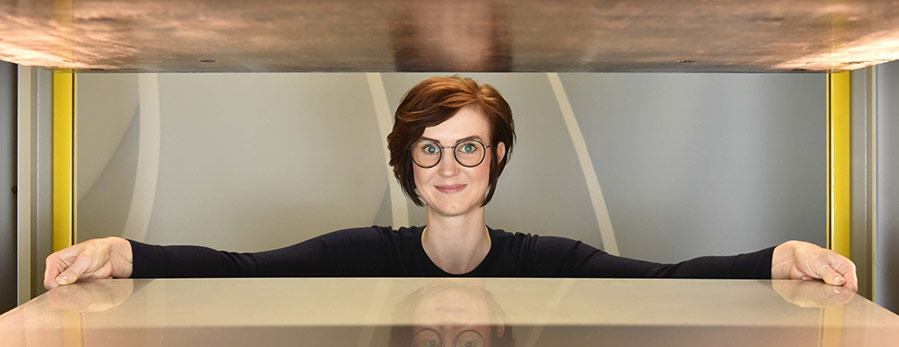
Prize winner Dr.-Ing. Larissa Born inserting the mirror plates (tool for test specimen production) into the hot press ©DITF Denkendorf
PhD student of ITFT at the University of Stuttgart awarded for her outstanding doctoral thesis

On 2nd July 2021, during the graduation ceremony for Master's students from the mechanical engineering faculties at the University of Stuttgart, Dr.-Ing. Larissa Born, research associate at the Institute of Textile and Fiber Technologies (ITFT), was awarded the Manfred Hirschvogel Prize 2021. The prize, endowed with 5,000 euros, is awarded annually at all TU9 universities – the nine leading technical universities in Germany – for the best dissertation in the field of mechanical engineering. The award-winning doctoral thesis is entitled "Principles for the layout and design of a hybrid material to be used in exterior, adaptive facade components made of fiber-reinforced plastic". Dr.-Ing. Marc Hirschvogel, Chairman of the Board of Trustees of the Frank Hirschvogel Foundation, especially highlighted the innovative approach and the scientific depth of the thesis during the award ceremony.

Since her student days, Larissa Born has been interested in fibre composites and their potential for a wide range of innovative applications. As part of her final theses during her studies as well as in her subsequent professional positions, she conducted intensive research on various material- and process-specific issues in context of fibre-reinforced composites. Since the beginning of her work at the ITFT, she has supervised numerous research projects on the development of adaptive fibre-reinforced composite components for shading systems with her textile-technological expertise. Within this research activity, she developed the topic of her dissertation: "Principles for the layout and design of a hybrid material to be used in exterior, adaptive facade components made of fiber-reinforced plastic".

With her doctoral thesis, Larissa Born provides a basic methodology for the development of adaptive fibre-reinforced plastics and exemplarily applied it to a hybrid material made of glass-fibre reinforced plastic, elastomer and thermoplastic polyurethane. Locally flexible areas (hinges) are integrated between stiff component areas by adapting the material set-up. Furthermore, to be able to analyse the adaptive material properties, she developed a new test method that allows a test specimen to be bent by up to 180°. The novel hybrid material allows a continuous load of 5,000 bending cycles by 180° with only marginal loss of tensile strength. A data base including a regression model to predict and adjust the mechanical properties of a hinge component is the result of the analyses performed within the thesis.


The hybrid material has already found application in different demonstrators, which were awarded the AVK Innovation Award (Flectofold) and the Materialica Gold Award (Flexafold). "With her work, Larissa Born has succeeded in establishing a completely new, material-technical basis for the development of adaptive fibre-reinforced plastics," lauded Prof. Dr.-Ing. Götz T. Gresser, doctoral supervisor and head of ITFT, at the award ceremony. "The application is not limited to the architectural context, but can also be transferred to other fields such as automotive and aviation. In this way, mechanical, high-maintenance joints can be replaced by low-wear, compliant mechanisms."
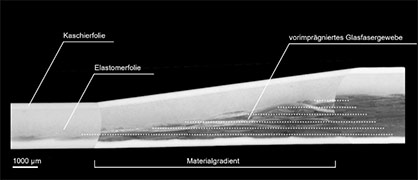
Cross-section (micrograph) of the transition from the flexible joint to the rigid component area in the joint component made of hybrid material ©University of Stuttgart (ITFT) L. Born


Larissa Born's remarkable professional career started at Reutlingen University in the Textile Technology/Management programme. As part of her bachelor's thesis, she developed flectofin®, the first adaptive façade shading component made of fibre-reinforced composites. This became the starting point for subsequent developments in this field, which she has accompanied and driven forward as a research associate at the ITFT since 2014, after working at the BMW Group and the Bremen Fibre Institute, the ITV Denkendorf and the Fraunhofer PYCO facility. The large-scale demonstrators Flectofold and ITECH Research Demonstrator 2018-19 were important milestones on this path.

After having finished her doctorate, Larissa Born will continue her research work at the ITFT as deputy director of the institute. The aim now is to deepen the existing research field together with Prof. Gresser and to open up new research topics in the field of fibre-reinforced composites. One important issue for Larissa Born is the promotion and support of young researchers and future doctoral students. Her diverse experience and expertise should inspire others to pursue a scientific career and support them on their way.




More News from TEXDATA International

#Texprocess 2026

Texprocess 2026: Automation, digitalisation and AI reshape textile processing

Investment decisions in textile processing have become increasingly complex. Rising energy prices, labour shortages and geopolitical uncertainties are forcing companies to prioritise technologies that deliver measurable improvements in efficiency and process stability. This applies not only to apparel production, but also to the processing of technical textiles and high-performance materials. Modernisation projects are therefore being evaluated more selectively – but the pressure to upgrade production systems continues to grow. Texprocess 2026 reflects this tension between cautious investment behaviour and increasing technological demand.

#Techtextil 2026

Textile Chemicals & Dyes: Innovation in Textile Chemistry moves into focus at Techtextil 2026

From PFAS-free finishes and water-saving dyeing technologies to advanced coatings and recycling-compatible formulations, innovation in textile chemistry is accelerating across the industry. Reflecting this development, Techtextil 2026 introduces Textile Chemicals & Dyes as a dedicated product segment, highlighting the growing role of chemical solutions in shaping the next generation of technical textiles.

#Recycling / Circular Economy

textile.4U publishes special edition “Top 100 Textile Recycling Companies 2025”

With a comprehensive 176-page special edition, textile.4U is dedicating its latest issue entirely to one of the most dynamic and influential topics in today’s textile industry: textile recycling. The new issue, published exclusively in high-quality print, presents the Top 100 textile recycling companies researched and selected by TexData – organizations that already play a key role in the transition to circular textiles or are expected to have a significant impact in the near future.

#Recycling / Circular Economy

Responsible Textile Recovery Act of 2024 signed by Governor

Senator Josh Newman (D-Fullerton) is proud to announce that Senate Bill 707 (SB 707), the Responsible Textile Recovery Act of 2024, has been signed into law by the Governor of California, Gavin Newsom. This groundbreaking legislation establishes the country’s first Extended Producer Responsibility (EPR) textile recycling program, marking a significant step forward in the state’s efforts to combat waste and promote sustainability.

More News on Research & Development

#Research & Development

Textilfabrik 7.0 launched: Mönchengladbach becomes a real-world lab for sustainable textile production

With the official kick-off event of the Textilfabrik 7.0 (T7), a major transformation project for the German textile and apparel industry has been launched in the Monforts Quarter in Mönchengladbach. At the “Textile Roundtable,” an event format organized by the Zukunftsagentur Rheinisches Revier, representatives from industry, research, politics, and the regional economy came together to jointly lay the foundation for CO₂-neutral, circular, and economically viable textile production in Germany.

#Techtextil 2026

STFI presents concepts for the textile circular economy and solutions for a healthy and safe life at Techtextil

Sächsisches Textilforschungsinstitut e.V. (STFI) has been supporting companies in developing marketable innovations for over 30 years. With a clear focus on sustainability, the environment, health and protection, the STFI offers future-oriented research, textile testing for tailor-made solutions and certification of per- sonal protective equipment. At Techtextil 2026, the institute will present ideas for the textile circular econ- omy and showcase solutions for healthy and safe living.

#Techtextil 2026

Cetex: Textile innovations “Made in Saxony” at Techtextil

This year, the Cetex Institut gGmbH is once again not only exhibiting but also organising a joint booth at Techtextil. Together with co-operation partners, textile innovations “Made in Saxony” will be presented on almost 85 m². The spectrum covers everything from textile machine construction and the manufacture of technical textiles to measuring and testing technology, with research and development also having its place.

#Composites

More affordable, environmentally friendly hydrogen pressure tanks at ITA-JEC booth

As a highlight of the JEC, the Institut für Textiltechnik (ITA) of RWTH Aachen University will be presenting hydrogen pressure tanks manufactured using multifilament winding processes at the NRW joint booth in Hall 5, Stand G65.

Latest News

#Techtextil 2026

Future ready nonwovens and fiber processing solutions – Meet Trützschler at Techtextil 2026

From April 21 to 24, 2026, the Trützschler Group will present its future‑ready solutions at Techtextil in Frankfurt, Germany. At Booth C61 in Hall 12.0, Trützschler Nonwovens will showcase its latest developments for efficient nonwovens production, including comprehensive service and consulting solutions. Highlights include the fully upgraded X‑Series nonwoven cards suitable for spunlace, needle‑punching and air‑through bonding (ATB) processes, as well as the T‑ONE digital working environment enhanced with new features. Trützschler Card Clothing will complement the presentation with a new card wire designed with a specially engineered surface for high‑performance nonwoven applications. Visitors can also take a closer look at Trützschler’s complete solution for the recycling of textile waste, TRUECYCLED.

#Recycling / Circular Economy

Europe needs tipping point to scale textile-to-textile recycling, BCG and ReHubs say

A new report from Boston Consulting Group (BCG) and ReHubs, titled “Advancing Textile Circularity – Europe’s textile waste challenge: Scaling Textile-to-Textile requires enabling mechanisms”, highlights the urgent need for systemic action to tackle Europe’s growing textile waste and scale a circular textile economy.

#Digital Printing

Former ASOS CEO Nick Beighton joins Kornit Digital to help shape the future of on-demand fashion

Kornit Digital LTD. (NASDAQ: KRNT) ("Kornit" or the "Company"), a global leader in sustainable, on-demand digital fashion and textile production technologies, today announced it has appointed Nick Beighton, former Chief Executive Officer of ASOS, as a strategic advisor to the Company and its Board of Directors. His appointment reflects Kornit’s continued focus on strengthening its connection to global brands, retailers, and digital commerce platforms as the industry transitions toward on-demand production. The Company plans to nominate Mr. Beighton for election to the Board at Kornit’s 2026 Annual Shareholder Meeting.

#Techtextil 2026

Gebr. Otto highlights versatility at Techtextil with regional supply chains, yarn innovations and new hygiene segment

At this year’s Techtextil, Gebr. Otto places its versatility at the center of its presentation. In addition to spinning, twisting and dyeing – traditionally focused on fine cotton – textile processors will also find a competent development partner for technical specialty solutions. The Dietenheim-based spinning mill has now built up a decade of experience in the production of technical yarns, particularly from aramids. A new hygiene segment has also been established, where yarns for medical and hygiene products are currently being produced. In the future, this department could also develop textile products for the food sector. Gebr. Otto will once again be present at the BW-i joint stand, booth D81, hall 12.1. What is wound onto the spool is determined by the customer: Gebr. Otto develops according to specific customer requirements and transforms its own ideas into yarn innovations.

TOP