[pageLogInLogOut]

#Research & Development

Elektrolysis made in Baden-Württemberg

Solar energy and other types of regenerative energy are representative of the energy turnaround in Germany. Water electrolysis is a key technology designed to support the energy turnaround at a weak point, namely the ability to store the energy produced. Hydrogen is a secondary energy carrier that enables efficient energy storage due to its high energy density. Therefore, water electrolysis can make a decisive contribution to climate neutrality.

DITF develop technology for new, reinforced membranes for electrolyzers

Hydrogen is a clean energy carrier. When converted to electricity in a fuel cell, it is characterized by a very high energy yield. Hydrogen is also transportable and can therefore be used locally by consumers. Hydrogen technology is particularly important for energy-intensive industries such as steel production or in the operation of refineries. But hydrogen is also very popular for modern mobility solutions: as a transportable energy carrier that is also locally emission-free.

Construction of a modern electrolyzer

In the joint research project 'Electrolysis made in Baden-Württemberg', the DITF are participating in the construction of a state-of-the-art electrolyzer for alkaline water electrolysis, which will serve to transfer technology to industry.  The project is coordinated by the Center for Solar Energy and Hydrogen Research (ZSW), which will build the demonstrator with an electrical output of one megawatt. The task of the DITF is to develop and manufacture nonwoven-reinforced membranes for the electrolysis cell.

Water electrolysis is an electrochemical process with the aim of obtaining hydrogen from water. In an electrolysis cell, water is split electrochemically and releases gaseous hydrogen at a cathode and oxygen at an anode. The anode and cathode are separated by a membrane. The passage of current is not interrupted by the membrane. Depending on the design of the electrolytic cell, the ionic conductivity of the membrane allows the exchange of ions. The membrane is gas-tight and thus prevents the mixing of the gases produced at the anode and cathode.

Membranes of this type are already in widespread use, but they usually have a relatively high ohmic resistance due to their material thickness. A correspondingly higher energy input is required for electrolysis. Thin and highly efficient membranes with better electrochemical properties, on the other hand, have so far not been robust enough, especially when used in larger cells. They are sensitive to mechanical stresses and are prone to stress cracking.

Reinforced membranes from the DITF

As part of the research project, membranes made of polymers are being produced at the DITF that are modified and thus precisely tailored to their task. The membranes exhibit excellent electrochemical properties. They are chemically stable in an alkaline environment, i.e. under the conditions that prevail inside the electrolytic cell. The membranes should also have good long-term stability. This means that they work almost faultlessly even under continuous stress. The membranes are inexpensive to manufacture and use.

The mechanical stability of the membrane is a central point in the development. On the one hand, it should be as thin as possible in order to work highly efficiently. On the other hand, it should not fall below a certain thickness to ensure mechanical load capacity. The mechanical load cannot be avoided, since during block assembly the membranes are pressed together with the mostly porous, structured surfaces of the electrodes in the block.


To alleviate this difficult situation, researchers at the DITF are taking a special approach: The membranes can be mechanically reinforced by using nonwovens made of ultrafine fibers (fiber diameter 0.2-2µm). The development of suitable nonwovens, their structural design and the choice of their chemical composition are just as great a challenge as the manufacture of the membranes. A specially developed integrated reinforcement frame made of composite materials also absorbs mechanical pressure loads and provides additional protection for the membrane. In addition to pure mechanical stabilization, it will be possible to use the nonwovens to reduce the passage of hydrogen through the membrane. The interface between the membrane and the nonwoven has a special significance in the structure of this composite: The electrical contact resistance must be kept low here so as not to impair the efficiency of the cell. This can be influenced by the choice of material for nonwoven fabrication or by surface treatment of the nonwoven. In this way, the electronic properties, but also the fiber-matrix (or fiber-membrane) adhesion, which is crucial for achieving an increase in stability through the use of nonwovens, are ensured and further developed.
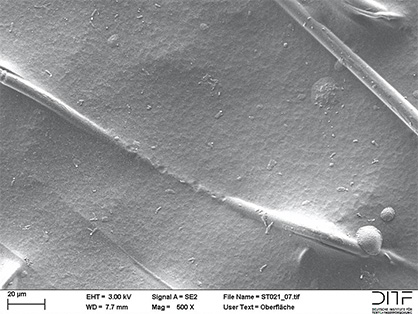
SEM-micrograph of the membrane.  © 2020 DITF
SEM-micrograph of the membrane. © 2020 DITF


Bringing together such disparate materials as an electrochemical membrane and a textile nonwoven is a very challenging undertaking. This makes the first promising laboratory results all the more noteworthy. The first nonwoven-reinforced membranes are available and are being tested for their practical suitability. The next step will be to optimize the structure of the membranes. At a later date, they will then be in service - for the time being within the demonstrator, which will set the state of the art in this joint project.

Project information

Under the slogans 'Electrolysis made in Baden-Württemberg', the Baden-Württemberg Ministry of Economics, Labor and Housing is funding a collaborative research project with five million euros. The lead partner is the Center for Solar Energy and Hydrogen Research Baden-Württemberg (ZSW). In addition to the German Institutes of Textile- and Fiber Research Denkendorf (DITF), the collaborative partners are the German Aerospace Center (DLR) and Hahn-Schickard Gesellschaft für angewandte Forschung (HS) in Stuttgart. The aim is to develop a modern, highly efficient water electrolysis plant that will serve as a demonstrator for technology transfer. The technology is intended to help plant engineers and component manufacturers position themselves advantageously in international competition. Specialist companies will be involved in the development project from the outset. The project sees itself as an initiator for state-of-the-art electrolysis production in Baden-Württemberg.

More News from Deutsche Institute für Textil- und Faserforschung Denkendorf

#Research & Development

More safety and comfort for protective clothing thanks to auxetic fabrics

When everyday materials are pulled, they stretch or elongate in the direction of the pull and become narrower in cross-section. We can also observe this property in two-dimensional textiles. Auxetic structures behave differently here. They have the striking property of not changing under tensile stress or even increasing their width or thickness. These properties are advantageous, for example, in protective textiles or textile filter media. The DITF are researching auxetic fabrics for various applications.

#Research & Development

Panty liners prevent bacterial vaginosis

Worldwide, almost one third of women of childbearing age suffer from bacterial vaginosis. This is when the sensitive microbiome of the vagina becomes unbalanced. Such a disorder of the vaginal flora can cause urogenital infections, abscesses on the ovaries or fallopian tubes or premature births. This significantly increases the risk of infertility in women and of contracting a sexually transmitted disease or HIV.

#Research & Development

DITF send a signal for climate protection

The German Institutes of Textile and Fiber Research Denkendorf (DITF) have successfully implemented extensive investments in photovoltaic systems at their site in Denkendorf. The systems installed on the roofs of the buildings and covered parking lots have a total installed capacity of 840 kilowatt peak (kWp). The DITF invested 1.6 million euros in this with the support of the state of Baden-Württemberg. The system was ceremonially put into operation on September 17, 2025.

#Research & Development

4.2 million Euros for research into textile recycling

Around the world, used textiles are still rarely recycled and pile up into huge mountains of waste. A recent study by the Boston Consulting Group (BCG) drew attention to this problem. However, the low recycling rate is also due to the fact that only a small percentage of used textiles are actually suitable for recycling into high-quality materials and for demanding applications. The German Institutes of Textile and Fiber Research Denkendorf (DITF) are addressing this problem with their research.

More News on Research & Development

#Research & Development

Fraunhofer CCPE presents the “Monomaterial Design Set” – Innovative solutions for circular product design

Composite materials made from different types of plastic often extend the lifetime of products but make recycling more difficult in the circular economy. That is why Fraunhofer CCPE has developed the “Monomaterial Design Set”. This new approach helps to reduce the variety of plastics used in durable products and offers circular solutions for designers and product developers.

#Research & Development

How innovations drive BASF’s success

“Innovation has always been part of BASF’s DNA. Especially in these volatile times, it is crucial to leverage our innovative strength to develop competitive solutions that differentiate us as a company in our markets and give us a competitive edge,” said Dr. Stephan Kothrade, Member of the Board of Executive Directors of BASF and Chief Technology Officer, at the company’s Research Press Briefing held today. To achieve this, BASF implemented its “Winning Ways” strategy about a year ago with the clear goal of becoming the preferred chemical company to enable its customers’ green transformation.

#Research & Development

Small tolerances, big impact and a recyclable alternative to elastane

ITA Master's student Janne Warnecke investigated tension differences over the fabric width in the weaving process and thereby contributed to quality assurance; ITA Bachelor's student Jasmin Roos found a basis for the development of recyclable yarns and textiles. For these developments, they were awarded the Walter Reiners Foundation's Promotion and Sustainability Prizes on 27 November. Peter D. Dornier, Chairman of the Walter Reiners Foundation, presented the awards at the Aachen-Dresden-Denkendorf International Textile Conference (ADD-ITC) in Aachen, Germany.

#Associations

Young researchers recognised for cutting-edge work in recycling, fibre technology and textile mechanics

At the Aachen-Dresden-Denkendorf International Textile Conference held in Aachen at the end of November, Peter D. Dornier, Chairman of the Walter Reiners Foundation of the VDMA, honoured five successful young engineers. Promotion and sustainability prizes were awarded in the categories bachelor/project theses and diploma/master theses. Academic theses that develop solutions for resource-saving products and technologies, for example, are eligible for the sustainability awards.

Latest News

#People

Happy Holidays!

Dear reader, the year 2025 is drawing to a close. We are entering what we hope will be a peaceful holiday season, spending time with our families and taking a moment to pause and reflect. We hope we have been able to support you once again this year with relevant news and articles, and we look forward to surprising you with many innovations in the coming year. Enjoy the festive season, stay healthy, and we wish you a happy and joyful holiday season.

#Weaving

Lindauer Dornier announces leadership transition in weaving machine business

After more than ten successful years at Lindauer DORNIER GmbH, Mr Wolfgang Schöffl will leave the family-owned company at the end of the year to enter well-deserved retirement.

#Heimtextil 2026

Texpertise Focus AI: Messe Frankfurt puts Artificial Intelligence centre stage at its international textile and apparel trade fairs

Under the banner 'Texpertise Focus AI, Messe Frankfurt will place a strong emphasis on Artificial Intelligence (AI) across its international textile and apparel trade fairs from 2026 onwards, setting a future-shaping signal for the industry. The initiative highlights the responsible use of AI along the entire textile value chain, from fibre production to the point of sale. The programme will launch at Heimtextil in Frankfurt in January 2026.

#Technical Textiles

Autoneum and Polestar set new benchmarks for passenger experience and sustainability

As the global market leader in sustainable acoustic and thermal management, Autoneum is a key supplier of interior and exterior components for the highly anticipated Polestar 5 model. The successful collaboration between Autoneum and Polestar marks a significant milestone in sustainable automotive engineering: the electric grand tourer sports car features several innovations in lightweight, fully recyclable polyester-based components that ensure a superior driving experience. Polestar 5 was revealed at the IAA Mobility 2025 in Munich and is available in 24 markets.

TOP