[pageLogInLogOut]

#Research & Development

Signing of memorandum of understandung between KIAT and RWTH Aachen University
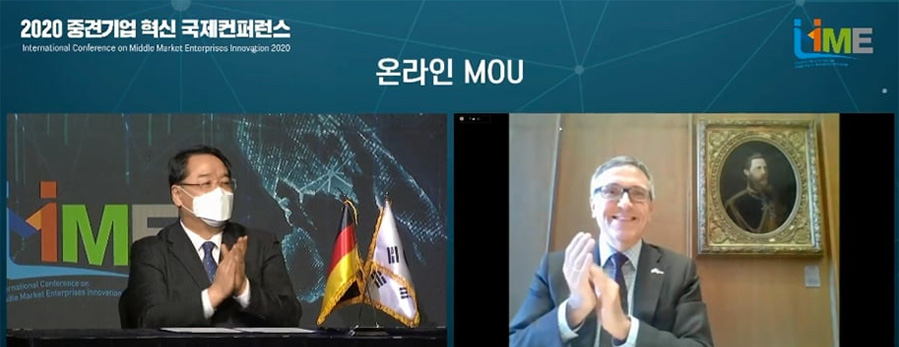
Dr Soek, Young Cheol, KIAT President, and Professor Dr Thomas Gries, ITA Institute Director, Source: Soyeon Schröder-Kim © 2020 / Soyeon Schröder-Kim / ITA
The Memorandum of Understanding between KIAT (Korean Institute for Advancement of Technology) and RWTH Aachen University was signed in a ceremony on November 19th, 2020. The signing took place during the International Conference of Middle Market Enterprise Innovation (MMI) 2020. The signing ceremony was attended by the Rectorate Commissioner for Korea, Professor Dr Martin, and representatives of the Faculty of Mechanical Engineering, Professor Dr Thomas Gries. On the Korean side, the President of KIAT, Dr Suhk, signed.

The Rectorate and the University support the cooperation, underlining the more than 70 years of exchange between Korea and Aachen. In the 150th anniversary year of RWTH Aachen University, this is a symbol for the further progress of the cooperation between Korea and RWTH Aachen University. The cooperation agreement supports the Korean German Technology Cooperation Center, which will start operations by 01.01.2021 in the Technology Center "Technologiepark Herzogenrath (TPH)". This will further strengthen the cooperation.

Address by Univ.-Prof. h.c. Dr.-Ing. Dipl.-Wirt.-Ing. Thomas Gries, Director of the Institut für Textiltechnik and representative of the Faculty of Mechanical Engineering of RWTH Aachen University:

Here in the RWTH Aachen Senate session hall, I sit under the painting of Crown Prince Friedrich Wilhelm, who founded the university 150 years ago as a public-private partnership together with industrialists from Aachen. But it is not only this historical date, there are other historical meanings. More than 55 years ago, Korean miners and nurses came to Europe to do their work here in the Aachen city region. They thus contributed to the economic miracle in Germany. Thank you very much, Gamsahamnida!

Today there is not a single coal mine in the region, but Aachen has become the heart of innovation for Europe. The RWTH Aachen University is the number one in research and cooperation with industry among all universities in Germany. The Faculty of Mechanical Engineering is home to the Internet of Production and Biobased Fuels clusters of excellence. It also addresses the main trends, namely Digitisation/Industry 4.0 and Bioeconomy. RWTH Aachen University also has the largest technology park (Industrial Convergence Center) between the university and industry. With an investment volume of almost four billion euros, it is the largest technology campus in Europe. We simply call it a campus because we take cooperation in the university between industry and academia for granted.

Against this background, there are numerous successful examples of cooperation between Korean middle market enterprises and RWTH Aachen University. As keynote speaker at MMI 2019, I had the honour of reporting in detail on these success stories.


Today's Memorandum of Understanding underlines this cooperation which will continue in a future-oriented way. In only five weeks, the Korean German Technology Cooperation Center (KGTCC) will start its work in the Technology Park Herzogenrath (TPH). The managing directors Dr. Johannes Pietzka and Dr. Kim John Gill were present at the signing ceremony. With the Memorandum of Understanding and the KGTCC, the cooperation between Middle Market Enterprises from Korea and the RWTH Aachen University will enter a new era. I look forward to a successful future and thank you for your trust and confidence in our cooperation.

Message of greeting by the Rectorate's representative for Korea Professor Dr Manfred Martin:

150th anniversary of the RWTH Aachen University. This should have been celebrated in Korea in March, had it not been for Covid-19. We will make up for this anniversary next year. The cooperation with Korea looks back on more than 70 years when the first Korean students arrived in Aachen. In the meantime the cooperation has developed very positively. The Korean Alumni Organisation is one of the largest foreign alumni organisations at RWTH Aachen University. Last year, during Rector Ulrich Rüdiger's visit to the Rectorate, the RWTH Liaison Office was opened in the centre of Seoul. It is headed by RWTH alumnus Dr Joseph Kim. Thus, Korean middle market enterprises and Korean scientists have a permanent contact point in Korea. Like this Liaison Office, today's signing of the Memorandum of Understanding between KIAT and RWTH Aachen University underlines the close ties between Korea and RWTH Aachen University. The Rectorate is looking forward to a further intensified cooperation!

More News from Institut für Textiltechnik of RWTH Aachen University (ITA)

#Research & Development

ITA has developed a washable digital smart jacket with real-time feedback and an AI-powered app for rehabilitation

As part of the PhysioTaix research project, the Institut für Textiltechnik (ITA) of RWTH Aachen University is developing a digital smart jacket with integrated sensors. The jacket is washable and reusable; it tracks movements during rehabilitation exercises in real time and transmits the data to an app.

#Recycling / Circular Economy

2. RETRAKT EU Conference - „Join the Circle“: Turning challenges of the textile sector into chances

On 19 November 2026, the second RETRAKT EU Conference – “Join the Circle” will take place in Brussels. The event, which focuses on the transformation of the textile sector towards a circular economy, will be held under the motto: “Turning Challenges in the Textile Sector into Chances.”

#Research & Development

From smart jackets to laser technology: Mona Neubaur explores Textile Factory 7.0

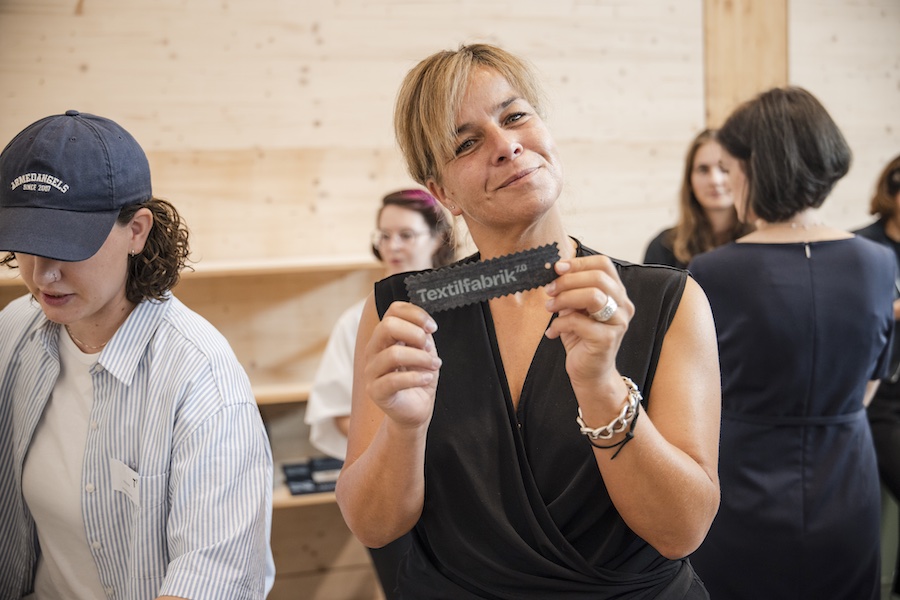
As part of her summer tour, North Rhine-Westphalia’s Minister for Economic Affairs and Climate Action, Mona Neubaur, visited Textilfabrik 7.0 in Mönchengladbach to experience the project’s innovations first-hand. Under the motto “smart and clean”, the visit focused on innovative technologies and sustainable alternatives for textile production - from smart jackets to the decolourisation of textiles using fungal cultures.

#Research & Development

Networking Day 2026: Industry stakeholders unite around textile recycling

In 2026, the Industry Research Group (IRG) Polymer Recycling once again brought together some of the key stakeholders in textile recycling for its annual Networking Day. This year, the event took place at EREMA’s premises in Ansfelden, Austria. It brought together key players from across the textile recycling value chain for a day of structured exchange and in-depth discussions.

More News on Research & Development

#Research & Development

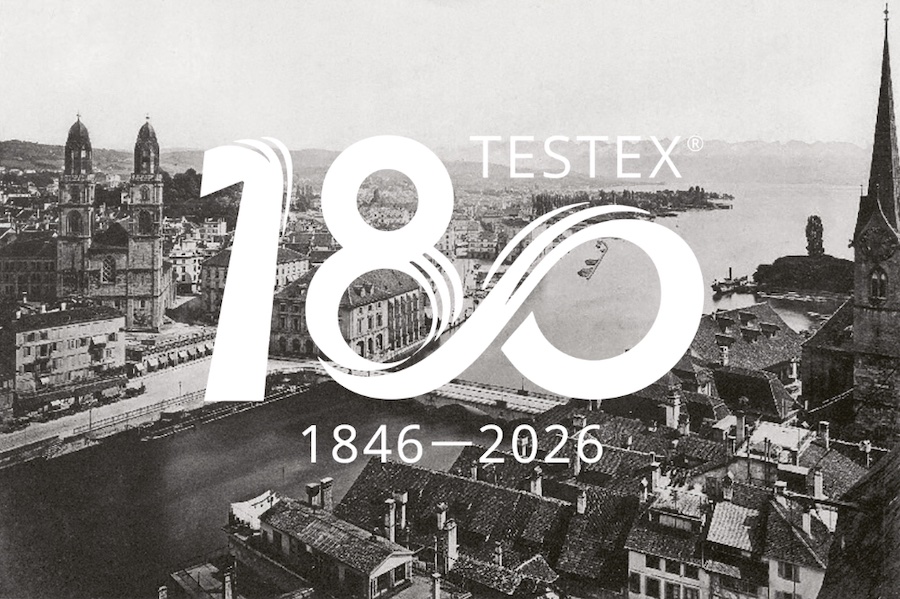
180 years of TESTEX: From Zurich silk testing to global certification

For 180 years, TESTEX has developed alongside the textile industry while maintaining the same underlying purpose: creating trust through independent and reliable measurement. Founded in Zurich in 1846 as the Zurich Silk Conditioning Institute, TESTEX has grown from a local institution serving the silk trade into an international Swiss testing and certification institute for textiles and leather.

#Recycling / Circular Economy

Moving Advanced Recycling from Innovation to Implementation

The Advanced Recycling Conference 2026 explores technologies, markets, financing and scale-up of innovative recycling solutions for waste streams including mixed plastic waste, textiles and PVC. Europe’s chemical and materials sector faces growing pressure to close carbon loops, strengthen raw-material safety and resilience and meet increasingly ambitious EU recycling targets. Against this backdrop, the Advanced Recycling Conference (ARC) will bring together industry leaders, technology providers, researchers, innovators and policy-makers on 17–18 November 2026 in Cologne, Germany.

#Research & Development

Reducing development times for technical textiles by accelerated thermo-oxidative aging in a high-pressure autoclave

Synthetic polymers used in technical textiles can be effectively protected against degradation caused by heat, oxygen, and water through the use of stabilizer systems. This enables service lives of several decades, extending to more than 50 years. As the use of durable technical textiles continues to grow, so does the demand for reliable methods to predict their service life within economically feasible testing periods. For the first time the German Institutes of Textile and Fiber Research Denkendorf (DITF) developed methods for robust service life prediction for textiles in an IGF research project.

#Research & Development

ADD-ITC 2026 highlights strong industry participation

The Aachen-Dresden-Denkendorf International Textile Conference (ADD-ITC) 2026 will place a strong focus on the exchange between textile research and industry when it takes place on November 26–27, 2026, at the International Congress Center Dresden. According to the preliminary conference program, more than two-thirds of all presentations will be contributed by companies or jointly presented by industry and research institutions.

Latest News

#Associations

ITMF names five winners of the Start-up Award 2026

Five start-ups from Switzerland, Brazil, the United States and China have been selected as winners of the ITMF Start-up Award 2026. Their concepts range from new polymer chemistry and natural-fiber biocomposites to zero-waste design, 3D weaving and enzymatic PET recycling.

#Associations

HeiQ & Archroma and Lenzing & Armedangels win ITMF International Collaboration Awards 2026

The International Textile Manufacturers Federation (ITMF) has named two industry partnerships as winners of the ITMF International Collaboration Awards 2026. The awards go to collaborations between HeiQ and Archroma as well as Lenzing and Armedangels, highlighting joint approaches to innovation and sustainability across different parts of the textile value chain.

#Associations

German textile industry and retailers form alliance to shape textile EPR system

Germany’s textile and fashion industry and retail sector have joined forces to establish the “Alliance for Textile Circularity” (Allianz für textile Kreisläufe). Initiated by the German Textile and Fashion Industry Association (Gesamtverband textil+mode) and the German Retail Federation (HDE), the alliance aims to contribute industry expertise to the development of Germany’s future Extended Producer Responsibility (EPR) system for textiles and footwear.

#Sustainability

Cascale launches member-led process to shape 2030 strategy

Cascale has launched a member-led process to define the industry alliance’s strategic direction for the next decade. At the Cascale Annual Meeting 2026 in Athens, CEO Ying McGuire announced that members will contribute to an industry system map that will inform Cascale’s 10-year vision, its 2030 strategy and priorities for 2027. The new strategy is scheduled to be finalized in December.

TOP