[pageLogInLogOut]

#Research & Development

CARL: First successful flight of a full composite rocket "made in Aachen" at EuRoC 2020
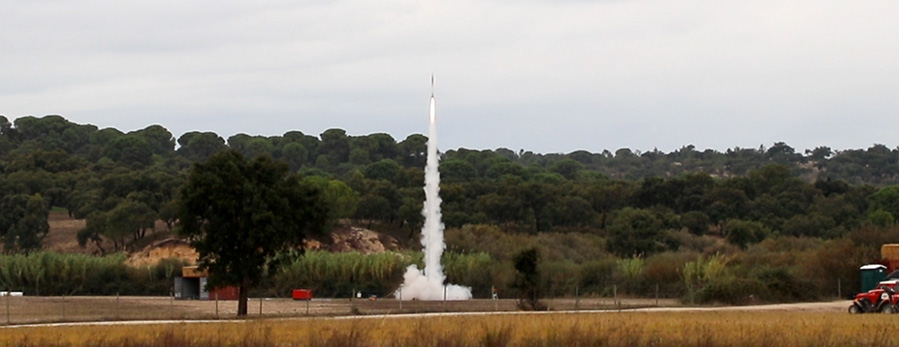
CARL launch© 2020 ITA Aachen / Space Team Aachen
Space Team Aachen receives Newcomer Award for good performance and short development time of CARL.

Space Team Aachen successfully launched its first high-performance CARL rocket EuRoC 2020 in Ponte de Sor, Portugal, on 24 October 2020

The EuRoC – European Rocketry Challenge is an inter-university competition which is similar to the well-known Spaceport America Cup (SA Cup). It was organised and hosted for the first time by the Portuguese Space Agency. 11 teams took part. The Space Team Aachen with the CARL rocket was one of four teams able to launch a technically functional rocket before the deadline. CARL consists of a full composite body designed and developed by students from Aachen. With a payload of 2530 grams and a top speed of approximately 0.57 Mach (196 metres per second), CARL reached the planned flight altitude of 1960 metres. The entire system was designed, manufactured and launched in less than a year.

Descent after main parachute is triggered © 2020 ITA Aachen / Space Team Aachen


This was driven forward by innovative technologies from the two RWTH institutes Institute for Structural Mechanics and Lightweight Design, short SLA, and Institut für Textiltechnik of RWTH Aachen University (ITA). The rocket body tubes and the rocket nose cone were manufactured using multi-supply filament winding technology. Tailored fibre placement was used to produce unique interchangeable fins. They are unique because detachable connections were integrated into the composite material during the manufacturing process.

Thanks to the successfully implemented parachute recovery system, CARL landed on the ground without damage and is now ready for a new challenge. Space Team Aachen plans to participate in the SA Cup 2021 and to develop hybrid rocket systems in Aachen, Germany.


More News from Institut für Textiltechnik of RWTH Aachen University (ITA)

#Research & Development

Exchange data between textile companies openly, securely and cost-effectively without a central platform – ITA makes it possible

The Institut für Textiltechnik (ITA) of RWTH Aachen University has launched a new demonstrator for an open and secure data space in the textile industry at the Digital Innovation Centre Europe (DICE). For the first time, the demonstrator shows directly and clearly how companies can share their data securely with each other without the need for a central platform. Data exchange is based on shared, freely usable technical foundations.

#Research & Development

Sustainable athletic wear made from bio-based Polyethylene

Conventional sports textiles made from petroleum-based synthetic fibres are to be replaced in the future by sustainable, bio-based, cooling textiles. Polyethylene, previously used mainly in the packaging industry, is thus qualified for use in textiles and, as a bio-based drop-in solution, offers a cost-effective, sustainable alternative for the future.

#Research & Development

India, ITA and innovation – enhanced cooperation in research, implementation and bilateral projects such as hydrogen mobility

The Indian Consul General, Dr Shuchita Kishore, visited the Institut für Textiltechnik (ITA) of RWTH Aachen University on 15 December to inspect the joint project between the ITA, the Indian Institute of Technology (IIT) Bombay and industrial partners from India and Germany and to tour the ITA.

#Research & Development

Small tolerances, big impact and a recyclable alternative to elastane

ITA Master's student Janne Warnecke investigated tension differences over the fabric width in the weaving process and thereby contributed to quality assurance; ITA Bachelor's student Jasmin Roos found a basis for the development of recyclable yarns and textiles. For these developments, they were awarded the Walter Reiners Foundation's Promotion and Sustainability Prizes on 27 November. Peter D. Dornier, Chairman of the Walter Reiners Foundation, presented the awards at the Aachen-Dresden-Denkendorf International Textile Conference (ADD-ITC) in Aachen, Germany.

More News on Research & Development

#Research & Development

Innovation center for textile circular economy inaugurated

Just over eight months after the foundation stone was laid, the new Innovation Center for Textile Circular Economy was officially inaugurated today at TITK Rudolstadt. Thuringia's Minister President Mario Voigt, TITK Director Benjamin Redlingshöfer, and other guests of honor cut the ribbon to the modern building complex and viewed the premises, which are now ready for occupancy. The “DICE – Demonstration and Innovation Center for Textile Circular Economy” is TITK's largest single investment to date. The Free State of Thuringia supported the total cost of €11.5 million with €8 million in GRW and FTI funding.

#Research & Development

Sustainable design of Geosynthetics and roof underlayments made from recyclates

Is it possible to recover plastic recyclates from previously unused waste streams in order to produce high-quality fibers and films? How can bio-based polymer fibers be manufactured so as to allow adjustable biodegradability? These are the questions being addressed by researchers from the Fraunhofer Cluster of Excellence Circular Plastics Economy CCPE in the Zirk-Tex project.

#Research & Development

More safety and comfort for protective clothing thanks to auxetic fabrics

When everyday materials are pulled, they stretch or elongate in the direction of the pull and become narrower in cross-section. We can also observe this property in two-dimensional textiles. Auxetic structures behave differently here. They have the striking property of not changing under tensile stress or even increasing their width or thickness. These properties are advantageous, for example, in protective textiles or textile filter media. The DITF are researching auxetic fabrics for various applications.

#Research & Development

Fraunhofer CCPE presents the “Monomaterial Design Set” – Innovative solutions for circular product design

Composite materials made from different types of plastic often extend the lifetime of products but make recycling more difficult in the circular economy. That is why Fraunhofer CCPE has developed the “Monomaterial Design Set”. This new approach helps to reduce the variety of plastics used in durable products and offers circular solutions for designers and product developers.

Latest News

#Natural Fibers

Modern testing methods for raw cotton

The 38th International Cotton Conference Bremen will take place from 25 to 27 March 2026 at the Bremen Parliament. This conference has traditionally stood for in-depth expertise and international exchange. The program will focus on technical innovations, market trends, and regulatory frameworks across the entire value chain – from agriculture to the circular economy. With high-profile speakers, the conference is regarded as the key meeting point for the global cotton industry. Today’s focus: Cotton quality and testing methods.

#Man-Made Fibers

Kelheim Fibres GmbH informs about the closure of operations

The management of Kelheim Fibres GmbH informs that business operations will be terminated as of 31 March 2026. A continuation of the company beyond this date is not possible. The investor and sales process conducted within the framework of the self-administration did not lead to a positive outcome. The potential strategic investor who most recently entered the process has withdrawn from a potential investment at short notice.

#Europe

EU and India conclude landmark Free Trade Agreement

The EU and India concluded negotiations today for a historic, ambitious and commercially significant free trade agreement (FTA), the largest such deal ever concluded by either side. It will strengthen economic and political ties between the world's second and fourth largest economies, at a time of rising geopolitical tensions and global economic challenges, highlighting their joint commitment to economic openness and rules-based trade.

#Spinning

atmos.io paves the way to the digital factory

UNITEX is expanding its capacity by a further 36,000 tons per year with a new filament yarn production plant. Once again, the Vietnamese company is relying on solutions from Barmag.

TOP