[pageLogInLogOut]

#Research & Development

A wound dressing that kills bacteria

Bacteria that are resistant to antibiotics can lead to severe, hard-to-treat wound infections. Image: CDC on Unsplash
In order to combat bacterial wound infections, Empa researchers have developed cellulose membranes equipped with antimicrobial peptides. Initial results show: The skin-friendly membranes made of plant-based materials kill bacteria very efficiently.

Antibacterial cellulose

If germs invade a wound, they can trigger a long-lasting infection that may fail to heal or even spread throughout the body, leading to life-threatening blood poisoning (sepsis). The problem of antibiotic resistance is becoming more and more widespread, particularly in complex wounds, as bacteria such as staphylococci have become resistant to what was once the miracle weapon of medicine. Empa researchers have therefore developed cellulose membranes, with which these infections can be eliminated early on.

The team led by Empa researcher Katharina Maniura from the Biointerfaces lab in St. Gallen produced fine membranes from cellulose using electrospinning technology. The cellulose fibers with a diameter of less than one micrometer were spun into a delicate multi-layered, three-dimensional fabric. The membranes became particularly flexible and at the same time stable after the researchers had added the polymer polyurethane to the spinning process.
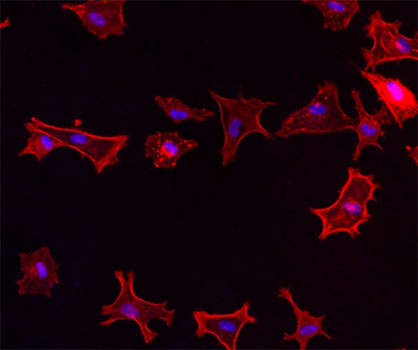

Yoga for connective tissue cells: In the presence of functionalized cellulose, connective tissue cells, as hoped, attach themselves more effectively and spread on the surface. Image: Empa


In order to achieve an antibacterial effect, the researchers designed multifunctional peptides – which can bind to cellulose fibers and exhibit antimicrobial activity. Peptides have several advantage compared to larger proteins: They are easier to produce and more stable than proteins, which react more sensitively to the chemical conditions in a wound.

Skin-friendly Membranes

If the cellulose membranes are treated with such a peptide solution, the fiber scaffold will become saturated with peptides. In cell culture experiments, the researchers then showed that the peptide-containing membranes are well tolerated by human skin cells. However, the cellulose membranes were a death sentence for bacteria such as staphylococci, which are often found in poorly healing wounds. "In bacterial cultures, over 99.99 percent of the germs were killed by the peptide-containing membranes," says Maniura.

In future, the antimicrobial membranes will be equipped with additional functions. "The peptides might, for instance, be functionalized with binding sites that enable the controlled release of further therapeutic substances," says Maniura.



More News from TEXDATA International

#ITM 2026

ITM 2026: The new geography of textile production

New production hubs are emerging across North Africa and Central Asia, while Türkiye is accelerating its transformation toward higher-value, technology-driven and more sustainable textile manufacturing.

#Research & Development

“Production is a product”

From technical textiles and AI-driven robotics to the limitations of textile circularity: Professor Dr Thomas Gries looks back on more than two decades of development at ITA Aachen. In the interview, he explains why production technology remains a decisive success factor, discusses international collaborations and innovation ecosystems, and shares his views on the transformation of production landscapes and the challenges facing an increasingly regulated industry.

#Knitting & Hosiery

“We need to move away from the price trap and return to a value-driven mindset.”

With its new Textile Innovation Center, KARL MAYER is sending a strong signal for innovation, collaboration, and the future of textile applications. In this interview, Karl Josef Mayer discusses new opportunities in warp knitting, the processing of staple fibres, recycling, the changing role of machinery manufacturers, and why the textile industry must once again focus more strongly on the value of textiles. by Oliver Schmidt

#Associations

“Innovation, resilience and international experience remain the great strengths of the Swiss textile machinery industry”

Geopolitical uncertainty, growing competitive pressure from China, new free trade agreements and the shift towards a circular economy are currently reshaping the global textile industry. In this interview, Cornelia Buchwalder discusses the current mood within the Swiss textile machinery sector, the industry’s distinctive innovative strength, new market opportunities in India and Asia, and the technological trends that could shape the upcoming trade fair cycle leading up to ITMA 2027.

More News on Research & Development

#Research & Development

TCLF: Resilient value chains in times of crises

The textiles, clothing, leather and footwear (TCLF) industry was at the centre of the webinar “Resilient value chains in times of crises”, which took place on 28 April 2026. Global supply chains continue to face increasing pressure, raw material dependencies are growing and economic uncertainties are affecting the entire sector.

#Research & Development

Textile climate control system in workwear – exhibition at the 2026 SME Innovation Day!

Conventional protective workwear often reaches its limits during strenuous physical activity. In particular, the transport of sweat and excess body heat poses a problem. The German Institutes of Textile and Fiber Research (DITF) conducted research on flow-optimized, air-conducting textile structures that enable targeted climate control directly on the body. These structures can be integrated straight into protective work garments. The textile climate control system supports the body’s natural thermoregulation. This contributes to improved workplace safety and comfort.

#Research & Development

Elastic yarns to become more recyclable and environmentally friendly in future

On 29 April 2026, ITA student Tobias Dickmeiß was awarded a sponsorship prize by the Wilhelm Lorch-Stiftung for his innovative approach, to replacing conventional elastane with elastic yarns made from thermoplastic copolyester elastomers (TPC). Thanks to their thermoplastic nature and compatibility with typical polyesters used in the textile industry, elastic TPC yarns offer improved recyclability. Furthermore, the use of the melt-spinning process in yarn production eliminates the need for solvents that are harmful to the environment and human health.

#Research & Development

Walter Reiners Foundation Prize awarded to three ITA graduates

Sabina Dann, Lukas Balon and Annegret Storm from the Institut für Textiltechnik (ITA) of RWTH Aachen University were awarded the Walter Reiners Foundation Prize by the German Engineering Federation (VDMA) for their master’s and bachelor’s theses. Peter Dornier, Chairman of the Walter Reiners Foundation, presented the awards during Techtextil at the VDMA stand in Frankfurt am Main, Germany.

Latest News

#Raw Materials

Better Cotton Initiative welcomes new and returning Council members

The Better Cotton Initiative (BCI) has confirmed a series of appointments and reappointments to its Council, the multistakeholder board responsible for BCI’s strategic direction.

#Man-Made Fibers

DYNEEMA® and NP Aerospace advance personal protection for military servicewomen

Dyneema®, owned by Avient Corporation, an innovator of materials solutions, is supplying its high-performance unidirectional (UD) materials to world-leading armor manufacturer NP Aerospace, enabling the production of armor systems designed specifically to fit the female body. With 2,000 new armor systems, including 4,000 plates, made in the United Kingdom (UK) and delivered in June 2026, this collaboration addresses a long-standing lack of high-quality personal protection specially built for female defense and security personnel.

#Man-Made Fibers

Textile Exchange publishes comprehensive polyester LCA study

Textile Exchange has released a new Life Cycle Assessment (LCA) study on polyester, providing detailed data on the environmental impacts of both virgin and recycled polyester production. The study aims to strengthen understanding across the fashion, textile and apparel industries and support more informed decision-making regarding polyester sourcing and production.

#Textiles & Apparel / Garment

Autopsy, the new trend book by Texworld Apparel Sourcing Paris, deciphers the fractures of our time through 12 creative signals

Presented during Texworld Apparel Sourcing Paris, from August 31 to September 2, 2026, at the Paris-Le Bourget Exhibition Center, Autopsy offers a reinterpretation of the contours of fashion in a world undergoing profound transformation, balancing radical introspection and sensitive renewal.

TOP