[pageLogInLogOut]

#Research & Development

Production of complex curved pipe structures using the multi-filament winding process

The cost-effective and productive manufacture of fibre-reinforced pipe components (pipeline) represents a major challenge for many applications. The multi-filament winding process enables the processing of a large number of fibre rovings simultaneously, which significantly increases productivity in the manufacture of rotationally symmetric components.

In close cooperation with Murata Machinery Ldt. from Japan, the multi-filament winding machine located at the Institut für Textiltechnik of RWTH Aachen University, short ITA, has been further developed. By extending the machine axes to a total of three translational and three rotational degrees of freedom, it is now possible to produce even complex curved pipe structures using the multi-filament winding process.

In addition to pipe systems and pipelines for hydrogen logistics, the process offers further versatile areas of application. For example, low-cost structural components for the automotive and aviation sectors can also be wound.
More News from Institut für Textiltechnik of RWTH Aachen University (ITA)

#Research & Development

Kick-off for the Textile Production of the Future: Establishment of a Textile Technology and Development Centre in Mönchengladbach, Germany

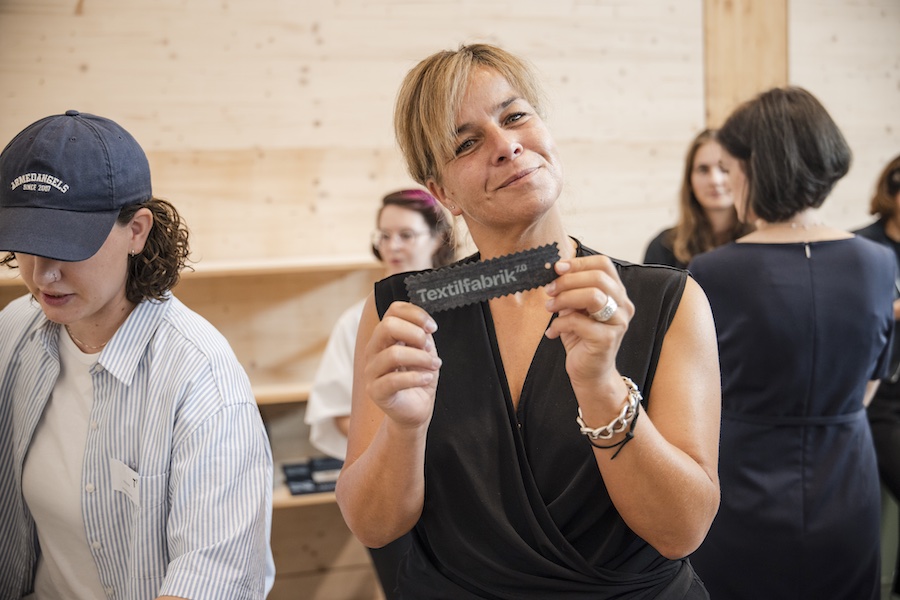
The Institut für Textiltechnik (ITA) of RWTH Aachen University, together with its partners, is pleased to announce that it has received approval for its joint initiative, ‘Textile Factory 7.0’. The goal of the project is the establishment of a technology and development centre for the textile industry in Mönchengladbach.

#Research & Development

Exchange data between textile companies openly, securely and cost-effectively without a central platform – ITA makes it possible

The Institut für Textiltechnik (ITA) of RWTH Aachen University has launched a new demonstrator for an open and secure data space in the textile industry at the Digital Innovation Centre Europe (DICE). For the first time, the demonstrator shows directly and clearly how companies can share their data securely with each other without the need for a central platform. Data exchange is based on shared, freely usable technical foundations.

#Research & Development

Sustainable athletic wear made from bio-based Polyethylene

Conventional sports textiles made from petroleum-based synthetic fibres are to be replaced in the future by sustainable, bio-based, cooling textiles. Polyethylene, previously used mainly in the packaging industry, is thus qualified for use in textiles and, as a bio-based drop-in solution, offers a cost-effective, sustainable alternative for the future.

#Research & Development

India, ITA and innovation – enhanced cooperation in research, implementation and bilateral projects such as hydrogen mobility

The Indian Consul General, Dr Shuchita Kishore, visited the Institut für Textiltechnik (ITA) of RWTH Aachen University on 15 December to inspect the joint project between the ITA, the Indian Institute of Technology (IIT) Bombay and industrial partners from India and Germany and to tour the ITA.

More News on Research & Development

#Research & Development

Bio-based fibers with good flame retardancy

Fibers made from bio-based plastics reduce dependence on fossil raw materials and promote the circular economy. The covalent bonding of flame-retardant additives can open the way for these fibers to enter the mass market.

#Research & Development

Innovation center for textile circular economy inaugurated

Just over eight months after the foundation stone was laid, the new Innovation Center for Textile Circular Economy was officially inaugurated today at TITK Rudolstadt. Thuringia's Minister President Mario Voigt, TITK Director Benjamin Redlingshöfer, and other guests of honor cut the ribbon to the modern building complex and viewed the premises, which are now ready for occupancy. The “DICE – Demonstration and Innovation Center for Textile Circular Economy” is TITK's largest single investment to date. The Free State of Thuringia supported the total cost of €11.5 million with €8 million in GRW and FTI funding.

#Research & Development

Sustainable design of Geosynthetics and roof underlayments made from recyclates

Is it possible to recover plastic recyclates from previously unused waste streams in order to produce high-quality fibers and films? How can bio-based polymer fibers be manufactured so as to allow adjustable biodegradability? These are the questions being addressed by researchers from the Fraunhofer Cluster of Excellence Circular Plastics Economy CCPE in the Zirk-Tex project.

#Research & Development

More safety and comfort for protective clothing thanks to auxetic fabrics

When everyday materials are pulled, they stretch or elongate in the direction of the pull and become narrower in cross-section. We can also observe this property in two-dimensional textiles. Auxetic structures behave differently here. They have the striking property of not changing under tensile stress or even increasing their width or thickness. These properties are advantageous, for example, in protective textiles or textile filter media. The DITF are researching auxetic fabrics for various applications.

Latest News

#Sustainability

VAUDE eliminates PFAS from all products

PFAS (per- and polyfluoroalkyl substances) are now detectable worldwide – in drinking water, soil and the human body. These so-called “forever chemicals” are considered hazardous to health and potentially carcinogenic, as they do not break down and remain in the environment permanently. Despite these risks, PFAS are still used in a wide range of products. More than 15 years ago, VAUDE made a strategic decision to gradually eliminate PFAS from all product categories.

#Man-Made Fibers

Lenzing AG to become majority owner of TreeToTextile AB and accelerates industrialization of new fibers

The Lenzing Group is taking another strategic milestone by acquiring a controlling majority in the Swedish innovation company TreeToTextile AB. This step strengthens Lenzing’s position as a leading provider of sustainable, wood‑based specialty fibers and expands its innovation pipeline with a highly scalable, patent‑protected technology platform. The transaction is executed through the issuance of new shares.

#

Better Cotton Initiative marks certification anniversary with progress update and accreditation

One year since becoming a certification scheme, the Better Cotton Initiative (BCI) has announced that more than 3,000 supply chain actors have been certified. At farm level, more than 30% of farms and producer units supplying BCI Cotton have received a positive audit outcome.

#Raw Materials

Cotton Incorporated appoints Bev Sylvester as Chief Marketing Officer

Cotton Incorporated announces the appointment of Bev Sylvester as chief marketing officer. In this newly created role, Sylvester will oversee Cotton Incorporated’s marketing strategy, brand positioning, consumer engagement and global outreach to increase demand for cotton and strengthen its relevance in the marketplace.

TOP