[pageLogInLogOut]

#Research & Development

Starlinger: Recycling specialist in research project for the separation and reprocessing of mixed textile waste
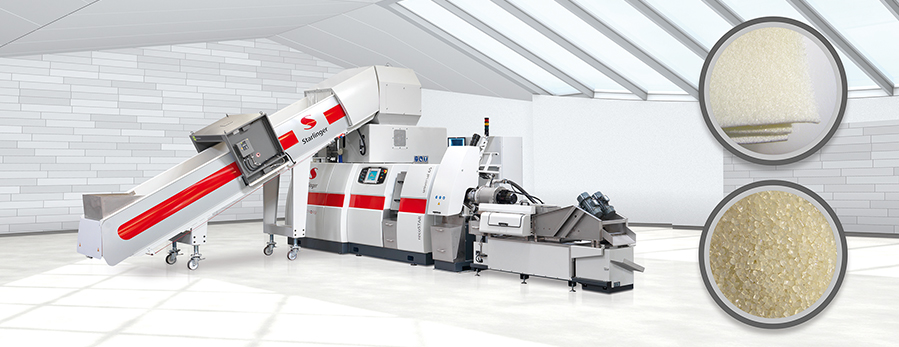
(c) 2018 Starlinger
Within the textile network PlasTexTron©, Starlinger recycling technology is searching for an ecologically and economically sound solution for the recycling of mixed textile waste of multi-material composition. Three universities and eight Austrian companies are involved in the COIN-project TEX2MAT, which is led by the Plastics Cluster of ecoplus, the business agency of Lower Austria, and funded by the Austrian Federal Ministry for Digital and Economic Affairs (BMDW).

Every year, tons of old textiles that cannot be reused or sold end up in incineration plants or even go to landfill. The textile industry is growing, and the proportion of multi-material textiles, i.e., mixtures of various natural and artificial fibers, is steadily increasing. Society and lawmakers rightly demand rapid technological solutions for the recycling of this kind of waste in order to protect the environment and save material resources. Besides closing the loop from raw material to raw material, the project aims at efficient recycling that yields an end product with virgin-like characteristics.

The project TEX2MAT addresses the recycling of different kinds of old textiles that consist of a mixture of polyester and cotton. The first step is the enzymatic separation of polyester and cotton in a procedure developed by the Viennese University of Natural Resources and Life Sciences; after appropriate reprocessing, the materials are reused in new products. The input material is supplied by the companies Herka Frottier, Salesianer Miettex and Huyck.Wangner Austria (Xerium Group), which are all located in Lower Austria. Starlinger recycling technology – a business unit of Starlinger which manufactures recycling lines and has already developed solutions for closed loop production in the field of polyester textiles – provides recycling services and expertise for the project. To achieve an optimal result, regular controls of the material properties are performed by the University of Leoben.


The project partners are working on specific case studies:

  • Mixtures of polyester and cotton from the production of towels as well as old textiles in the form of bed linens and working clothes are shredded by Starlinger recycling technology in Weissenbach and then undergo enzymatic treatment at the Technical University of Vienna. The goal is to develop a sample process for closed loop production.
  • Technical nonwovens made of polyamides are shredded and turned into regranulate by Starlinger recycling technology; Thermoplastkreislauf GmbH then adds substances such as glass fibers, additives and/or colors as needed (a process commonly known as compounding). The companies Multiplast Kunststoffverarbeitung and Fildan use this customized material in the production of highly technical plastic parts such as components for fire extinguishers or bra fasteners.

The project TEX2MAT started in November 2017 and will be running over the course of two years. The project partners meet in regular intervals to align the individual steps and discuss the overall progress. In September 2018, TEX2MAT will be presented at the international fiber congress GFC in Dornbirn; initial results are expected to become available until K show 2019 in Düsseldorf.
More News from Starlinger & Co GmbH

More News on Research & Development

#Research & Development

Kick-off for the Textile Production of the Future: Establishment of a Textile Technology and Development Centre in Mönchengladbach, Germany

The Institut für Textiltechnik (ITA) of RWTH Aachen University, together with its partners, is pleased to announce that it has received approval for its joint initiative, ‘Textile Factory 7.0’. The goal of the project is the establishment of a technology and development centre for the textile industry in Mönchengladbach.

#Research & Development

Bio-based fibers with good flame retardancy

Fibers made from bio-based plastics reduce dependence on fossil raw materials and promote the circular economy. The covalent bonding of flame-retardant additives can open the way for these fibers to enter the mass market.

#Research & Development

Exchange data between textile companies openly, securely and cost-effectively without a central platform – ITA makes it possible

The Institut für Textiltechnik (ITA) of RWTH Aachen University has launched a new demonstrator for an open and secure data space in the textile industry at the Digital Innovation Centre Europe (DICE). For the first time, the demonstrator shows directly and clearly how companies can share their data securely with each other without the need for a central platform. Data exchange is based on shared, freely usable technical foundations.

#Research & Development

Sustainable athletic wear made from bio-based Polyethylene

Conventional sports textiles made from petroleum-based synthetic fibres are to be replaced in the future by sustainable, bio-based, cooling textiles. Polyethylene, previously used mainly in the packaging industry, is thus qualified for use in textiles and, as a bio-based drop-in solution, offers a cost-effective, sustainable alternative for the future.

Latest News

#Functional Fabrics

“Action helps us change what we do!”

DAY 0 takes place deliberately before PERFORMANCE DAYS begins. It is conceived as a space for reflection, dialogue and active engagement — a moment to pause before the fair, rethink established systems and address sustainability not as a trend, but as a fundamental transformation challenge. Under the guiding metaphor “Turn the Tap Off”, DAY 0 focuses on root causes rather than symptoms, systemic change rather than isolated solutions, and collective responsibility rather than individual silos.

#Textiles & Apparel / Garment

Pets in fashion: functional and sustainable textiles find new market at Intertextile Apparel

China’s pet economy is booming, especially amongst younger generations, and pet apparel – from designer outfits to functional garments – was a RMB 3.5 billion (over USD 500 million) market in 2024, growing more than 20% annually¹. To help exhibitors harness this trend, Intertextile Shanghai Apparel Fabrics – Spring Edition 2026 will launch the Pet Boutique, presenting a range of innovative, sustainable materials that prioritise both functionality and comfort for pets.

#Sustainability

VAUDE eliminates PFAS from all products

PFAS (per- and polyfluoroalkyl substances) are now detectable worldwide – in drinking water, soil and the human body. These so-called “forever chemicals” are considered hazardous to health and potentially carcinogenic, as they do not break down and remain in the environment permanently. Despite these risks, PFAS are still used in a wide range of products. More than 15 years ago, VAUDE made a strategic decision to gradually eliminate PFAS from all product categories.

#Man-Made Fibers

Lenzing AG to become majority owner of TreeToTextile AB and accelerates industrialization of new fibers

The Lenzing Group is taking another strategic milestone by acquiring a controlling majority in the Swedish innovation company TreeToTextile AB. This step strengthens Lenzing’s position as a leading provider of sustainable, wood‑based specialty fibers and expands its innovation pipeline with a highly scalable, patent‑protected technology platform. The transaction is executed through the issuance of new shares.

TOP