[pageLogInLogOut]

#Recycling / Circular Economy

Millions of PUMA football jerseys made with recycled textile waste
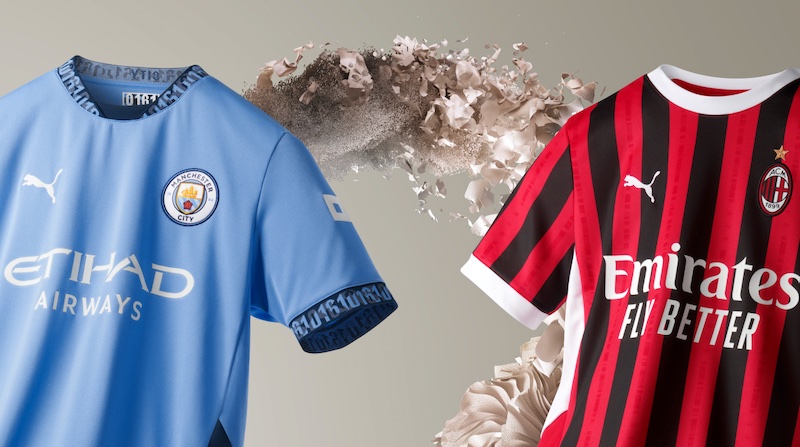
Global sports company PUMA has scaled up its textile-to-textile recycling innovation RE:FIBRE, creating millions of replica football jerseys with a minimum of 75% recycled textile waste and other waste material. For the first time, from the start of the 24/25 season, PUMA football replica jerseys* (featuring 35 Clubs), including those for the Euro and Copa América tournaments, are made from RE:FIBRE.
© 2024 PUMA
© 2024 PUMA


The upscaling builds on the 46,000 RE:FIBRE jerseys produced in 2023 and seeks to not only reduce textile waste, but also to create less reliance on plastic bottles to produce recycled polyester products. To make the upscaling possible, PUMA is exploring diversified ways to recycle polyester – such as thermo-mechanical and chemical recycling techniques enabling PUMA to significantly increase its capacity to recycle textile waste.

“RE:FIBRE gives football fans a tangible example of how PUMA is working towards creating a Forever Better,” said Anne-Laure Descours, Chief Sourcing Officer at PUMA. “Our wish is to have 100% of our polyester products created from textile waste. Rethinking how we produce and moving towards a more circular business model is important and RE: FIBRE is central to that.”

To celebrate this milestone, PUMA will hold a weekend of activities in the New York flagship store, timed to coincide with the launch of the AC Milan and Manchester City home replica kits and ahead of the two PUMA football teams playing in New York City. Fans of PUMA, AC Milan and Manchester City are welcome to get involved and celebrate PUMA’s RE:FIBRE journey in store.

Saturday 20th July 2024

One hundred limited edition badges upcycled from match worn jerseys by Jack Grealish and Christian Pulisic will be up for grabs in-store. The badges have been designed by US upcycler and PUMA Voice of a RE:Generation Andrew Burgess, to commemorate the expansion of PUMA RE:FIBRE.

Sunday 21st July

Andrew Burgess will host three upcycling workshops to educate fashion-curious consumers on the techniques for customising and upcycling clothing to extend their lifespan. Leaning into the crossover between sport and fashion, consumers will have the chance to take a RE:FIBRE t-shirt and turn it into a sportstyle inspired garment.

More information on this can be found here:

https://foreverbetter.com/en/circularity/refibre


More News from PUMA

More News on Recycling / Circular Economy

#ITM 2026

BB Engineering unveils new, patented “Val-uePack” spin pack at ITM

At the upcoming ITM in Istanbul, taking place June 9–13 at the Tüyap Fair Convention and Congress Center in Hall 7, Booth 702B, BB Engineering will once again be represented at a joint booth with its parent company, Barmag, and its representative, Tekstil Servis. The German machine manufacturer will show-case its expertise in man-made fiber and recycling technology, presenting its entire product portfolio, which includes compo-nents such as extruders and filters, as well as complete sys-tems for spinning synthetic fibers, air-texturing, and PET recy-cling.

#Recycled Fibers

Syre expands partnership with Target to advance next-generation recycled materials at scale

Advancing next-generation materials to support scalable circular solutions across global retail Stockholm, May 2026 — Syre, the textile impact company hyperscaling textile-to-textile recycling today announced an expanded collaboration with Target to accelerate the adoption of next-generation recycled materials across retail at scale.

#Recycling / Circular Economy

Project REWEAR investigates diverse economies of rewear as a global practice of circularity

Every year, European households discard millions of tonnes of clothing. Around a quarter of what gets separately collected is exported, much of it classified as rewearable. A significant share ends up in markets like Kantamanto in Accra, Ghana, where an estimated 15 million garments arrive every week. New research published today reveals what happens when that clothing arrives.

#Recycling / Circular Economy

RE&UP contributes to Global Fashion Summit 2026 circularity discussion

RE&UP contributed to the global conversation on textile circularity at Global Fashion Summit 2026 in Copenhagen, where Fatih Konukoğlu, Chairman of RE&UP and Vice Chairman of Sanko Holding, took part in both the keynote session “The New Rules” and the panel discussion “A Reckoning and Renewal for Circular Horizons”, alongside leaders from H&M Group, Looper Textile Co. and Sourcing Journal.

Latest News

#INDEX 2026

“We clearly see that reliability, flexibility, service and total cost of ownership are becoming increasingly important again.”

The nonwovens industry continues to face a challenging market environment. Nevertheless, AUTEFA Solutions reports successful projects, new line sales and growing demand for energy-efficient and flexible solutions. In this interview, André Imhof of AUTEFA Solutions talks about competitiveness against Chinese suppliers, new service and recycling concepts, the growing importance of application development and the opportunities created by countercyclical investments.

#INDEX 2026

“Needle punching technology is more universal and sustainable than ever!”

Needle punching technology was long regarded as a rather traditional and comparatively slow technology within the nonwovens industry. In this interview, Johann Philipp Dilo explains why needle punching is more relevant than ever today – ranging from energy efficiency and resource conservation to hygiene applications, new machine concepts and design-oriented nonwoven solutions.

#Research & Development

Textile climate control system in workwear – exhibition at the 2026 SME Innovation Day!

Conventional protective workwear often reaches its limits during strenuous physical activity. In particular, the transport of sweat and excess body heat poses a problem. The German Institutes of Textile and Fiber Research (DITF) conducted research on flow-optimized, air-conducting textile structures that enable targeted climate control directly on the body. These structures can be integrated straight into protective work garments. The textile climate control system supports the body’s natural thermoregulation. This contributes to improved workplace safety and comfort.

#Nonwovens

PET spunbond from China – EDANA welcomes imposition of provisional anti-dumping measures

On 13 May 2026, after eight months of investigation, the European Commission imposed provisional anti-dumping duties of 45.6-50.0% on imports of PET spunbond from China. EDANA welcomes this expression of the Commission’s clear determination to protect EU industries from the unfair trade practices of Chinese producers.

TOP