[pageLogInLogOut]

#Recycling / Circular Economy

Re-fresh global and Soex join forces to establish the first complete textile waste recycling circuit
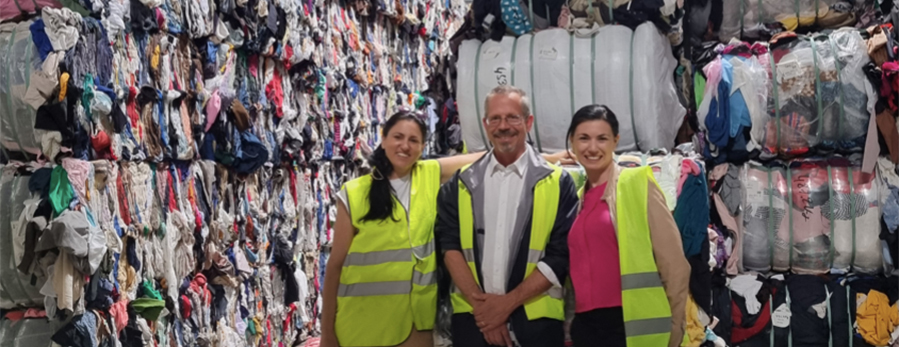
© 2023 Re-fresh global
Re-Fresh Global, a pioneer in the sustainable textile industry, proudly announced today the groundbreaking partnership with SOEX textile recycling company, enabling the realization of a complete used clothing recycling cycle by producing first demonstrator parts for the Volkswagen Group.

First product samples produced for the volkswagen group

The partnership between Re-Fresh Global and SOEX marks a significant milestone in the global effort to make the textile industry more innovative, sustainable, and environmentally friendly. Within this collaboration, Re-Fresh Global produced Re-SanPulpTM, an upcycled polyester fabric that was used to produce first demonstrator parts for the trunk of a current model of the Volkswagen Group. 

© 2023 Re-fresh global


At the heart of this collaboration, made possible with the support of the Volkswagen Group Innovation and especially Konnect, the Volkswagen Group Innovation Hub in Tel Aviv, is the creation of a closed-loop textile waste recycling system. The automotive industry, facing significant environmental challenges, is one of the sectors that can benefit greatly from Re-Fresh Global's end-to-end solution.

A cornerstone of this collaboration is the establishment of a closed-loop system for textile waste recovery. This means that the material from the worn textiles used for the production of the Volkswagen demonstrator parts was not simply discarded after the clothing’s lifespan but was instead reused, recycled, and reintegrated into a value-adding production process. This innovative approach underscores the commitment of Re-Fresh Global and SOEX to a sustainable future.

"We are thrilled to be a part of this historic moment in textile recycling," said Viktoria Kanar, CEO of Re-Fresh Global. "This partnership underscores our dedication to creating sustainable solutions and reducing the environmental footprint in our industry. We firmly believe that this is just the beginning and that our collaboration with SOEX will drive further innovative developments."

SOEX brings its extensive experience and expertise in textile recycling to the partnership. Combined with Re-Fresh Global's SMART-UP Microfactory, which was implemented here as a pilot project, an upcycling process has been put in place to transform used textiles into high-quality raw materials, reducing resource consumption. Using the resulting raw materials, known as multifunctional fibers (Re-SanPulp), a product for the automotive industry was created for the first time. This end-to-end solution serves as a prime example of a closed-loop economy, from recycling textile waste to a finished product.


The next step in this promising partnership is the construction of Re-Fresh Global's end-to-end solution on the SOEX site, the SMART-UP Microfactory, where the full textile waste conversion process will be developed. This includes processing all types of used textiles, both from synthetic and natural sources, into high-quality raw materials in order to reduce resource consumption. For the first time, a product for the automotive industry was created from the synthetic raw materials, so-called multifunctional fibers (Re-SanPulpTM). The materials obtained from natural fibers, Re-ThanolTM and Re-NanoTM, are also used in a number of manufacturing industries as an alternative to virgin materials. This end-to-end solution is a prime example of a closed circular economy, from recycling textile waste to the finished product.

Roland Hovestadt, CEO of SOEX Textile Recycling Company, sees the establishment of international flagship projects as a significant opportunity for the entire textile industry: "By investing in the advancement of recycling processes and promoting innovative solutions like those offered by Re-Fresh Global, integrated into existing recycling processes, we can lead the entire industry towards a circular transformation. In the end, everyone benefits because this is how we remain sustainable for the future."

Both companies plan to expand their collaboration and apply the insights gained from this project to other areas of the textile industry. In Europe alone, approximately 7.5 million tons of textile waste are generated annually. The textile industry ranks as the fourth-largest global contributor to climate change. Re-Fresh Global's method can recycle up to 98% of the textile waste generated. The EU has already presented regulatory drafts, and the industry can expect strict requirements. The goal is to develop the textile industry into an integral part of a circular economy. The Extended Producer Responsibility (EPR) for textiles, which includes guidelines for product recycling, is already legally established in some European countries. 

© 2023 Re-fresh global


In this context, the significance and advancement of sustainable practices in the textile industry become particularly evident. Their promotion is essential for a sustainable future.

More News from TEXDATA International

#ITM 2026

ITM 2026: The new geography of textile production

New production hubs are emerging across North Africa and Central Asia, while Türkiye is accelerating its transformation toward higher-value, technology-driven and more sustainable textile manufacturing.

#Research & Development

“Production is a product”

From technical textiles and AI-driven robotics to the limitations of textile circularity: Professor Dr Thomas Gries looks back on more than two decades of development at ITA Aachen. In the interview, he explains why production technology remains a decisive success factor, discusses international collaborations and innovation ecosystems, and shares his views on the transformation of production landscapes and the challenges facing an increasingly regulated industry.

#Knitting & Hosiery

“We need to move away from the price trap and return to a value-driven mindset.”

With its new Textile Innovation Center, KARL MAYER is sending a strong signal for innovation, collaboration, and the future of textile applications. In this interview, Karl Josef Mayer discusses new opportunities in warp knitting, the processing of staple fibres, recycling, the changing role of machinery manufacturers, and why the textile industry must once again focus more strongly on the value of textiles. by Oliver Schmidt

#Associations

“Innovation, resilience and international experience remain the great strengths of the Swiss textile machinery industry”

Geopolitical uncertainty, growing competitive pressure from China, new free trade agreements and the shift towards a circular economy are currently reshaping the global textile industry. In this interview, Cornelia Buchwalder discusses the current mood within the Swiss textile machinery sector, the industry’s distinctive innovative strength, new market opportunities in India and Asia, and the technological trends that could shape the upcoming trade fair cycle leading up to ITMA 2027.

More News on Recycling / Circular Economy

#Recycling / Circular Economy

Mesdan to showcase laboratory-scale textile recycling solutions at Textiles Recycling Expo 2026

At Stand 2235 during the Textiles Recycling Expo 2026 in Brussels, Mesdan will present laboratory solutions designed to support the development and evaluation of textile-to-textile recycling processes.

#Recycled Fibers

Carbios and Wankai postpone startup of China’s first PET biorecycling plant to 2028

The industrial deployment of enzymatic PET recycling in Asia is progressing, but at a slower pace than initially planned. French recycling technology company Carbios and its Chinese partner Wankai New Materials have announced that the commissioning of their planned PET biorecycling facility in Haining, Zhejiang Province, has been postponed and is now expected in the first half of 2028.

#Sustainability

Closing the Footwear Loop reveals challenges and opportunities for circular footwear

The footwear industry faces one of the most complex circularity challenges in the fashion sector. A new Phase 1 report from the Fashion for Good initiative Closing the Footwear Loop, developed together with Circle Economy, provides new insights into the composition, condition and recycling potential of post-consumer footwear waste.

#Recycling / Circular Economy

Textiles Recycling Expo 2026 to spotlight the companies turning textile circularity into industrial reality

As the textile industry faces mounting pressure to scale circular solutions, improve recycling infrastructure, and respond to evolving regulation, Textiles Recycling Expo 2026 will bring together the organisations leading that transformation in practice.

Latest News

#ITM 2026

Sweden targets Türkiye’s textile future at ITM 2026

Following the opening of its new showroom and test centre in Sweden, imogo will be introducing its groundbreaking new Dye-Max spray dyeing technology to Türkiye’s textile manufacturers at ITM 2026 in Istanbul from June 9-13.

#Knitting & Hosiery

TM WEFT, 270" – More width, more design freedom for the fashion world

KARL MAYER is expanding its successful TM WEFT series with an innovative model that opens up new possibilities, particularly in the fashion & apparel sectors. With a working width of 270", this new machine with weft-insertion not only offers significantly higher output than its narrower counterparts but is also specifically tailored to the demands of dynamic clothing market – particularly in China and Türkiye. A well-thought-out upgrade also ensures even greater design versatility.

#Textile processing

YKK invests USD 150 million in new manufacturing facility in India

YKK Corporation has announced plans to construct a new manufacturing facility in India, reinforcing its long-term commitment to one of the world's fastest-growing textile and apparel production hubs. The new factory will be built at Origins by Mahindra in Chennai, Tamil Nadu, and will become the third manufacturing site of YKK India Private Limited. The facility is expected to be completed by February 2028 and represents an investment of approximately USD 150 million, covering land, buildings, machinery and equipment.

#ITM 2026

Marzoli promotes ‘Don’t Replace, Repower’ approach at ITM 2026

At ITM 2026 in Istanbul, Marzoli will place a strong focus on spinning mill modernization, presenting retrofitting and reengineering solutions designed to improve efficiency, extend machine lifetime and maximize the value of existing assets.

TOP