[pageLogInLogOut]

#Recycling / Circular Economy

First 10 speakers from leading and emerging companies confirmed for Advanced Recycling Conference
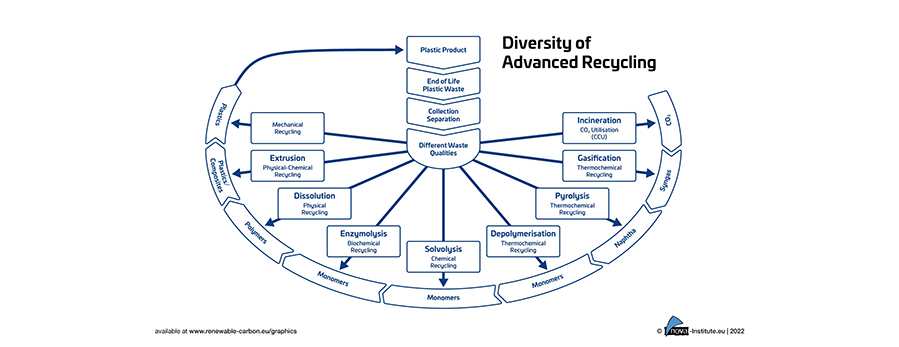
22-09-05 Graphic Overview Diversity of Advanced Recycling Technologies Source: nova-Institute GmbH
Everything you ever want to know about advanced recycling technologies and renewable chemicals, building-blocks, monomers, and polymers based on recycling: Hear about it at the Advanced Recycling Conference (ARC) 14-15 November 2022, Cologne, Germany (hybrid event).

The unique concept of presenting a variety of advanced recycling solutions and related topics at one event guarantees a comprehensive and exciting conference experience, including technologies such as extrusion, dissolution, solvolysis, enzymolysis, pyrolysis, thermal depolymerisation, gasification, and incineration with Carbon Capture Utilisation (CCU). 

The conference gained momentum with an increasing number of submitted abstracts and the first 10 speakers are already confirmed while the program is steadily shaped and expanded through ongoing evaluation of further exiting contributions.

The selected contributions illustrate the dynamic development of the plastics recycling sector

Recent developments in markets and policy indicate a clear transformation and long-lasting change in the circular economy of plastics. While the European Green Deal has set the overarching aim for the European Union, markets and big industrial players as well as emerging start-ups worldwide have set off on a journey to implement and establish advanced recycling solutions. Still, some milestones in this quest can only be achieved through co-operation, partnerships, acquisitions, or fusions which could be observed throughout many announcements of past year. Especially the most recent developments point towards strategies that build bridges between conventional mechanical recycling and advanced recycling technologies in which both elements complement each other.

Versatile and innovative landscape of advances recycling technologies

The current landscape offers a versatile set of different technologies that serve as an interface between a wide range of different waste streams and products to further improve existing or establish new value chains. These technologies are based on mechanical, physical, biochemical, chemical, and thermochemical processes whereby the borders of some processes may be floating. Not all pathways could be ecologically or economically meaningful which is currently extensively evaluated and discussed. A Life Cycle Assessment (LCA) is the most widely recognised and accepted methodology for analysing potential environmental impacts to assess environmental sustainability. Several LCAs on different recycling technologies and value chains are already published. However, critical aspects remain to be discussed and clarified, for instance on how to conduct such assessment in detail and which parameters to consider in order to compare the different technologies, feedstocks, and products with each other to draw meaningful conclusions.

Besides the recycling technologies, pre- and post-processing as well as upgrading technologies represent important pillars for the establishment of meaningful value chains and together contribute to the evolution of the circular economy.


With the first confirmed speakers the attendees of ARC already offer deep insights into those developments including exchange and networking opportunities with a variety of stakeholders along the entire plastics value chain. 

The following companies and speakers are participatings:

  • BASF (DE), Carolin Deregowski – LCA of chemical recycling of mixed plastic waste
  • Carbios (FR), Martin Stephan – Recycling any kind of PET wastes into any kind of PET products: the power of biology
  • DSD – Duales System (DE), Michael Wiener – Closed loop recycling – building bridges between chemical and mechanical recycling
  • Interzero (DE), Richard von Goetze – Enabling Chemical Recycling in Germany – What feedstock can actually be used for Chemical Recycling
  • KPMG (NL), Tom Hesselink – The green deal: a game changer for the waste management and plastics industries
  • Krauss Maffei Extrusion (DE), Franz-Xaver Keilbach – Solvent-based and chemical recycling with single and twin-screw extrusion
  • Plastic Energy (UK), Carlos Monreal – Closed-loop recycling: building bridges between chemical and mechanical recycling
  • Rittec Umwelttechnik (DE), Mathias Kirstein – Innovative back-to-monomer recycling – solution for mixed PET/Polyester waste
  • Shell (DE), N.N. – Shell’s Plastic Circular Economy ambitions
  • Sulzer Chemtech (CH), Luis Hoffmann – Overcoming the challenge of purification in chemical recycling.

Participation in the Advanced Recycling Conference?

Interested individuals and companies can still participate in the conference with presentations, posters or an exhibition stand until 30 September. Sponsors are also welcome. Further information at:

http://www.advanced-recycling.eu
More News from TEXDATA International

#Texprocess 2026

Texprocess 2026: Automation, digitalisation and AI reshape textile processing

Investment decisions in textile processing have become increasingly complex. Rising energy prices, labour shortages and geopolitical uncertainties are forcing companies to prioritise technologies that deliver measurable improvements in efficiency and process stability. This applies not only to apparel production, but also to the processing of technical textiles and high-performance materials. Modernisation projects are therefore being evaluated more selectively – but the pressure to upgrade production systems continues to grow. Texprocess 2026 reflects this tension between cautious investment behaviour and increasing technological demand.

#Techtextil 2026

Textile Chemicals & Dyes: Innovation in Textile Chemistry moves into focus at Techtextil 2026

From PFAS-free finishes and water-saving dyeing technologies to advanced coatings and recycling-compatible formulations, innovation in textile chemistry is accelerating across the industry. Reflecting this development, Techtextil 2026 introduces Textile Chemicals & Dyes as a dedicated product segment, highlighting the growing role of chemical solutions in shaping the next generation of technical textiles.

#Recycling / Circular Economy

textile.4U publishes special edition “Top 100 Textile Recycling Companies 2025”

With a comprehensive 176-page special edition, textile.4U is dedicating its latest issue entirely to one of the most dynamic and influential topics in today’s textile industry: textile recycling. The new issue, published exclusively in high-quality print, presents the Top 100 textile recycling companies researched and selected by TexData – organizations that already play a key role in the transition to circular textiles or are expected to have a significant impact in the near future.

#Recycling / Circular Economy

Responsible Textile Recovery Act of 2024 signed by Governor

Senator Josh Newman (D-Fullerton) is proud to announce that Senate Bill 707 (SB 707), the Responsible Textile Recovery Act of 2024, has been signed into law by the Governor of California, Gavin Newsom. This groundbreaking legislation establishes the country’s first Extended Producer Responsibility (EPR) textile recycling program, marking a significant step forward in the state’s efforts to combat waste and promote sustainability.

More News on Recycling / Circular Economy

#Recycling / Circular Economy

AI Circular Economy Conference 2026 fuels innovation at the intersection of AI and Circular Economy

The AI Circular Economy Conference 2026, organised by nova-Institute, brought together 116 participants from 15 countries in Cologne and online to explore the transformation of the chemical and materials industry supported and accelerated by artificial intelligence. During the two-day event, leading experts from industry, research, start-ups and the investment community discussed how AI can maximise the potential of renewable carbon creating efficient circular value chains. The conference featured 24 presentations and multiple panel discussions, highlighting the growing convergence of digital technologies and circular material systems. It demonstrated how artificial intelligence is progressing from the experimental stage to real industrial implementation within the circular economy.

#Recycled_Fibers

Circ deepens access to recycled fibers with Xinxiang Bailu Chemical Fiber Co., Ltd. partnership agreement

Circ®, a global leader in textile‑to‑textile recycling, today announced a new partnership agreement with Xinxiang Bailu Chemical Fiber Co., a Canopy Dark Green Shirt producer and one of the world’s leading producers of viscose filament. The agreement marks a significant step in Circ’s continued expansion in China and strengthens its position within the country’s rapidly evolving circular textile ecosystem; further supporting Circ’s ability to supply recycled fibers near existing fashion supply chains.

#Recycled_Fibers

Worn Again Technologies unveils the Accelerator

Worn Again Technologies unveils the Accelerator, the next major step towards commercialising its pioneering Textile-to-Fibre recycling process and proving the technical and economic feasibility of polycotton recycling.

#Recycling / Circular Economy

Textile‑to‑textile recycling leader Circulose joins Spinnova’s ecosystem to accelerate technology scale‑up

Textile‑to‑textile recycling leader Circulose joins Spinnova’s ecosystem (consortium) to help advance the scale‑up of Spinnova’s technology. Spinnova has actively sought partners to accelerate commercial scale‑up, and Circulose, as a key player in textile recycling, strengthens the ecosystem by providing a raw material that is in high demand across the industry.

Latest News

#Techtextil 2026

Gebr. Otto highlights versatility at Techtextil with regional supply chains, yarn innovations and new hygiene segment

At this year’s Techtextil, Gebr. Otto places its versatility at the center of its presentation. In addition to spinning, twisting and dyeing – traditionally focused on fine cotton – textile processors will also find a competent development partner for technical specialty solutions. The Dietenheim-based spinning mill has now built up a decade of experience in the production of technical yarns, particularly from aramids. A new hygiene segment has also been established, where yarns for medical and hygiene products are currently being produced. In the future, this department could also develop textile products for the food sector. Gebr. Otto will once again be present at the BW-i joint stand, booth D81, hall 12.1. What is wound onto the spool is determined by the customer: Gebr. Otto develops according to specific customer requirements and transforms its own ideas into yarn innovations.

#Europe

Commission presents proposal for EU Inc. - unlocking the full potential of the Single Market for Europe's entrepreneurs

Today, the European Commission presented its proposal for EU Inc., a new single set of corporate rules, building the cornerstone and starting point for the EU's 28th regime. EU Inc. is an optional, digital-by-default European corporate framework. It will make it easier for businesses to start, operate and grow across the EU – incentivising them to stay in Europe, and encourage those who once looked elsewhere to return.

#Man-Made Fibers

OnceMore® from Södra brings end-to-end traceability for circular Man-made Cellulosic Fibers (MMCF) using TextileGenesis

OnceMore® from Södra, the world’s first large-scale process for recycling blended fabrics into high‐quality dissolving pulp, will begin using TextileGenesis, a Lectra company, to strengthen traceability from raw material to retail across the value chain. OnceMore® produces dissolving pulp made from blended textile waste and wood sourced from responsibly managed Swedish forests. By integrating TextileGenesis, OnceMore® supports the growing need for verified data and secure, transparent tracking throughout increasingly complex supply chain.

#Sustainability

Experts publish APAC policy priorities

Cascale today announced the publication of its APAC Policy Priorities Paper, developed by the Asia-Pacific (APAC) Policy Member Expert Team (MET) to identify key regional sustainability challenges and provide practical, aligned recommendations for policymakers and industry stakeholders across Asia-Pacific.

TOP