[pageLogInLogOut]

#Recycling / Circular Economy

Moving Advanced Recycling from Innovation to Implementation
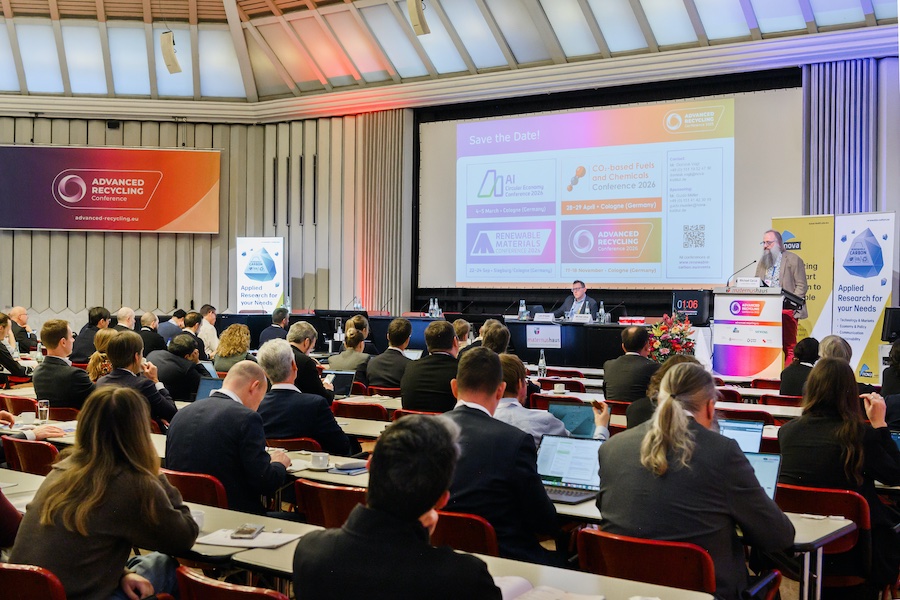
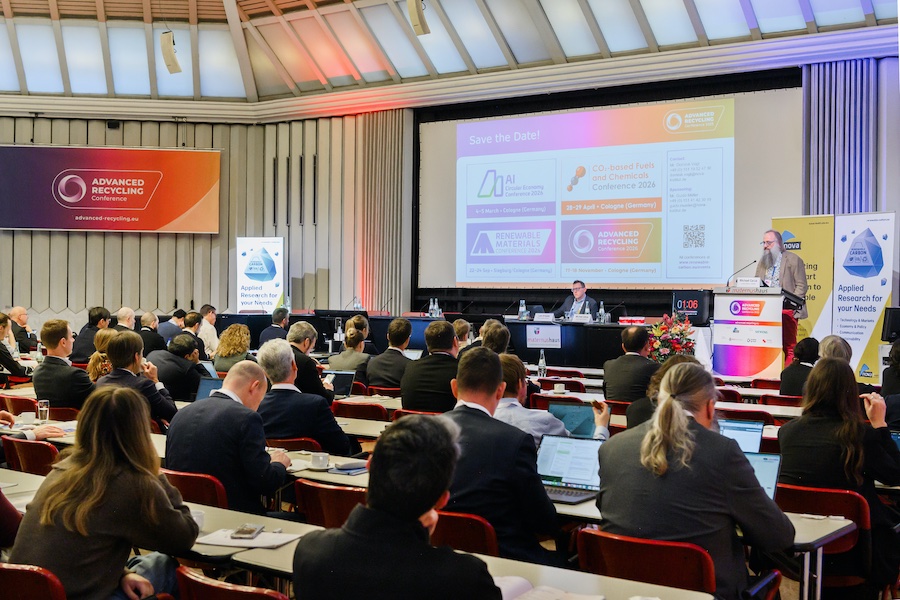
Advanced Recycling Conference 2025 © 2026 Audience nova-Institute
The Advanced Recycling Conference 2026 explores technologies, markets, financing and scale-up of innovative recycling solutions for waste streams including mixed plastic waste, textiles and PVC. Europe’s chemical and materials sector faces growing pressure to close carbon loops, strengthen raw-material safety and resilience and meet increasingly ambitious EU recycling targets. Against this backdrop, the Advanced Recycling Conference (ARC) will bring together industry leaders, technology providers, researchers, innovators and policy-makers on 17–18 November 2026 in Cologne, Germany.

Alongside core topics such as plastics and polymer recycling, this year’s conference will place a strong focus on relevant sectors such as textiles and on material-specific challenges including PVC. Dedicated sessions will examine key technologies such as dissolution, depolymerisation, pyrolysis and thermochemical recycling. The programme will also explore how digitalisation, financing and investment can accelerate the scale-up and commercial implementation of advanced recycling solutions. International experts will assess market potential and environmental performance and discuss the implications of evolving policy and regulatory frameworks.

With nearly 300 participants, the Advanced Recycling Conference has established itself as a key international meeting point for the recycling and materials sector. It enables technology providers, industry, researchers, investors and policy-makers to exchange practical knowledge and identify opportunities for collaboration. In doing so, the conference supports the transition of advanced recycling technologies from innovation to successful industrial implementation.

Further information and the full conference programme are available at https://advanced-recycling.eu.

Focus sessions tackle key challenges

The conference comes at a critical time, as new EU regulations are tightening requirements for recycling quotas and the use of recycled materials. The Packaging and Packaging Waste Regulation (PPWR), for example, introduces minimum recycled-content requirements of between 10 % and 35 % for different types of plastic packaging by 2030, with higher targets expected by 2040. The proposed End-of-Life Vehicles Regulation would also require a minimum of 25 % recycled plastic in new vehicles. If adopted, this could significantly increase demand for recycled post-consumer plastics.

Meeting these targets will require the wider deployment of innovative recycling technologies and further investment in the necessary infrastructure. The conference will therefore address not only key technologies, but also regulatory impacts, market dynamics and environmental considerations in dedicated sessions:

  • Advanced Recycling – Markets, Financing & Scaling
  • Sustainability & Life Cycle Assessments
  • Pyrolysis Oil Post-processing & Upgrading
  • Textile Recycling
  • PVC Recycling
  • Depolymerisation Technologies for PET & Si-O-Based Polymers
  • Dissolution Technologies
  • Regulations and Tools for End-to-end Certifications Within the Recycling Loop

Increasing impact through collaboration

The Advanced Recycling Conference 2026 is supported by sponsors commited to advancing circular solutions. nova-Institute thanks Gold Sponsor Siemens, Silver sponsors BUSS ChemTech and Yncoris, and bronze sponsor Erema Group.

To encourage exchange among industry professionals, the event also features a trade exhibition and poster session. Exhibition stands can be booked at https://advanced-recycling.eu/exhibition-booking/. Posters can be submitted until 9 October 2026 via https://advanced-recycling.eu/call-for-posters/.

The Advanced Recycling Conference is supported by industry and trade associations, non- profit organisations, research institutions and interest groups that are thematically linked to the conference: BCNP Consultants (DE), C.A.R.M.E.N. (DE), ChemCologne (DE), Chemie-Cluster Bayern (DE), CLIB (DE), Fecc – European Association of Chemical Distributors (EU), IBB Netzwerk (DE), kunststoffland.NRW (DE), Plastics Europe (DE), Renewable Carbon Initiative (International), VinylPlus(DE).

More News from nova-Institut für politische und ökologische Innovation GmbH

#Recycling / Circular Economy

nova-Institute launches groundbreaking Advanced Recycling Database for strategic market insight

The new Advanced Recycling Database reduces complexity by providing industry stakeholders with up-to-date expert-reviewed intelligence on companies, technologies, plants, capacities, locations, products and partnerships across the global advanced recycling landscape.

#Man-Made Fibers

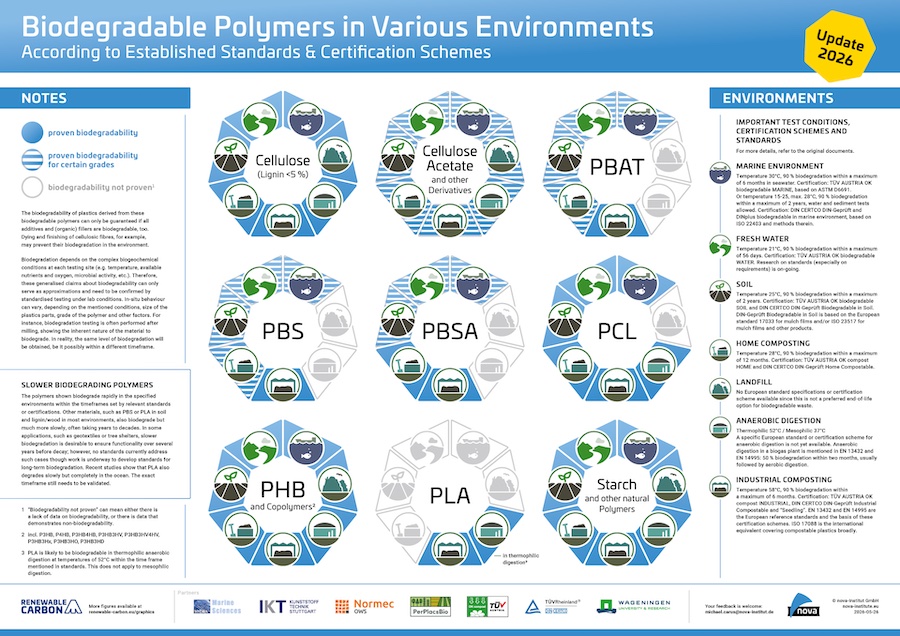
The updated poster on biodegradable Polymers in various environments has been released

As part of the PerPlacsBio project, nova-Institute has updated its popular poster on the biodegradability of polymers in different environments. The updated version reflects current standards, certifications and the latest scientific findings. The poster can be used to assess biodegradable alternatives for use in agriculture and forestry, and it is now available in German for the first time.

#Recycling / Circular Economy

Advanced Recycling Conference 2026 to showcase innovations – Call for abstracts

The call for abstracts is now open for the Advanced Recycling Conference (ARC) 2026, taking place on 17–18 November 2026 in Cologne, Germany, and online. Europe’s leading platform for advanced recycling brings together hands-on solutions and cutting-edge research on recycling technologies for various waste streams like plastics, polymers, textiles or automotive, highlighting progress towards a circular renewable carbon economy.

#Recycling / Circular Economy

AI Circular Economy Conference 2026 fuels innovation at the intersection of AI and Circular Economy

The AI Circular Economy Conference 2026, organised by nova-Institute, brought together 116 participants from 15 countries in Cologne and online to explore the transformation of the chemical and materials industry supported and accelerated by artificial intelligence. During the two-day event, leading experts from industry, research, start-ups and the investment community discussed how AI can maximise the potential of renewable carbon creating efficient circular value chains. The conference featured 24 presentations and multiple panel discussions, highlighting the growing convergence of digital technologies and circular material systems. It demonstrated how artificial intelligence is progressing from the experimental stage to real industrial implementation within the circular economy.

More News on Recycling / Circular Economy

#Recycling / Circular Economy

PURE LOOP's DynaShape® automation increases recycling productivity by up to ten percent

The intelligent automation solution for the ISEC evo recycling machine automatically adjusts operating parameters to changing input materials, improving throughput, melt quality and process stability while reducing operator workload.

#Recycling / Circular Economy

From textile waste to spinning-grade fiber: STADLER Group engineers integrated sorting solution for IGERS in Italy

As technology partner, STADLER worked alongside IGERS on its new plant in San Pietro Mosezzo, Novara, from the first process discussions to the final layout – integrating key treatment equipment into one system and supplying the fully automated sorting line. Together, the two companies have taken IGERS' patented textile recycling process from vision to industrial reality.

#Recycled Fibers

Toray develops Polyester-Nylon fiber containing at least 93% recycled material by mass

Toray Industries, Inc., announced today that it has developed a polyester-nylon fiber with at least 93% recycled content by mass, based on the total weight of the raw yarn. This percentage applies to the newly developed raw yarn and does not represent the recycled content of the finished fabric or garment.

#Recycling / Circular Economy

Canopy shifts focus towards recycling and traceability in updated Hot Button criteria

Environmental non-profit organisation Canopy has introduced revised criteria for its annual Hot Button Report, which evaluates producers of man-made cellulosic fibres (MMCFs), including viscose, lyocell and acetate. The updated framework places greater emphasis on scaling alternative fibre sources, improving supply chain traceability and supporting forest conservation, while maintaining responsible sourcing as a central requirement.

Latest News

TOP