#Recycling / Circular Economy
Pioneering EU funded T-REX Project celebrates completion and Rreveals blueprint for scaling textile-to-textile recycling in Europe
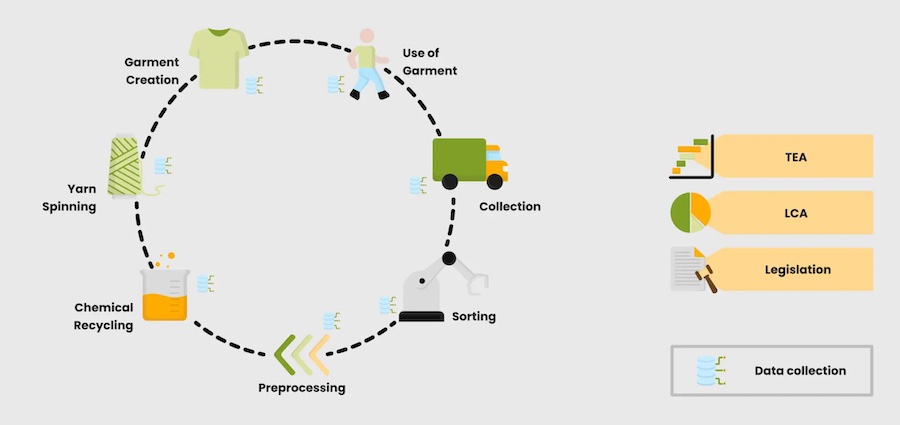
The blueprint, which spotlights insights and recommendations for each phase of the value chain, has been informed by in-depth analysis conducted by the consortium through-out the project, assessing the technical feasibility, economic viability and environmental impact of the recycling value chain.
The textile industry remains a major contributor to environmental impacts, with over 6.95 million tonnes of textile waste generated annually in the European Union alone*. Most of this waste is still landfilled or incinerated, with only a small fraction being reused or recycled. In response, the T-REX Project launched June 2022 with the aim of bringing together 13 leading stakeholders from across the value chain to develop a harmonised blueprint for closed-loop recycling of post-consumer household textile waste in the EU.
The insights outlined below identify key challenges and propose targeted interventions to support scaling a circular textile system across four core areas:
TECHNICAL SCALABILITY
+ Sorting efficiency is currently low: Manual sorting, which is still the primary method, remains inefficient and costly. Automation could improve the quality and purity of feedstock available for recyclers. Advancements in automated sorting technologies such as Near Infrared (NIR) and AI-powered systems to improve yield, throughput, and identification of multi-layer or blended garments is essential. It is also important to prioritise R&D funding for enhanced detection technologies capable of distinguishing material blends and contaminants more accurately.
+ Pre-processing is critical: It is important to recognise preprocessing as a critical step in the recycling value chain, with direct impact on the recyclability and quality of the final product. Harmonised mechanical pre-processing for post-consumer textile waste, ideally co-located with sorting facilities for improving yields and efficiency is vital to improve feedstock consistency. To improve feedstock consistency and purity, further mechanical and chemical pre-processing steps are required, mechanical can be co-located in sorting facilities whilst chemical processes can be integrated into the recyclers’ operations to match the specific technologies.
BUSINESS VIABILITY
While the market potential for textile-to-textile recycling in Europe is clear — with volumes of post-consumer textile waste suitable for fibre-to-fibre recycling projected to reach 1.2 million tonnes by 2030** and increasing regulatory pressure — realising a viable business case remains challenging due to two interconnected barriers: limited access to quality feedstock, and a lack of infrastructure at scale.
+ Feedstock is limited and expensive: Despite the abundance of textile waste, recyclers face both scarcity and high costs of feedstock. There is insufficient post-consumer material suitable for recycling available, due to low collection rates in most EU member states and lack of incentive for sorters to provide feedstock quality needed for recycling. What exists often lacks the specifications needed for most current recycling technologies.
+ Current inefficiencies in sorting and pre-processing result in high material losses, driving up overall OPEX. When feedstock quality does not meet recyclers’ requirements, it further undermines the overall process efficiency. While R&D is needed to make sure recycling technologies are capable of handling more complex inputs, tackling feedstock complexity at the source will be equally critical, making the enforcement of Ecodesign principles a key lever for future-proofing textile-to-textile recycling.
+ High operational costs in Europe: Energy and labour costs are major cost drivers. Labour costs could be significantly reduced through automation, especially for the collection, sorting, and preprocessing step while energy-efficient operations and access to low-cost renewable energy are key for recyclers. Policies should enable recycling innovations and also address structural cost imbalance for conventional production that does not consider environmental and social impacts.
+ Scaling textile-to-textile recycling in Europe requires coordinated financial, regulatory, and industrial efforts to stimulate demand, reduce costs, and mobilise the necessary capital and should complement broader circular strategies including reuse, repair, and smarter design to unlock a circular approach to textile waste management.
ENVIRONMENTAL IMPACT
+ Textile recycling has strong potential to reduce the environmental impacts associated with fibre production. However, the magnitude of these benefits depends heavily on both the type of material being recycled and the specific recycling technology used. Different fibre types and recycling processes vary in their efficiency, yield, and overall environmental performance, meaning that outcomes can differ significantly across materials and methods.
+ One of the main contributors to environmental impact typically arises from the most energy-intensive stages of the process. This highlights the importance of improving energy efficiency and sourcing low-impact energy. This is true as well for the recycling process as for the rest of the manufacturing and supply chain, where downstream processes include energy intensive processes such as dyeing. It is therefore essential that the recycling process produces fibres compatible with advanced, environmentally friendly manufacturing techniques.
+ While recycling is a vital tool in improving sustainability across the textile value chain, it is not a stand-alone solution. The manufacturing and use stages remain significant contributors to environmental impacts. Designing for durability will increase the lifespan of garments by focusing on the physical longevity of products, together with reusability.
POLICY RECOMMENDATIONS
+ It is essential to introduce economic incentives that fairly distribute the responsibility of textile waste management across the entire value chain—including collectors, sorters, pre-processors, and recyclers.
+ End-of-waste (EoW) criteria should be aligned with practical, market-driven standards to promote textile circularity. This will support the use of recycled textiles in new products and improve the recycling of EU textile waste. EoW rules also directly affect Extended Producer Responsibility (EPR) schemes and the cross-border waste shipment directive.
+ Set realistic, achievable targets for recycled content, underpinned by clear and pragmatic criteria. These criteria should encourage market demand without limiting the use of emerging technologies or diverse feedstock inputs.
+ Recyclability standards must be harmonized, focusing on the dominant material in products to reduce material complexity. Standards should remain flexible to accommodate innovation and emerging recycling technologies, ensuring alignment and clarity within the regulatory framework.
Despite the challenges, the projected rise of post-consumer textile waste to 7.3 million tonnes by 2030 makes it crucial to explore recycling as an alternative to landfill, incineration, or export. While recycling can help manage the growing volume of non-reusable textiles, it must be integrated into a broader strategy that also prioritizes reuse, repair, and demand management.
The full T-REX blueprint for textile-to-textile recycling in Europe will be available at www.trexproject.eu from 28th May 2025. For further information, please refer to the analysis reports which will be released on the T-REX Project website from 28th May - 6th June.
https://trexproject.eu/t-rex-blueprint/