[pageLogInLogOut]

#Raw Materials

37. International Cotton Conference Bremen - Successful conference attracts around 400 guests
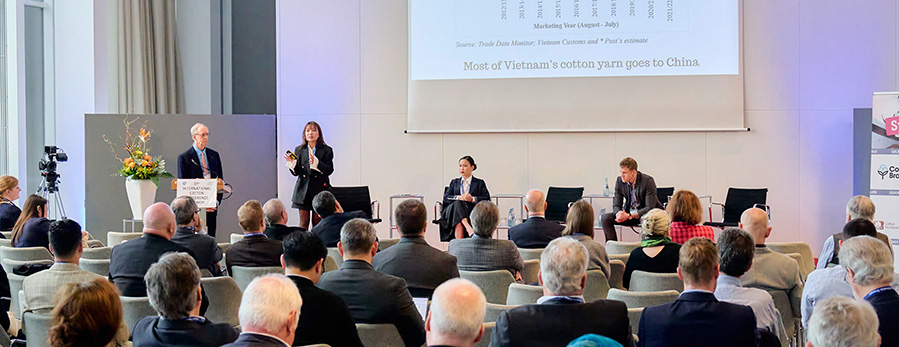
(c) 2024 Bremen Cotton Exchange, Photographer Carsten Heidmann
Around 400 participants from almost 40 countries attended the 37th International Cotton Conference Bremen from March 20 to 22. On site and online, guests were able to attend eleven sessions with almost 70 speakers and find out about the latest research findings and innovative practical applications in the cotton industry.

This year, the Bremen Parliament served as venue for the International Cotton Conference Bremen for the first time.

In the bright ballroom of the building with a view of the historic ensemble of Bremen‘s market square, the President of the Bremen Parliament, Antje Grotheer, welcomed the international participants at the start of the conference.

„For a few days, Bremen was once again the centre of the cotton world. Presentations at a high professional level, exciting discussions and in-depth insights into industry-wide progress once again made it clear that the Bremen conference is an essential module for exchange within the cotton community. This was demonstrated by the lively debates surrounding the current legislative proposals with regard to sustainability and transparency with consequences for the entire industry,“ said Jean-Paul Haessig, President of the Bremen Cotton Exchange.

„The joint organization of the International Cotton Conference by the Bremen Fibre Institute and the Bremen Cotton Exchange is an excellent example of how science and practice can complement and benefit from each other. The diverse and top-class conference programme as well as the many expert meetings on the fringes of the conference speak a clear language again this year,“ added Prof Dr Axel Herrmann for the Faserinstitut Bremen (FIBRE).

Highlights of the conference: the keynotes

The keynote sessions that opened the day were among the highlights. Colin Iles, Executive Manager Cotton & Sugar at Viterra, got the participants in the right mood with his enlightening and entertaining overview of current developments on the commodity markets and their impact on cotton.

Analyst Veronica Bates Kassatly provided plenty of material for discussion by focusing on the upcoming legislative regulations and their serious consequences for the entire industry. This was supplemented by practical recommendations from Commerzbank representatives Manuel Höchemer and Lennert van Mens. They showed how companies in the European Union can navigate new regulations on sustainability reporting.

The keynotes on Thursday as well offered a select mix of inspiring insights and exciting facts from the world of cotton and beyond. Nicolas Rubio reported on his experience in European politics in his role as Agricultural Counsellor at the United States Embassy in Berlin. Hubertus Lohner, Airbus Operations in Bremen and Head of the ECOMAT Technology Centre, presented ways in which the use of natural fibres can contribute to the decarbonization of the mobility sector - especially in aircraft construction.

Panel discussion with focus on Vietnam

Under the headline ‚Region in Focus‘, the session focusing on the Vietnamese cotton and textile industry highlighted the dynamic industry in the Asian country. Thuy Vi Nguyen from the Vietnamese Cotton and Spinning Association VCOSA, Yen Tracy Mai, President and CEO Long Van Yarn Ltd and Graham Soley, USDA analyst, paved the way for a lively discussion among the representatives and experts of the Vietnamese textile industry.

Sustainability as a cross-cutting issue

The topic of sustainability is now interwoven with the various areas in the supply chain, so that it no longer stands out as a single topic, but rather must be considered everywhere as a cross-cutting issue. As a result, practically all sessions on topics along the cotton supply chain included aspects of the now so broadly diversified area of sustainability.

The research work of Filipe Natalio, for example, with the aim of understanding the underlying mechanisms of natural organisms in order to produce biological materials such as cotton with special sustainable properties, deserves special mention. But there were also exciting presentations with intensive discussions on other sustainability-related keywords. These included, for example, the presentations ‚Environmental impact of cotton cultivation systems‘ by Jens Soth, Helvetas, and ‚Textiles on the way to a circular economy‘ by Stefan Schlichter, Augsburg University of Applied Sciences. The conference also addressed issues relating to traceability and transparency as well as the impact of climate change and fair incomes on the lives of cotton farmers. 

Focus on recycling

The topic of recycling played a special role during this conference. This session which demonstrated exemplary cooperation between research and practice, focused on the quality of cotton fibres in the recycling process. During the discussion, it became clear what opportunities, but also challenges, exist in the recycling of this natural fibre.

The topic of recycling was also on the agenda of the Spinning & Textile Seminar in the run-up to the conference. The four organizers, the Bremen Cotton Exchange, the Bremen Fibre Institute (FIBRE), the International Textile Manufacturers‘ Federation (ITMF) and the German Industrial Association for Yarns and Textiles (IVGT), had once again invited participants on Tuesday. Under the title ‚Use and challenges of fibres in textile recycling systems‘, speakers from the textile industry shed light on the recycling value chain from the sorting of used clothing to the new product from a practical perspective.

Conference still accessible online for participants

All sessions of the conference were recorded and are available on the talque platform. Every participant of the conference has been given access and can use the platform to look up missed sessions and contact speakers or participants. 

The presentations will soon be available on the Bremen Cotton Exchange website.

News and programme details are still available on the conference website: 

www.cotton-conference-bremen.de


More News from Bremer Baumwollbörse

#Raw Materials

Modern testing methods for raw cotton

The 38th International Cotton Conference Bremen will take place from 25 to 27 March 2026 at the Bremen Parliament. This conference has traditionally stood for in-depth expertise and international exchange. The program will focus on technical innovations, market trends, and regulatory frameworks across the entire value chain – from agriculture to the circular economy. With high-profile speakers, the conference is regarded as the key meeting point for the global cotton industry. Today’s focus: Cotton quality and testing methods.

#Natural Fibers

Modern testing methods for raw cotton

The 38th International Cotton Conference Bremen will take place from 25 to 27 March 2026 at the Bremen Parliament. This conference has traditionally stood for in-depth expertise and international exchange. The program will focus on technical innovations, market trends, and regulatory frameworks across the entire value chain – from agriculture to the circular economy. With high-profile speakers, the conference is regarded as the key meeting point for the global cotton industry. Today’s focus: Cotton quality and testing methods.

#Natural Fibers

38th International Cotton Conference Bremen: Let´s Talk about Cotton!

The 38th International Cotton Conference Bremen, to be held on 25-27 March 2026 in Bremen’s parliament building on market square, once again sends a powerful signal for professional excellence and international dialogue. The focus is on the latest market trends and technical innovations throughout the entire value chain – from agriculture and quality assurance to processing and the circular economy. With its high-calibre speakers, the conference remains an indispensable forum for anyone involved in shaping the cotton industry scientifically, technically, or economically.

#Natural Fibers

38th International Cotton Conference Bremen launches registration and unveils key topics

Participants can now register online for the 38th International Cotton Conference Bremen, which will be held on 25-27 March 2026 at the Haus der Bürgerschaft parliament building on market square. All visitors can look forward to a high-calibre conference programme, numerous additional meetings and a valuable exchange of knowledge and information. The comprehensive range of topics covering the entire value chain will provide practical expertise, address current developments, answer key industry questions, and provide new impetus for the future.

More News on Raw Materials

#Raw Materials

Esquel Group adds two new extra-long staple cotton varieties approved

Esquel Group’s Xinjiang Research & Development Center has successfully developed two new Sea Island cotton (Extra-Long-Staple cotton, ELS cotton) varieties named “Yuan Loong 37” and “Yuan Loong 42,” which have been officially approved and granted registration numbers. Both varieties have also obtained Plant Variety Rights certificates, marking another significant breakthrough for the Group in cotton breeding and commercial application.

#Raw Materials

Aid by Trade Foundation reaches new milestones in supply chain transparency

The Aid by Trade Foundation (AbTF) is reaching new milestones as it leads the way towards greater physical traceability for Cotton made in Africa® (CmiA) cotton. With around 700 suppliers and producers in a total of 25 countries, the Aid by Trade Foundation has reached a new record number of partners who can trace CmiA cotton from the product back to its origin. This is more than double the previous year’s figure.

#Raw Materials

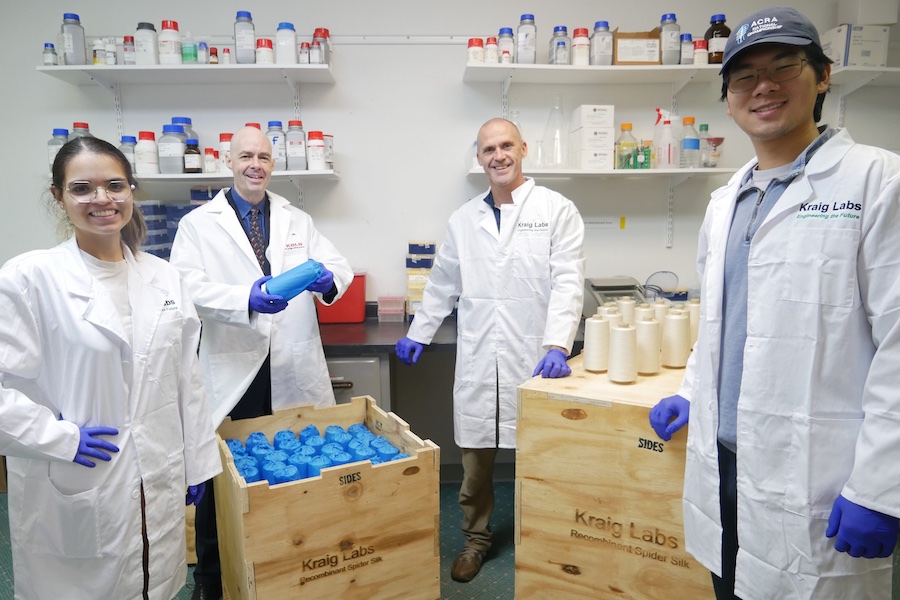
2026 production plan set for a record 10 metric tons of recombinant spider silk cocoon per month

Kraig Biocraft Laboratories, Inc. (OTCQB: KBLB) (“the Company”, “Kraig Labs”, or “Kraig’s”), a world leader in spider silk technology*, today announced its 2026 production plan that will drive explosive growth and establish a new global benchmark for spider silk manufacturing.

#Man-Made Fibers

Lenzing AG to become majority owner of TreeToTextile AB and accelerates industrialization of new fibers

The Lenzing Group is taking another strategic milestone by acquiring a controlling majority in the Swedish innovation company TreeToTextile AB. This step strengthens Lenzing’s position as a leading provider of sustainable, wood‑based specialty fibers and expands its innovation pipeline with a highly scalable, patent‑protected technology platform. The transaction is executed through the issuance of new shares.

Latest News

#Weaving

Itema America acquires Palmetto Loom Reed, strengthening local manufacturing and service in the U.S.

Itema America, the U.S. subsidiary of Italy-based Itema Group, has acquired – through an Assets Purchase Agreement – Palmetto Loom Reed, a Greenville, South Carolina-based manufacturer of weaving reeds and one of the last remaining domestic producers of these precision components in the United States.

#Recycled_Fibers

Reju announces site selection for French Regeneration Hub in Lacq advancing Europe’s circular textile infrastructure

Reju, the textile-to-textile regeneration company based in France, announces the site selection for an industrial sized Regeneration Hub, in Lacq, in the Pyrénées-Atlantiques, on the Induslacq platform. Reju, a Technip Energies owned company, is deepening its roots in France through the development of this new Regeneration Hub.

#Functional Fabrics

lululemon introduces Unrestricted Power™ — A new sensation for strength training

lululemon (NASDAQ: LULU) has unveiled Unrestricted Power™, a new innovation platform engineered for heavy lifts and demanding gym sessions. The assortment, which launches in North America, is backed by thousands of hours of research and development, providing secure support without compromising comfort and mobility, enabling a distraction-free fit built to match every move.

#Natural Fibers

Merino wool moves into China’s high-performance sportswear market

China’s leading sportswear brands are beginning to treat Merino wool not as a lifestyle material, but as a performance input as natural fibres move from the margins of sportswear into elite technical applications. That shift is increasingly evident in the material strategies of major domestic groups such as ANTA.

TOP