[pageLogInLogOut]

#Raw Materials

How are ICAC projections doing halfway through the 2022/23 Season?

Making any kind of prediction about what will happen in the future is an inherently risky proposition, and that goes double for an industry as volatile as cotton. Nonetheless, it's the job ICAC Data Scientist Matthew Looney signed up for, and in the just-released edition of Cotton This Month, he takes a clear-eyed look at how accurate his projections are now that we're halfway through the 2022/23 season.

In the June 2022 edition of CTM, the first official publication of numerical value projections and narration surrounding the 2022/23 projections were disclosed. Global production was forecasted at 26.13 million tonnes while consumption was projected to decrease only slightly to 26.09 million tonnes. An increase in production and only a very small decrease in consumption certainly indicated good times ahead. 
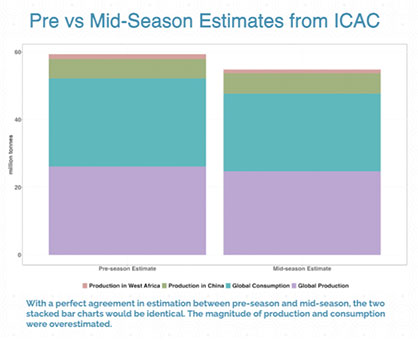
© 2023 ICAC
© 2023 ICAC


Then Mother Nature got involved, subjecting two major cotton producing countries, the United States and Pakistan, to severe drought and catastrophic flooding, respectively. The weather has always been a wild card for cotton but the erratic adverse weather patterns are intensifying as a result of climate change, so it's understandable when things that are completely unpredictable are missed.

'In hindsight, the high inflation numbers posted around the time of writing the June 2022 CTM should have been given more weight', said Mr Looney, author of Cotton This Month. 'All in all, 2022/23 has been a bad season for production, consumption — and projections. But on the bright side, the season is only half over, and I prefer to be optimistic', he added, pointing to falling inflation numbers and the fact that general economic indicators are moving in the right direction.


Price Projections

The Secretariat’s current price forecast of the season-average A index for 2022/23 ranges from 96 cents to 126 cents, with a midpoint at 104 cents per pound. The price projection for 2022/23 is based on the ending stocks-to-mill use ratio in the world-less-China in 2020/21 (estimate), in 2021/22 (estimate) and in 2022/23 (projection), on the ratio of Chinese net imports to world imports in 2021/22 (estimate) and 2022/23 (projection), and the average price in 2021/22. The projection reflects a 95% confidence interval.

Cotton This Month is published at the beginning of the month with the Cotton Update published mid-month. The Cotton Update is a mid-month report with updated information on supply/demand estimates and prices. The next Cotton Update will be released on 15 February 2023. The next Cotton This Month will be released on 1 March 2023.

More News from International Cotton Advisory Committee (ICAC)

#Natural Fibers

ICAC to collaborate with Uzbekistan and Bizpando on regenerative agriculture

The Government of Uzbekistan has allocated 55,000 hectares of land to implement a regenerative agriculture program for cotton as part of a collaborative project with the International Cotton Advisory Committee (ICAC) and Bizpando, a company with a a blockchain-based internet platform designed to ensure supply chain compliance.

#Natural Fibers

Bangladesh becomes World's largest importer in 2024/25 after China cuts imports by 65% to 1.1 million tonnes

As we prepare to turn the calendar on 2025, world cotton lint production currently is estimated to be about 25.4 million tonnes — roughly the same as the last season — surpassing the world cotton lint consumption by 392,000 tonnes.

#Natural Fibers

ICAC announces postponement of the 83rd Plenary Meeting in Tanzania

Due to unforeseen circumstances arising from the recent developments in Tanzania, the ICAC has announced that its upcoming 83rd Plenary Meeting has been postponed. Scheduled for Nov. 17-20 in Mwanza, the delay was recommended by Tanzania, and the decision was made out of an abundance of caution, prioritizing the safety and well-being of all participants.

#Natural Fibers

World Cotton Trade declined 4.1% in 2024/25, according to ICAC's 2025 World Cotton Trade Report

Washington, DC — The International Cotton Advisory Committee (ICAC) has released the 2025 World Cotton Trade Report, which covers trade developments in raw cotton since 1980. An annual publication, it provides analysis of world trade by region; import/export projections by country; matrices of trade flows; and seasonal estimates of export commitments to date.

More News on Raw Materials

#Raw Materials

Better Cotton Initiative opens enrollment in the US with promising opportunities for producers

Producer enrollment for the US Program of the Better Cotton Initiative (BCI) is open until May 15 for the 2026-2027 season. With over 2,600 members spanning the cotton supply chain and more than 11,000 users of its Better Cotton Platform (BCP) as of 2025, BCI’s standard is implemented in 15 countries and covers one fifth of global cotton production.

#Natural Fibers

Modern testing methods for raw cotton

The 38th International Cotton Conference Bremen will take place from 25 to 27 March 2026 at the Bremen Parliament. This conference has traditionally stood for in-depth expertise and international exchange. The program will focus on technical innovations, market trends, and regulatory frameworks across the entire value chain – from agriculture to the circular economy. With high-profile speakers, the conference is regarded as the key meeting point for the global cotton industry. Today’s focus: Cotton quality and testing methods.

#Natural Fibers

38th International Cotton Conference Bremen: Let´s Talk about Cotton!

The 38th International Cotton Conference Bremen, to be held on 25-27 March 2026 in Bremen’s parliament building on market square, once again sends a powerful signal for professional excellence and international dialogue. The focus is on the latest market trends and technical innovations throughout the entire value chain – from agriculture and quality assurance to processing and the circular economy. With its high-calibre speakers, the conference remains an indispensable forum for anyone involved in shaping the cotton industry scientifically, technically, or economically.

#Natural Fibers

Human Rights Day: Cotton made in Africa reinforces its commitment to ensuring respect for human rights in cotton production

The sustainable cotton standard Cotton made in Africa (CmiA) has always focussed on respect for human rights, including by prohibiting child labour and discrimination. With the new version of the CmiA standard coming into force, AbTF raises requirements for due diligence in the areas of human rights and risk management.

Latest News

#Digital Printing

Epson launches SureColor G9000: high-production Direct-To-Film printer delivering greater productivity and reliability

Epson today announces the launch of the SureColor G9000, a new high-production Direct-To-Film (DTFilm) printer designed to meet growing global demand for flexible and efficient textile transfer printing. Expanding Epson’s DTFilm line-up alongside the SC-G6000, the SC-G9000 introduces enhanced speed, reliability and ease of maintenance for commercial garment decorators and textile producers.

#Nonwoven machines

Three ANDRITZ spunlace lines start operating at Alar Silk Road New Materials in China

Alar Silk Road New Materials and ANDRITZ have successfully commissioned three spunlace lines in crosslapped configuration at Alar’s facility in Aral City, Xinjiang, China.

#Knitting & Hosiery

SHIMA SEIKI to exhibit at GMMSA Expo India

Leading Japanese computerized flat knitting technologist SHIMA SEIKI MFG., LTD. of Wakayama, Japan, together with its Indian sales representative Universal MEP Projects & Engineering Services, Ltd., will participate in the upcoming Garments Machinery Manufacturers & Suppliers Association (GMMSA) Expo India 2026 exhibition to be held in Ludhiana, India next month. Through its lineup at GMMSA, SHIMA SEIKI aims to further strengthen its presence within the Indian market with an exhibit that caters to diverse needs, consisting of seam-free WHOLEGARMENT® knitting technology as well as a brand-new shaping machine with high productivity and excellent cost performance.

#Research & Development

Bio-based fibers with good flame retardancy

Fibers made from bio-based plastics reduce dependence on fossil raw materials and promote the circular economy. The covalent bonding of flame-retardant additives can open the way for these fibers to enter the mass market.

TOP