[pageLogInLogOut]

#Raw Materials

COTTON USA SOLUTIONS technical seminar in Bangkok targets spinning mill decision-makers

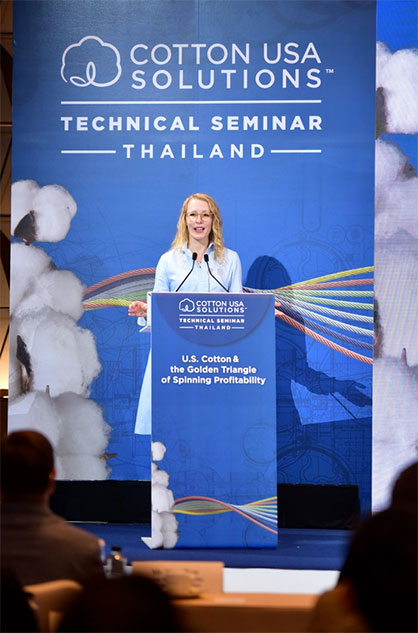
Cotton Council International’s (CCI) first “U.S. Cotton & The Golden Triangle of Spinning Profitability” seminar in Bangkok, Thailand, had 51 attendees from 17 mills. Twenty-eight executives, primarily mill owners, joined the seminar in person while 23 joined online. The presentations targeted owners, mill managers, supply chain and sales representatives that make up the “Golden Triangle” of decision-makers.

According to the results of a post-event survey, 82% of participants are very likely to purchase U.S. cotton as a result of attending. Future purchases are estimated at 75,946 bales of U.S. cotton.

Five companies indicated they would be interested in scheduling a COTTON USA SOLUTIONS™ 1:1 Mill Visit after the event, and four said they would be interested in scheduling a Mill Mastery™ Course.

Ms. Kelly Stange, Regional Agricultural Counselor, U.S. Embassy Thailand, delivered welcome remarks and nine presentations followed:

• “CCI Update by William Bettendorf, CCI Director • “Update on the Thai Textile and Garment Industries” by Yutthana Silpsanvich, Chairman, Thai Garment Manufacturers Association (TGMA) • “Global Cotton Supply & Demand” by Steve Dyer, ACSA/LDC • “U.S. Cotton Supply & Demand” by Darren Long, ACSA/ECOM • “The Golden Triangle of Spinning Profitability” by Joerg Bauersachs, CCI Technical Team Leader • “Global Transportation Situation” by Richard Cash, Country General Manager Thailand, Hapag Lloyd • “Review of U.S. Transportation Situation” by Hope Brooks, AMCOT/Staplcotn • “The Importance of Cotton Bale Management” by Dr. Muhammad Tausif, CCI Technical Team Consultant • “The Environmental Footprint of U.S. Cotton in the Manufacture of Knitted Garments” by Roger Gilmartin, CCI Technical Team Special Advisor


The group found the topics presented by the U.S. exporters very useful, and these presentations rated particularly high with those who identified themselves as the CEO/president/owners of their companies.

© 2022 COTTON USA
© 2022 COTTON USA


More News from TEXDATA International

#ITM 2026

ITM 2026: The new geography of textile production

New production hubs are emerging across North Africa and Central Asia, while Türkiye is accelerating its transformation toward higher-value, technology-driven and more sustainable textile manufacturing.

#Research & Development

“Production is a product”

From technical textiles and AI-driven robotics to the limitations of textile circularity: Professor Dr Thomas Gries looks back on more than two decades of development at ITA Aachen. In the interview, he explains why production technology remains a decisive success factor, discusses international collaborations and innovation ecosystems, and shares his views on the transformation of production landscapes and the challenges facing an increasingly regulated industry.

#Knitting & Hosiery

“We need to move away from the price trap and return to a value-driven mindset.”

With its new Textile Innovation Center, KARL MAYER is sending a strong signal for innovation, collaboration, and the future of textile applications. In this interview, Karl Josef Mayer discusses new opportunities in warp knitting, the processing of staple fibres, recycling, the changing role of machinery manufacturers, and why the textile industry must once again focus more strongly on the value of textiles. by Oliver Schmidt

#Associations

“Innovation, resilience and international experience remain the great strengths of the Swiss textile machinery industry”

Geopolitical uncertainty, growing competitive pressure from China, new free trade agreements and the shift towards a circular economy are currently reshaping the global textile industry. In this interview, Cornelia Buchwalder discusses the current mood within the Swiss textile machinery sector, the industry’s distinctive innovative strength, new market opportunities in India and Asia, and the technological trends that could shape the upcoming trade fair cycle leading up to ITMA 2027.

More News on Raw Materials

#Natural Fibers

Global cotton trade poised for recovery as India and China drive import demand

The July 2026 issue of Cotton This Month highlights a changing global cotton market, with consumption and trade expected to strengthen despite a modest decline in production during the 2026/27 season. The next issue of Cotton This Month will be released on August 1, 2026.

#Natural Fibers

Cotton made in Africa partners receive top marks in independent verifications

Cotton made in Africa® (CmiA) and CmiA Organic are two internationally recognised standards that aim to promote sustainable development in the African cotton sector south of the Sahara. To ensure the standards’ credibility among brands, retailers, and consumers, independent verifiers evaluate compliance on the ground. The verification results for 2025, now published in the Aggregated Verification & Implementation Report, were very strong: The verifiers awarded consistently very good remarks regarding management, people, prosperity, and the environment.

#Natural Fibers

Cotton ConneXions Insight to Impact brings supply chain leaders together around cotton innovation

Cotton Incorporated’s Cotton ConneXions Insight to Impact brought together more than 300 industry leaders from 140 companies across 10 countries, including more than 45 top global brands and sourcing organizations, underscoring strong global interest in cotton-rich product development, sourcing and supply chain collaboration.

#Natural Fibers

Bremen Cotton Exchange: Fritz A. Grobien re-elected as President

The members of the Bremen Cotton Exchange have re-elected Fritz A. Grobien as President during the association’s 152nd General Assembly on June 18, 2026. The election confirms the organization’s commitment to maintaining its role as a leading international platform for the cotton and fiber industry amid a period of geopolitical and economic uncertainty.

Latest News

#Digital Printing

USColorworks expands digital platform with Kornit Atlas MATRIX and Atlas MAX PLUS solutions

Kornit Digital Ltd. (NASDAQ: KRNT), a global pioneer in sustainable, on-demand digital fashion and textile production, today announced that USColorworks, a North Carolina-based apparel decoration and fulfillment company specializing in custom and on-demand printing for retail and promotional markets, has expanded its Kornit digital production platform with the addition of Atlas MATRIX and Atlas MAX PLUS systems to deliver high-quality, on-demand apparel across cotton, blended fabrics and polyester.

#Functional Fabrics

CovationBio introduces two new bio-based innovations at Functional Fabric Fair New York

Covation Biomaterials LLC (“CovationBio®”) is showcasing its two new bio-based innovations, Xatryx® and Sorona® elasterell-p fiber, at this year’s Functional Fabric Fair in New York City, July 7–9, 2026. Attendees can visit CovationBio at Booth #404 to explore this next generation of bio-based performance materials.

#Research & Development

Geotextiles made from recycled materials: GREEN leads the way into the industry

For the industry, recycled materials are creating new opportunities in geotextile production. In the GREEN project, the Fraunhofer Cluster of Excellence Circular Plastics Economy CCPE demonstrates that recycled polypro-pylene (PP), polyethylene terephthalate (PET), and high-density polyeth-ylene (HDPE) can be processed into nonwovens, fibers, and membranes that meet industrial requirements. This creates opportunities for use in existing production lines and new value chains in the geotextile market.

#Nonwoven machines

A Penteadora starts up ANDRITZ textile recycling and needlepunch nonwoven lines in Portugal

A Penteadora SA has successfully started up a complete mechanical textile recycling line and a needlepunch nonwoven line supplied by ANDRITZ at its production site in Unhais da Serra, Portugal. This investment enables A Penteadora to expand its industrial capabilities and develop a new generation of solutions based on pre- and post-consumer recycled textiles. The input materials originate from its own production waste and other textile waste streams. Both lines are fully operational, and the first products are expected to reach the market in July.

TOP