[pageLogInLogOut]

#Natural Fibers

COTTON USA™ leads global shift toward sustainable sourcing at Bangkok Sourcing Fair
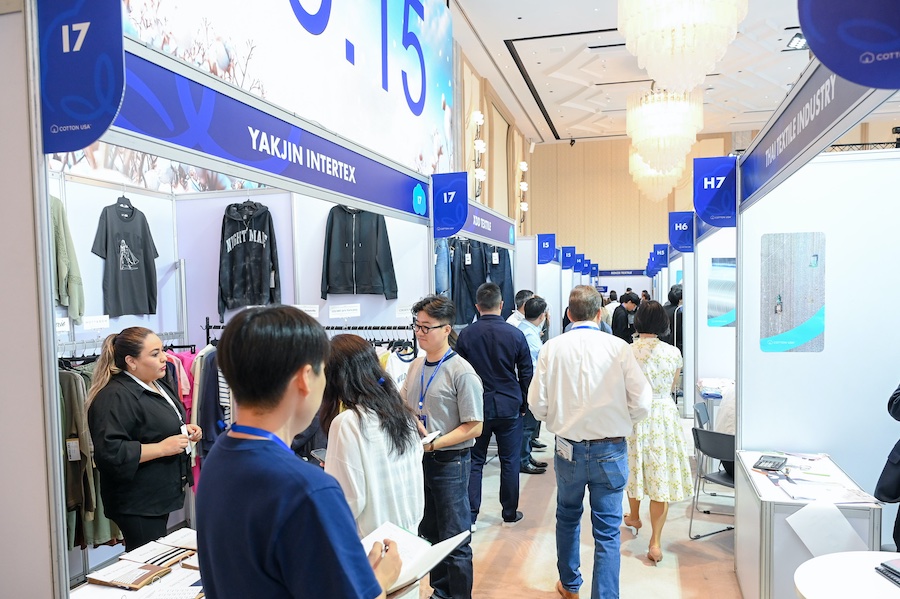
COTTON USA™ strengthened its position as a global connector in sustainable U.S. cotton textile sourcing at its recent Sourcing Fair in Bangkok, Thailand, drawing over 300 top brand, retailer, manufacturer, and mill representatives from 13 countries.
© 2025 Cotton Council International


Themed "Sustainable Sourcing—Strategic Growth," the event, hosted by Cotton Council International (CCI), facilitated over 4,500 targeted one-on-one business meetings—a powerful catalyst for expanding the use of U.S. cotton across the international textile supply chain.

Attendees represented 128 companies from Bangladesh, Hong Kong, India, Indonesia, Japan, Malaysia, Pakistan, Singapore, South Korea, Sri Lanka, Taiwan, Thailand, and Vietnam.

Following the business meetings, attendees participated in a seminar and an exclusive mill tour. Adam Branson, USDA Foreign Agricultural Service (FAS) regional agricultural counselor for Thailand, Burma, and Laos, delivered welcome remarks on behalf of the U.S. Embassy in Bangkok. The Sourcing Fair’s slate of seminar speakers followed with key insights into sustainability trends, evolving global legislation, and the technical advantages of U.S. cotton.

Providing invaluable, hands-on exposure to U.S. cotton’s superior textile production performance, more than 30 participants from 18 brand and retailers toured three leading Thai mills: Thai Rung Textile, Thai Textile Printing, and Thai Textile Industry.

By connecting leading industry players and spotlighting the superior quality, sustainability, and traceability of U.S. cotton, the COTTON USA™ Sourcing Fair in Bangkok affirmed COTTON USA™ as a trusted global partner in sustainable textile sourcing.

More News from Cotton Council International

More News on Natural Fibers

#Raw Materials

Textile Exchange publishes cotton Life Cycle Assessment study to strengthen impact data

Textile Exchange has published the first in a series of seven Life Cycle Assessment (LCA) studies designed to improve the quality and robustness of environmental impact data for raw material production across the fashion, textile, and apparel industry. The first LCA study focuses on cotton and addresses critical data gaps and methodology variability through new high-quality data across key producing countries. The study includes organic, regenerative, recycled, and country averages for conventional cotton production systems, providing a clearer picture of the associated environmental impact.

#Raw Materials

The 83rd Plenary Meeting: Reports from the ICAC Secretariat

Every year, one of the most anticipated sessions at the International Cotton Advisory Committee's (ICAC) Plenary Meeting is the Reports from the Secretariat — and the 83rd edition in Bremen, Germany, did not disappoint.

#Raw Materials

A Powerful Opening: Global thought leaders launch the International Cotton Conference Bremen

The International Cotton Conference Bremen will open on 25 March 2026 in the Parliament building of the Free Hanseatic City of Bremen with a keynote session of exceptional calibre. Distinguished international experts will set the stage for the conference by offering incisive perspectives on the most pressing challenges and the defining trends shaping the future of the global cotton trade. Their insights will span a broad spectrum — from geopolitically driven disruptions affecting global supply chains to the opportunities emerging from innovation-led agriculture capable of supporting a growing world population. Together, these opening keynotes will frame the dialogue of the conference, highlighting both the complexity of today’s market environment and the pathways toward a resilient and forward-looking cotton sector.

#Natural Fibers

Beyond Cotton: Natural Fibres in the Spotlight at the Bremen Cotton Conference - Branded by DNFI

Climate targets, fragile supply chains, and rising regulatory requirements are fundamentally changing the perspective of the textile industry - the focus is increasingly shifting toward the base material. Not only cotton, but natural fibres are gaining significant importance: they stand out not only because of their outstanding functional properties, but also because they make a valuable contribution to the bioeconomy and responsible product development.

Latest News

#Composites

KARL MAYER strengthens partnerships in the composites industry at JEC World 2026

KARL MAYER further strengthened its role as a reliable and competent partner to the composites industry at JEC World 2026. The global market leader in textile machinery manufacturing used the trade show to meet key customers, establish numerous new contacts, and engage in in-depth technical discussions.

#Recycling / Circular Economy

ABB and Syre partner to explore technologies for industrial-scale textile recycling

ABB has signed a Memorandum of Understanding (MoU) with Swedish textile impact company Syre to jointly explore technologies to support the development of Syre’s first textile-to-textile recycling plant in Vietnam. The agreement establishes a framework for collaboration to investigate how ABB’s automation, electrification and digital technologies could contribute to safe, efficient and scalable operations. It will also explore how these capabilities could further optimize process and quality control performance as Syre advances its ambition to produce circular polyester at industrial scale.

#Techtextil 2026

From Nature Performance to Circular Economy: Techtextil 2026 focuses on the future market for technical textiles

Alternative materials and recycling technologies are one of the most important future segments and drivers of innovation in technical textiles. Sustainability goals and regulatory requirements increase their relevance, while advances in performance and economic viability enhance their market competitiveness. Taking place from 21 to 24 April 2026, Techtextil reflects this key industry trend with a growing number of specialised exhibitors. With the new “Nature Performance” label, the leading global trade fair bundles relevant market offerings and facilitates access to new solutions – from natural fibres and yarns to bio-based materials and circular approaches.

#Research & Development

Textile cascade filter for removing microplastics from wastewater

Microplastics are now found almost everywhere, even in remote regions of Antarctica. They enter the human body through the food chain. Studies indicate that microplastics may have negative effects on the human health.

TOP