[pageLogInLogOut]

#Natural Fibers

Global cotton industry converges in Guangzhou as Cotton Council International (Cci) champions U.S. Cotton’s sustainability
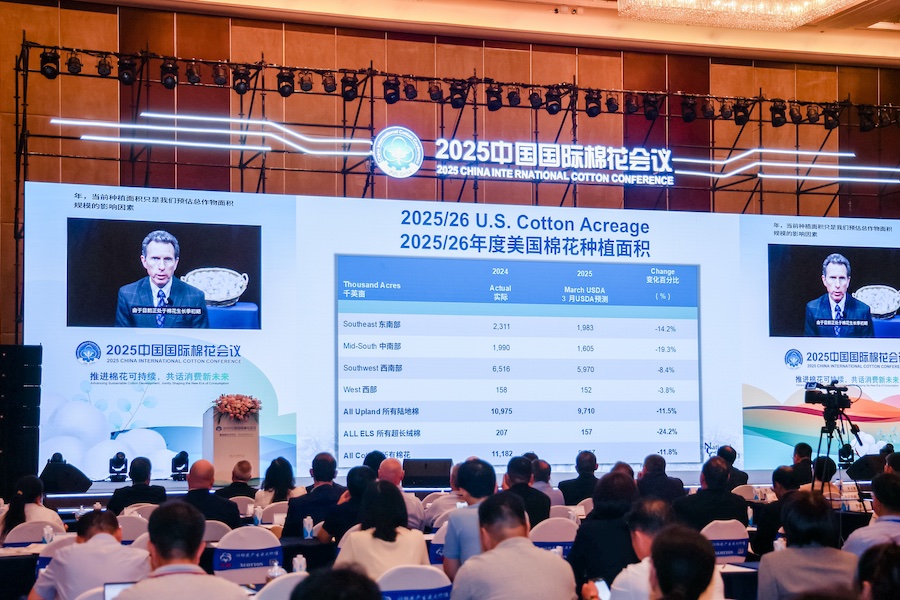
Cotton Council International (CCI) joined nearly 400 industry leaders at the 2025 China International Cotton Conference in Guangzhou to engage in critical discussions on the future of cotton.
© 2025 CCI
© 2025 CCI


CCI was a silver sponsor of the event, jointly organized by the China Cotton Association and the China National Cotton Exchange. Emphasizing the importance of collaboration and partnerships among various stakeholders in driving positive change, attendees represented domestic and international government agencies, industry organizations, merchants, textile enterprises and domestic brands.

CCI, the export promotion arm of the National Cotton Council (NCC), participated in collaborative discussions focused on accelerating sustainable development in the cotton industry and advancing efforts to promote global cotton consumption—while reinforcing a preference for U.S. cotton through its COTTON USA™ brand.

Dr. Gary Adams, NCC President and CEO, delivered a virtual keynote that highlighted the challenges and progress shaping U.S. cotton today. He provided updates on the global cotton supply and demand; the current U.S. economic environment; U.S. cotton planting, production and sales; and the U.S. Cotton Trust Protocol®, the sustainability program and traceability platform for U.S. cotton.

“The biggest challenge facing the global cotton industry is stagnant demand,” said Adams. “We look forward to collaborating on ways to increase demand for cotton around the world.”

In addition to the conference’s focus on the importance of building more responsible and traceable supply chains, it also featured forums on policy, domestic and international market trends, risk management through futures markets and new models for global cooperation.

The event served as an opportunity to engage with Chinese and international industry leaders, strengthen partnerships and reinforce the role of the U.S. cotton industry in delivering high-quality and more sustainable fiber.

“U.S. cotton growers are not only committed to quality—they’re committed to measurable progress in sustainability,” concluded Adams. “The U.S. cotton industry supports a future where innovation, accountability and sustainability drive the cotton industry forward.”


More News from Cotton Council International

More News on Natural Fibers

#Raw Materials

New study shows low environmental impact by Cotton made in Africa Organic Cotton from Tanzania

Today, the Aid by Trade Foundation (AbTF) is announcing the results of a comprehensive life-cycle analysis (LCA) for cotton produced in Tanzania under the Cotton made in Africa Organic (CmiA Organic) standard. The study emphasises the small ecological footprint of CmiA Organic verified cotton. This can largely be traced back to the absence of synthetic pesticides, artificial fertilisers, and artificial irrigation. Consequently, CmiA Organic cotton can help the textile industry meet regulatory requirements as well as science-based targets. The results also show that the consequences of climate change threaten the livelihoods of these cotton farmers, even though the type of agriculture they practise barely contributes to climate change.

#Raw Materials

Better Cotton Initiative strengthens regenerative focus in standard update

The Better Cotton Initiative (BCI) has strengthened the regenerative focus of its field-level standard with the launch of a new version of its Principles & Criteria (P&C), which marks the next step in the organisation’s journey to becoming a regenerative standards system.

#Natural Fibers

Global Standard gGmbH launches second public consultation for GRTS Draft 2 for the textile industry (1–30 April 2026)

Global Standard gGmbH is pleased to announce the release of Draft 2 of the Global Responsible Textile Standard (GRTS) for its second public consultation. The consultation will be open from 1 April 2026 to 30 April 2026, inviting stakeholders across the textile and apparel value chain to provide input and contribute to the further development of this new Standard.

#Raw Materials

Global production expected to decline in 2026/27 as policy shifts and weak demand reshape trade

Early projections for the 2026/27 season indicate that global cotton lint production will decline by 4% to 24.9 million tonnes, while world consumption is expected to remain stable at approximately 25 million tonnes, according to the April 2026 issue of Cotton This Month.

Latest News

#Heimtextil 2027

Heimtextil celebrates Milan Design Week honoring partnerships with Patricia Urquiola and Alcova Milano

Heimtextil is represented at Milan Design Week with its strong design partners Patricia Urquiola and Alcova. At Villa Pestarini, the leading trade fair spotlighted its dynamic collaborations with acclaimed designer Patricia Urquiola and Alcova Milano.

#Texprocess 2026

Kornit Digital expands digital production into footwear and technical textiles with Presto MAX PLUS

Kornit Digital (NASDAQ: KRNT) (“Kornit” or the “Company”), a global pioneer in sustainable, on-demand digital fashion and textile production, today unveiled the Kornit Presto MAX PLUS, a new roll-to-roll system expanding digital manufacturing into footwear, automotive interiors, military camouflage, high-performance sportswear, and high-end furnishings. Debuting at Texprocess 2026 in Frankfurt, Presto MAX PLUS enables entirely new applications for on-demand textile production.

#Textile processing

NATULON® zipper series surpasses 50% of YKK’s global zipper sales

YKK Corporation (Headquarters: Chiyoda-ku, Tokyo; President: Koichi Matsushima; hereafter, YKK) announces that the global sales share of its NATULON® zipper series—zippers that incorporate recycled materials—has exceeded 50%.

#Smart Textiles

Covestro, FILK Freiberg, and OUT e.V. develop flexible, conductive polymer smart textile system

As the smart textiles market continues to grow across healthcare, personal protection, sportswear, and automotive applications, developers are seeking new ways to integrate electronic functionality directly into textiles, without the rigidity and complexity of conventional wiring. To address this challenge, FILK Freiberg Institute, an independent research institution with expertise in polymer coatings for textile applications, collaborated with Optotransmitter-Umweltschutz-Technologie (OUT) e.V. The joint project, funded under the German Industrielle Gemeinschaftsforschung (IGF) program of the Bundesministerium für Wirtschaft und Energie (BMWE), focused on developing flexible, conductive polymer surfaces for next-generation smart textiles.

TOP