#Market Analysis & Forecasts
Cotton yarn market to hit USD 100.68 billion by 2028 |
Key companies covered in cotton yarn market are Texhong, Vardhman Group, BROS, Weiqiao Textile, Lutai Textile, Huafu, Alok, Huamao, China Resources, Nahar Spinning, Nishat Mills, Trident Group, Fortex, Aarti International, KPR Mill Limited and Others.
List of Key Players Mentioned in the Cotton Yarn Market Report:
Texhong (China)
Vardhman Group (India)
BROS (China)
Weiqiao Textile (China)
Lutai Textile (China)
Huafu (China)
Alok (India)
Huamao (China)
China Resources (China)
Nahar Spinning (India)
Nishat Mills (Pakistan)
Trident Group (India)
Fortex (Vietnam)
Aarti International (India)
KPR Mill Limited (India)
Get a Free Sample Research PDF:
https://www.fortunebusinessinsights.com/enquiry/request-sample-pdf/cotton-yarn-market-107241
Report Scope & Segmentation:
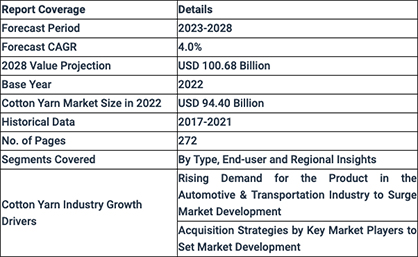
Segments:
Carded Yarn Segment to Record Appreciable Growth Due to Surging Product Adoption in Textile Manufacturing
On the basis of type, the market is segmented into combed yarn, carded yarn, and others. Of these, the carded yarn segment is estimated to depict considerable expansion over the forecast period. The rise is due to the increasing usage of the product for manufacturing woolen threads.
Apparel Segment to Depict Substantial Expansion Owing to Growing Yarn Demand
Based on application, the market is fragmented into textiles, apparel, and others. The apparel segment is set to register commendable growth over the estimated period. The surge can be attributed to the escalating disposable income, growing penetration of e-commerce, and others.
Based on geography, the market for cotton yarn has been analyzed across North America, Europe, Asia Pacific, Latin America, and the Middle East & Africa.
Report Coverage:
The report gives an in-depth analysis of the significant trends that are expected to drive the global industry outlook over the forthcoming years. It further delves into the key factors boosting market expansion throughout the projected period. These insights have been provided after extensive research and data collation from credible sources.
Drivers and Restraints:
Market Value to Rise Owing to Increasing Support from Government Bodies
One of the key factors propelling the cotton yarn market growth is the increase in government initiatives for supporting the growth of their domestic textile sectors. These initiatives are focused on skill development, the creation of infrastructure, and sectoral development in the textile sector.
However, the industry expansion could be hampered due to the high price of the product compared to synthetic yarn.
Browse Detailed Summary of Research Report with TOC:
https://www.fortunebusinessinsights.com/cotton-yarn-market-107241
Regional Insights:
Asia Pacific to Gain Traction Driven by Surging Product Demand from the Increasing Population
The Asia Pacific cotton yarn market share is expected to record substantial expansion over the projected period. The rise can be credited to the escalating product demand from the growing population and an increase in consumer expenditure in the region.
The Europe market is estimated to grow at a lucrative pace over the analysis period. The surge is being driven by the growing demand for raw materials and technical textiles over the forthcoming years.
Competitive Landscape:
Pivotal Players Enter into Partnership Agreements to Expand Product Reach
Major cotton yarn companies are focused on the adoption of a series of strategic steps such as mergers, acquisitions, and the formation of alliances to strengthen their position in the market. Some industry players are also undertaking research activities for the development of new products.
Table of Content:
Cotton Yarn Market Overview
- Product Overview and Scope of Cotton Yarn
- Cotton Yarn Segment by Type
- Global Cotton Yarn Sales Growth Rate Comparison by Type (2017-2028)
- Carded Yarn
- Combed Yarn
- Market Analysis by Application
- Cotton Yarn Sales Comparison by Application (2017-2028)
- Apparel
- Textiles
- Global Market Growth Prospects
- Global Cotton Yarn Revenue Estimates and Forecasts (2017-2028)
- Global Cotton Yarn Sales Estimates and Forecasts (2017-2028)
- Global Cotton Yarn Market Size Estimates and Forecasts by Region: 2017 VS 2022 VS 2028
- Global Cotton knitted fabric Market Size
- Global Apparel Market Size, 2017-2028
Market Competition by Manufacturers
- Global Cotton Yarn Sales and Market Share by Manufacturer
- Global Cotton Yarn Revenue and Market Share by Manufacturer
- Cotton Yarn Market Share by Company Type (Tier 1, Tier 2 and Tier 3)
- Global Cotton Yarn Average Price by Manufacturers
- Manufacturers Cotton Yarn Production Capacity Sites, Area Served, Product Types
- Cotton Yarn Market Competitive Situation and Trends
- Cotton Yarn Market Concentration Rate
- Global Top 5 and Top 10 Players Market Share by Revenue
- Mergers & Acquisitions, Expansion
Cotton Yarn Retrospective Market Scenario by Region
- Global Cotton Yarn Retrospective Market Scenario in Consumption by Region: 2017-2022
- Global Cotton Yarn Consumption by Region
- Global Cotton Yarn Consumption Market Share by Region
- North America Cotton Yarn Consumption
- North America Cotton Yarn Consumption by Country (2017-2022)
- North America Cotton Yarn Revenue by Country (2017-2022)
- U.S. Cotton Yarn Consumption and Growth (2017-2022)
- Canada Cotton Yarn Consumption and Growth (2017-2022)
- Europe Cotton Yarn Consumption
- Europe Cotton Yarn Consumption by Country (2017-2022)
- Europe Cotton Yarn Revenue by Country (2017-2022)
- Germany Cotton Yarn Consumption and Growth (2017-2022)
- France Cotton Yarn Consumption and Growth (2017-2022)
- U.K. Cotton Yarn Consumption and Growth (2017-2022)
- Italy Cotton Yarn Consumption and Growth (2017-2022)
- Russia Cotton Yarn Consumption and Growth (2017-2022)
- Rest of Europe Cotton Yarn Consumption and Growth (2017-2022)
- Asia Pacific Cotton Yarn Consumption
- Asia Pacific Cotton Yarn Consumption by Country (2017-2022)
- Asia Pacific Cotton Yarn Revenue by Country (2017-2022)
- China Cotton Yarn Consumption and Growth (2017-2022)
- India Cotton Yarn Consumption and Growth (2017-2022)
- Japan Cotton Yarn Consumption and Growth (2017-2022)
- South Korea Cotton Yarn Consumption and Growth (2017-2022)
- South East Asia Cotton Yarn Consumption and Growth (2017-2022)
- Rest of APAC Cotton Yarn Consumption and Growth (2017-2022)
- Latin America Cotton Yarn Consumption
- Latin America Cotton Yarn Consumption by Country (2017-2022)
- Latin America Cotton Yarn Revenue by Country (2017-2022)
- Brazil Cotton Yarn Consumption and Growth (2017-2022)
- Mexico Cotton Yarn Consumption and Growth (2017-2022)
- Rest of LATAM Cotton Yarn Consumption and Growth (2017-2022)
- Middle East and Africa Cotton Yarn Consumption
- Middle East and Africa Cotton Yarn Consumption by Country (2017-2022)
- Middle East and Africa Cotton Yarn Revenue by Country (2017-2022)
- Turkey Cotton Yarn Consumption and Growth (2017-2022)
- Egypt Cotton Yarn Consumption and Growth (2017-2022)
- Nigeria Cotton Yarn Consumption and Growth (2017-2022)
- South Africa Cotton Yarn Consumption and Growth (2017-2022)
- UAE Cotton Yarn Consumption and Growth (2017-2022)
- Rest of MEA Cotton Yarn Consumption and Growth (2017-2022)
Global Cotton Yarn Sales, Revenue, Price Trend by Type
Global Cotton Yarn Sales and Market Share by Type (2017-2022)
Global Cotton Yarn Revenue Market Share by Type (2017-2022)
Global Cotton Yarn Price by Type (2017-2022)
Global Cotton Yarn Consumption Analysis by Application
Global Cotton Yarn Consumption Market Share by Application (2017-2022)
Global Cotton Yarn Consumption Growth Rate by Application (2017-2022)
More info:
https://www.fortunebusinessinsights.com/enquiry/get-a-quote/cotton-yarn-market-107241