[pageLogInLogOut]

#ITMA 2023

Tecnorama: ITMA 23 confirms the leadership
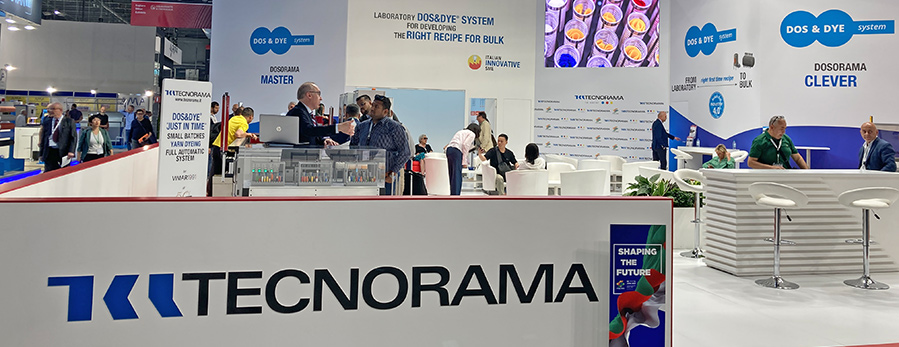
© 2023 Tecnorama
Tecnorama is the leader in dyeing laboratory automation thanks to its patented Dos&Dye® systems that allows to obtain the exact recipe to be replicated in bulk machines that drastically reduce corrections in production and re-dyeing with significant time savings and increased productivity.

For more than 35 years, the company has been developing high-tech products with a strong innovative connotation: it acknowledges and analyses market needs and develops products to meet the highest market expectations. Tecnorama has seen steady growth over the years because its proposed values have always been appreciated by customers who recognize its cutting-edge technology, innovative results, attention to the environment, customer care with tailor-made solutions, and pre- and after-sales support.

The leadership position is also corroborated by being considered as a benchmark by the market so that the machines developed and built in Tecnorama are often emulated by companies that cannot count on the same expertise and are therefore unable to offer equally reliable products of comparable quality. Being competitive for dyehouses means adopting strategies and processes that improve production efficiency, that's the plus of the original Dos&Dye® systems: cutting lab costs, avoiding errors, optimizing reliability and reproducibility to improve production.

The company pursues its goals with continuous and significant investment in R&D and by developing in-house departments capable of responding to demands for product innovation and commercial follow-up. It's been a while since the founders have, with foresight, adopted a strategy to continue growing maintaining market leadership. In this spirit, Mario Scatizzi and Romana Barni have set up a management team capable of continuing to run the company with the same energy they always expressed. 


ITMA 2023 was an opportunity to confirm Alessandro Giugni as CEO and the entire management team formed by the professional figures who have contributed to the company's success for many years. ?The new products that Tecnorama exhibited at the fair also made their mark at this ITMA.?

Perfectly integrated into the Dos&Dye® systems for the laboratory, the high-performance Dosorama MASTER and the Dyrama 4R/1000 for dyeing yarns with a capacity of 1kg were the major innovations physically present in the booth. There was also great resonance for the Dos&Dye® 6000 Just in Time system for dyeing small batches, which has already been chosen by prestigious internationally recognized companies.


More News from TEXDATA International

#ITM 2026

ITM 2026: The new geography of textile production

New production hubs are emerging across North Africa and Central Asia, while Türkiye is accelerating its transformation toward higher-value, technology-driven and more sustainable textile manufacturing.

#Research & Development

“Production is a product”

From technical textiles and AI-driven robotics to the limitations of textile circularity: Professor Dr Thomas Gries looks back on more than two decades of development at ITA Aachen. In the interview, he explains why production technology remains a decisive success factor, discusses international collaborations and innovation ecosystems, and shares his views on the transformation of production landscapes and the challenges facing an increasingly regulated industry.

#Knitting & Hosiery

“We need to move away from the price trap and return to a value-driven mindset.”

With its new Textile Innovation Center, KARL MAYER is sending a strong signal for innovation, collaboration, and the future of textile applications. In this interview, Karl Josef Mayer discusses new opportunities in warp knitting, the processing of staple fibres, recycling, the changing role of machinery manufacturers, and why the textile industry must once again focus more strongly on the value of textiles. by Oliver Schmidt

#Associations

“Innovation, resilience and international experience remain the great strengths of the Swiss textile machinery industry”

Geopolitical uncertainty, growing competitive pressure from China, new free trade agreements and the shift towards a circular economy are currently reshaping the global textile industry. In this interview, Cornelia Buchwalder discusses the current mood within the Swiss textile machinery sector, the industry’s distinctive innovative strength, new market opportunities in India and Asia, and the technological trends that could shape the upcoming trade fair cycle leading up to ITMA 2027.

More News on ITMA 2023

Latest News

#Industry 4.0 / Digitalization

Coats Digital launches AI-powered GSD RealMotion for motion analysis

Coats Digital has launched GSD RealMotion, an AI-powered solution designed to provide apparel manufacturers with greater visibility into factory-floor operations. By analysing shop-floor video and applying Coats Digital’s GSD methodology, the solution turns video recordings into structured, motion-by-motion method studies.

#Textile chemistry

Archroma and Lameirinho partner in pioneering deployment of InOneGO single-step dyeing

Archroma, a global leader in specialty chemicals, and Lameirinho, a leading home textiles manufacturer based in Portugal, are collaborating to bring InOneGO by Archroma, a new single-step dyeing process, into commercial production. Lameirinho’s first InOneGo bedlinens collection is now available worldwide.

#Knitting & Hosiery

KARL MAYER launches extra-wide HKS 3-M EL for increased productivity

KARL MAYER has launched a new extra-wide version of its HKS 3-M EL tricot machine, designed to increase productivity particularly in the manufacture of textiles for sports, activewear and athleisure applications.

#Research & Development

Reducing development times for technical textiles by accelerated thermo-oxidative aging in a high-pressure autoclave

Synthetic polymers used in technical textiles can be effectively protected against degradation caused by heat, oxygen, and water through the use of stabilizer systems. This enables service lives of several decades, extending to more than 50 years. As the use of durable technical textiles continues to grow, so does the demand for reliable methods to predict their service life within economically feasible testing periods. For the first time the German Institutes of Textile and Fiber Research Denkendorf (DITF) developed methods for robust service life prediction for textiles in an IGF research project.

TOP





