[pageLogInLogOut]
ITM 2026  9-13 JUNE 2026 ISTANBUL

#ITM 2026

Recycled fibers: the vital data for quality and profitability

Uster’s new Recycling Opening Index guides spinners to the perfect blend
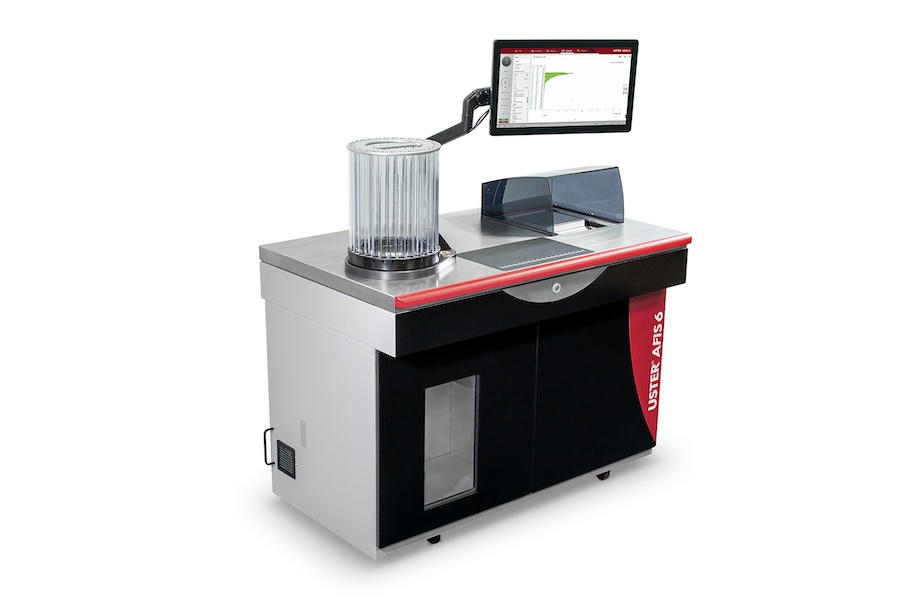
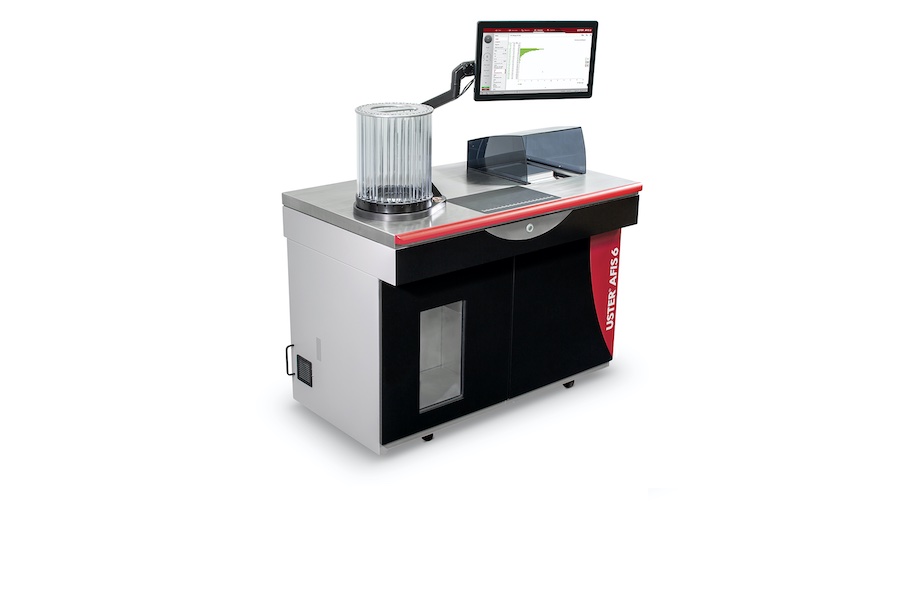
Uster AFIS 6 – The fiber process control system © 2026 USTER
Uster AFIS 6 now offers the key data for better decisions when blending recycled fibers. Process control is decisive in determining the quality and economic outcome. The new R Recycling Module of AFIS 6 introduces the Recycling Opening Index (ROI), so spinners can optimize their circularity credentials. It was officially launched at ITM 2026 in Istanbul, Türkiye.

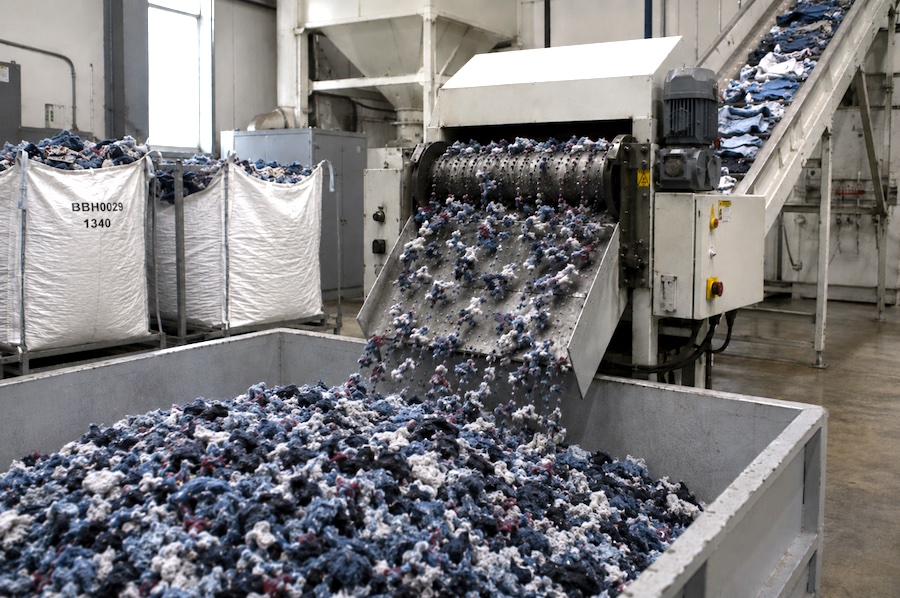
Cotton recycling has become a strategic priority for brands, regulators, and technology providers because it directly addresses the textile sector’s biggest challenges: growing volumes of waste, resource scarcity, climate impact, and regulatory pressure.

Recycled waste and the use of it

Recent industry data shows that most textile waste is post-consumer waste (75% by volume) while post-industrial (pre-consumer) waste makes up around 25%. However, when it comes to recycling – turning this waste into quality new yarn – the situation is different.

Even though it’s a smaller share of total waste, about 95-99% of post-industrial waste is already being reused. Almost every scrap of factory waste is already being collected and spun back into yarn. That’s because it’s clean, consistent, and relatively easy to process.

Spinners generally see it as the safer option to start their recycling activities with post-industrial waste. These raw materials are more predictable in their behaviour, so it’s simpler to refine spinning techniques to suit them. An optimized process can then be developed for blending in pre- and/or post-consumer waste.

Controlling processes with recycled raw materials

Now, objective measurement data from Uster is available to give clear indicators of processability and profitability when using recycled raw materials. This comes with the Recycling Opening Index (ROI), together with the total yarn pieces value. The ROI is a metric in the Uster AFIS 6 R Recycling Module, which describes the effectiveness of the opening process in the recycling of cotton fibers. It is defined as the ratio of opened fibers to remaining yarn pieces (hard ends). ‘Total yarn pieces’ means the sum of yarn fragments present in the raw material that have not yet been fully opened into individual fibers.

If a low ROI value is indicated, this suggests a poor degree of opening, which can disrupt the spinning process and cause issues such as yarn irregularity (IPI), weak spots and uneven surface structures.

So, the ROI is a vital metric for evaluating the quality of recycled cotton materials. For the first time, spinners can have a quantitative assessment of the opening process.
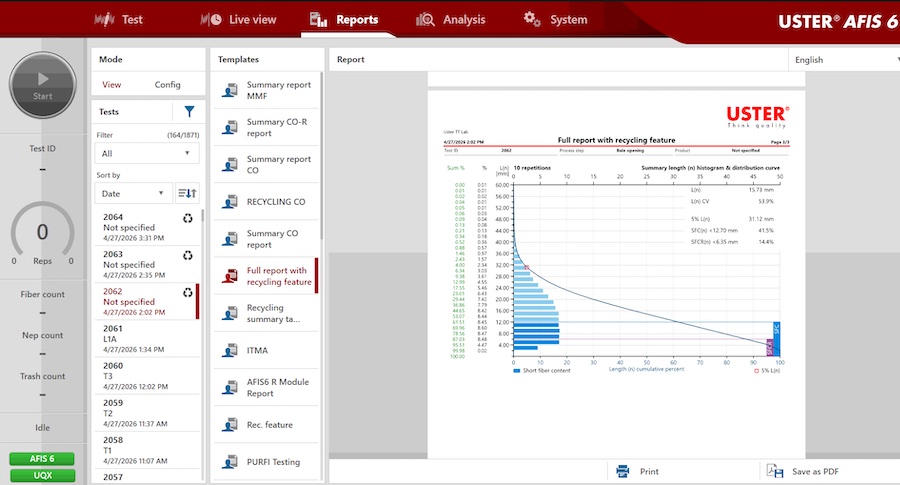
Screenshot of Uster AFIS 6 R Recycling Module measurement showing summary of length (n) histogram and distribution curve.<br />
 © 2026 USTER
Screenshot of Uster AFIS 6 R Recycling Module measurement showing summary of length (n) histogram and distribution curve. © 2026 USTER


R Recycling Module of Uster AFIS 6

Uster AFIS 6 with the R Recycling Module supports better decisions through real measurements. The concept of the Recycling Opening Index (ROI) combined with the number of yarn pieces per gram, provides spinners with a more precise evaluation of recycled material processing. The R Recycling Module also offers advanced recycling parameter measurements, as well as a refined short fiber content analysis with < 6.35 mm indicating the non-spinnable fiber content. In addition, the module enhances fiber quality assessment by incorporating detailed nep and fiber length parameters. The R Recycling Module on AFIS 6 is an optional, on-demand feature designed exclusively for this latest model.

The new module fits perfectly within Uster AFIS 6, with its expanded measurement range for 100% synthetic fibers giving details of cut length and denier/fineness, to help spinners make proper raw material selections. The updated reporting package simplifies complex data analysis, and the integrated Uster Statistics remains the essential tool for spinners to optimize intermediate process steps – finally empowering full control of their processes.
More News from Uster Technologies AG

#Spinning

Measure and control the fiber – optimize yarn quality

Producing consistent yarn quality is an everyday challenge – and a very difficult one. Detailed knowledge and understanding of the fiber raw material is absolutely critical to achieving the best possible quality in the yarn. To help spinners, Uster experts have put together guidelines for avoiding yarn irregularity claims, in a special edition of the Uster News Bulletin.

#ITMA Asia + CITME Singapore 2025

Uster presents novelties at ITMA Asia + CITME 2025

There’s news from Uster Technologies to be announced for the industry’s upcoming event in Singapore. The Uster 360Q universe is growing with new products, solutions and services. Innovation developments can also be recorded in the fields of man-made fiber testing and fabric inspection. Uster innovations address the industry’s trending topics as mill management and process control, optimization of delivered fabric quality and yield.

#Spinning

Uster Technologies marks 150 years of empowering quality excellence

Uster Technologies marks 150 years of excellence – a milestone that reflects continuous adaptation to customer needs and industry change. Over the decades, Uster has evolved from manufacturing quality testing instruments into a trusted partner shaping the future of textile production.

#Recycling / Circular Economy

Challenges of making yarn from recycled fibers

What does it take to spin quality yarn from recycled fibers? Uster Technologies brought textile industry leaders together to discuss the role of technology, data and automation – as well as the current challenges in using recycled raw material. Experts from Rieter, Säntis Textiles, Otto Yarns, and TVU commented on the current situation and looked into the future of spinning in a panel discussion organized at Uster headquarters.

More News on ITM 2026

#ITM 2026

ITM 2028 opens exhibitor registration following successful 2026 edition

Following the successful conclusion of ITM 2026, preparations for the next edition of the International Textile Machinery Exhibition are already underway. The organisers have officially opened exhibitor registration for ITM 2028, which will take place from June 13–17, 2028, at the Tüyap Fair and Congress Center in Istanbul.

#ITM 2026

ITM 2026: Mayer & Cie. Global presents itself successfully at international industry trade fair

Mayer & Cie. Global has used ITM 2026 in Istanbul for its first major international appearance since the restart. Together with the Turkish representative Mayer Mümessillik, the company presented its premium circular knitting machines "Made in Germany", explained its future positioning within the group of companies and held talks with customers and representatives from numerous markets. The response to the restart was positive. The clear orientation of the company, the reliable worldwide network of representatives and the resumption of service and spare parts supply were welcomed by customers.

#Spinning

New spinning package with two-step filtration for recycled yarns and more

At the ITM in Istanbul, BB Engineering unveiled its new, patented ValuePack spinning package for the first time, which features a two-stage filtration system. This is particularly beneficial for re-cycling processes. Until now, spinning packs have used either metal powder (“sand”) or filter candles as filter media. Both options are suitable for differ-ent applications, and each has its own specific advantages and dis-advantages.

#ITM 2026

Positive market signals for KARL MAYER at ITM 2026

KARL MAYER is pleased with its participation as an exhibitor at ITM 2026. Faced with the challenges of rising domestic costs and fierce competition from low-priced Asian markets, the industry leader had traveled to Istanbul with mixed feelings – yet still draws a really positive conclusion.

Latest News

#Research & Development

ALADIN paves the way for circular and demand-driven textile production in Europe

Textile production can be organized sustainably by utilizing short supply chains and preventing overproduction. This can already be achieved today by intelligently connecting and efficiently utilizing existing infrastructure. At the same time, production becomes circular when innovative technologies and materials are used that enable high-quality recycling. The ALADIN research project, launched in May 2026 and co-funded with five million euros under the EU Horizon Europe program, is creating the conditions for this.

#Nonwovens

Katharina Obergruber appointed to the Management Board of Sandler AG

The Supervisory Board of Sandler AG has appointed Katharina Obergruber to the company’s Management Board. Effective September 1, 2026, the Board will consist of Philipp Ebbinghaus (CEO), Dr. Ulrich Hornfeck (currently CCO, future COO), and Katharina Obergruber (CCO). Katharina Obergruber, currently Chief Sales Officer Hygiene and member of the Management Team of Sandler AG, will assume responsibility for all sales activities as Chief Commercial Officer. She will assume this role from Dr. Ulrich Hornfeck, who will focus primarily on production and supply chain topics.

#Recycling / Circular Economy

Ence and ShareTex begin initial testing of the ATENEA innovation project to promote textile recycling in Spain

Ence and ShareTex are making progress on the Atenea R&D project, which aims to develop a complete value chain for textile recycling in Spain. Specifically, the goal of the ATENEA project—which is funded by the Center for Technological Development and Innovation (CDTI)—is to connect all the necessary stages for the recovery of textile waste, from collection and management, through recycling and transformation into new raw materials, to their incorporation into new textile products.

#Recycling / Circular Economy

DePoly Inaugurates its Showcase Plant in Monthey Switzerland

What if used plastic bottles, PET packaging material and polyester textiles could become raw materials just as high performing as virgin resources? That is the ambition of DePoly, a circular materials company based in Sion, Switzerland which inaugurated its Showcase Plant in Monthey on July 6th & 7th. The first depolymerization facility of its kind and scale in Switzerland, this industrial Showcase Plant represents a major milestone in the company's growth and its journey toward commercialization.

TOP