[pageLogInLogOut]

#ITM 2018

Bräcker at ITM 2018 in Istanbul

Bräcker (booth 313A in hall 3) will exhibit the high quality products and present the latest innovations at the ITM 2018 Exhibition. Bräcker’s products enable spinning mills to increase the production output at an efficient price-performance ratio.

With this ambitious goal, new traveller treatment and ring/travellers systems are launched:

  • The surface treatment of the ONYX travellers facilitates a higher efficiency. The improved gliding characteristic allows for an increase of the spindle speed by up to +1000 rpm and prolongs the life of the traveller by up to +50%. On top of that the running-in period is considerably reduced.
  • The large contact surface between SFB traveller and ORBIT ring enables mhigher spindle speeds even with fibers like viscose or with fibers, tending to thermal damage, e.g. polyester. Higher traveller speeds of 10 to 20% are achieved compared to the T-flange ring/C-shaped traveller system. To cover the new demands, the SFB traveller portfolio was substantially expanded in regardsof traveller profiles and weights.
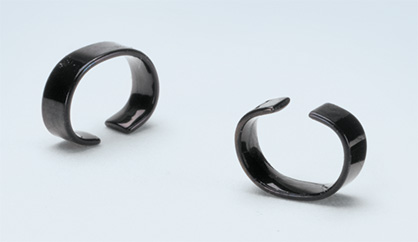
ONYX (c) 2018 Bräcker


ORBIT System (c) 2018 Bräcker


In addition, Bräcker introduces the new BERKOL® multigrinder to the market. The entire range of top rollers and long cots used in a spinning mill can be processed on only one single machine.

A detailed overview about the full product range of Bräcker can be found under http://www.bracker.ch.

More News from Rieter Textile Systems

#Spinning

Rieter prepares leadership transition in Components & Technology

Roger Albrecht, Head of the “Components & Technology” Division, has decided to pursue a new opportunity outside the Rieter Group. Roger has worked for the Group for 11 years and has been instrumental in maintaining Rieter’s position as a technology leader in the short-staple business.

#Recycling / Circular Economy

Rieter and partners launch Recycling Powerhouse for industrial-scale textile recycling

Recycling Powerhouse Ltd. was established in July 2026 to industrialize, standardize and scale textile recycling. Based in Switzerland, the venture will operate a franchise-driven business model that enables the production of high-quality, certified recycled yarns. The project is supported by the following partners: Rieter Group, the world’s leading system supplier for natural and man-made fibers, Säntis Textiles, a Swiss textile engineering company, and Valvan, a Belgian sorting technology company. The first blueprint franchise operation is scheduled to launch early 2027 in partnership with Suhail Industrial Holding Group in Qatar.

#Spinning

Rieter sees Barmag integration on track as orders and sales rise

The first half of 2026 was shaped by the successful completion of the largest acquisition in Rieter’s history. The Man-Made Fiber Division enables entry into the growth segment of man-made fibers and sustainably strengthens Rieter’s market position in the Asia region. The expanded Group is now the world’s leading system supplier for the processing of natural and man-made fibers. In the first half of the year, initial cost savings in material costs and operating expenses have already been realized. The targeted synergies are expected to amount to at least CHF 20 million by the end of the 2028 financial year. Due to the completion of the acquisition on February 2, 2026, the first half of the year for the Man-Made Fiber Division only amounts to five months.

#Spinning

"We will become a recycling powerhouse"

The textile industry is now in its fourth consecutive year of crisis, while automation, artificial intelligence and recycling are reshaping the rules of the game. In this interview, Rieter CEO Thomas Oetterli discusses the first signs of a market recovery, reflects on his first three years at the helm of the company, explains the integration of Barmag, outlines Rieter’s vision of the fully automated spinning mill and highlights the strategic importance of recycling. In doing so, he explains why the new Rieter Group aims to play a leading role in transforming the textile value chain into a circular economy.

More News on ITM 2018

Latest News

#Raw Materials

Brazil sets new cotton export record and consolidates global leadership

Brazil ended the 2025/26 commercial year with a new record, consolidating its position as the world’s largest cotton exporter. Between August 2025 and July 2026, the country shipped 3,373,941 tonnes of the fiber, 19% more than in the previous cycle, and reached record revenue of US$5.3 billion. The result represents a milestone in Brazil’s expansion in the international market and reinforces the country’s role as a strategic supplier to the global textile industry.

#Raw Materials

Better Cotton Initiative partners with Avalo in AI plant breeding for climate-resilient cotton

The Better Cotton Initiative (BCI) has partnered with agriculture solutions company Avalo, whose platform accelerates the speed at which plants with key resiliency traits may be developed.

#Man-Made Fibers

The LYCRA Company expands its co-creation vision through an immersive Lifestyle District at Intertextile Shanghai.

The LYCRA Company, a global leader in fiber and technology solutions for the apparel industry, is reimagining the trade show experience at Intertextile Shanghai Apparel Fabrics Autumn Edition, which opened today in China. Building on the success of last year's ALL IN concept, the company has expanded its co-creation vision into a 356-square-meter Lifestyle District featuring partners Jingzili New Material, JYT Textile, Lianxingfa Knitting, and Trend Textile. The district is part of a larger 895-square-meter pavilion showcasing a total of 19 co-exhibitors. Together, they demonstrate how innovations in fiber, fabric, and garments can be combined to create compelling solutions for both work and play.

#Natural Fibers

Plastic-free stretch technologies drive new direction for denim innovation

As the denim industry looks for ways to reduce its reliance on synthetic fibres, plastic-free stretch technologies are gaining momentum. Developments based on mechanical fabric construction and natural rubber are demonstrating that comfort and stretch can be achieved without conventional elastane, supporting both recyclability and circular product design.

TOP