[pageLogInLogOut]

#INDEX 20

Unique spunbond technology to be showcased at INDEX 2020
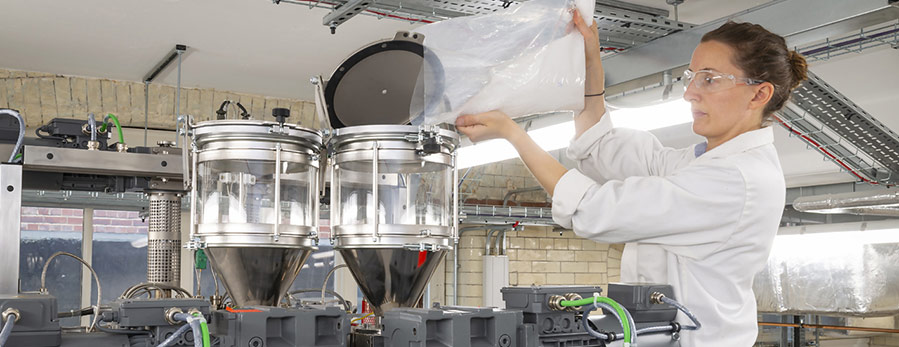
The technology is unique in providing the ability to process a wide range of polymers, including those normally not considered appropriate for the spunbond process. © 2021 FET
The UK’s Fibre Extrusion Technology (FET) will introduce its new lab-scale spunbond system at the forthcoming INDEX 2020 nonwovens exhibition taking place in Geneva, Switzerland, from October 19-22.

Complementing the company’s successful meltblown technology, the new spunbond range provides unprecedented opportunities for the scaled development of new nonwoven fabrics based on a wide range of fibres and polymers, including bicomponents.

The market availability of this new technology is particularly timely, given the industry’s current preoccupation with the development of new substrates based on biopolymers, sustainable resins or recycled fibres.

FET has already supplied one of these new spunbond lines to University of Leeds in the UK, and a second, in combination with a metlblown line, to the University of Erlangen-Nuremberg in Germany.

“Our new spunbond technology is unique in providing the ability to process a wide range of polymers, including those normally not considered appropriate for the spunbond process, at the scale required to fully explore material combinations and bring new products to market,” says FET Managing Director Richard Slack. “FET has built on its melt spinning expertise to develop a true laboratory scale spunbond system.”
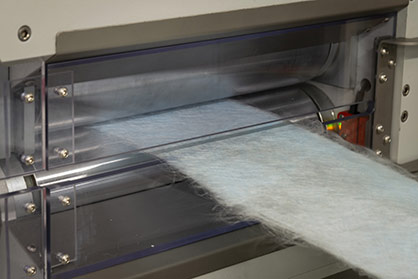
The versatile new spunbond system is perfectly suited to academic research work. © 2021 FET


Properties

Steve Russell, Professor of Textile Materials and Technology at University of Leeds, agrees.
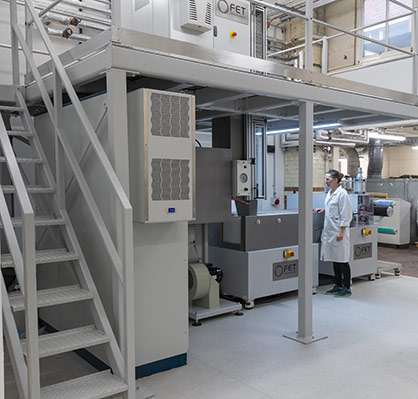
FET’s new spunbond line at University of Leeds. © 2021 FET


“Our new spunbond line from FET forms part of a wider investment in facilities to support fundamental, academic research on future manufacturing, where the focus is on studying the small-scale processing of unconventional polymers and additive mixes to form spunbond fabrics with multifunctional properties,” he says. “Key to this research is developing the underlying process-structure-performance relationships, based on the measured data, to provide a detailed understanding of how final fabric performance can be controlled during processing.”

Many exciting materials developed in academic research struggle to progress beyond the bench as a result of compatibility issues with key manufacturing processes such as spunbond, he adds.

“By leveraging mono, core-sheath and island-in-the-sea bicomponent technology, the Leeds team is working with polymer and biomaterial research scientists, engineers and clinicians to explore the incorporation of unusual materials in spunbond fabrics, potentially widening applications,” Russell says. “The new spunbond system is perfectly suited to our academic research work, and is already proving itself to be extremely versatile and intuitive to use.”

“We look forward to discussing the possibilities of this versatile new system with interested parties at INDEX in Geneva,” Richard Slack concludes. “It is capable of processing pure polymer with no requirement for processing aids or additives, to obtain a wide range of structural and mechanical properties, and there are numerous options for the post-processing of the webs.”

FET is at stand 1163 at the show in Geneva.



More News from TEXDATA International

#Techtextil 2026

Textile Chemicals & Dyes: Innovation in Textile Chemistry moves into focus at Techtextil 2026

From PFAS-free finishes and water-saving dyeing technologies to advanced coatings and recycling-compatible formulations, innovation in textile chemistry is accelerating across the industry. Reflecting this development, Techtextil 2026 introduces Textile Chemicals & Dyes as a dedicated product segment, highlighting the growing role of chemical solutions in shaping the next generation of technical textiles.

#Recycling / Circular Economy

textile.4U publishes special edition “Top 100 Textile Recycling Companies 2025”

With a comprehensive 176-page special edition, textile.4U is dedicating its latest issue entirely to one of the most dynamic and influential topics in today’s textile industry: textile recycling. The new issue, published exclusively in high-quality print, presents the Top 100 textile recycling companies researched and selected by TexData – organizations that already play a key role in the transition to circular textiles or are expected to have a significant impact in the near future.

#Recycling / Circular Economy

Responsible Textile Recovery Act of 2024 signed by Governor

Senator Josh Newman (D-Fullerton) is proud to announce that Senate Bill 707 (SB 707), the Responsible Textile Recovery Act of 2024, has been signed into law by the Governor of California, Gavin Newsom. This groundbreaking legislation establishes the country’s first Extended Producer Responsibility (EPR) textile recycling program, marking a significant step forward in the state’s efforts to combat waste and promote sustainability.

#Textiles & Apparel / Garment

Modtissimo promotes sustainability with 28 coordinates in the Green Circle

Modtissimo is proving more and more to be a textile and clothing show that delivers the latest innovations in the area of sustainability, with the iTechStyle Green Circle being the main showcase for companies' creations. In this 60+4 edition, taking place on 12 and 13 September, 28 coordinates will be exhibited in a section organised by CITEVE and curated by Paulo Gomes.

More News on INDEX 20

Latest News

#Techtextil 2026

DIENES at Techtextil 2026: Flexible pilot lines for bio-based fiber development

The growing relevance of bio-based materials in technical textiles is accompanied by increasing demands for reproducibility, high-quality data, and scalable process routes. Especially when working with cellulose and its derivatives, chitosan, lignin-based approaches, or bio-based PAN as a carbon-fiber precursor, R&D teams face variable feedstock quality, tighter process windows, and the need for reliable comparability across trials. This calls for flexible, data-driven experimental setups that can be reconfigured efficiently when recipes, solvents, and raw-material batches change.

#Texprocess 2026

Gunold showcases embroidery product range and services at Texprocess

At Texprocess 2026, GUNOLD will present numerous hands-on examples related to embroidery in Hall 8, Booth E20. The focus is on creative embroidery designs as well as the extensive product range of threads, nonwovens, and accessories for embroidery and embellishment. “Trade visitors can once again look forward to many new and creative embroidery designs. Of course, we will also showcase the matching products required to bring these ideas to life,” announces Marketing Manager Stephan Gunold.

#Nonwovens

EDANA and more than 70 industry organisations call for consistent exemptions in EU packaging regulation

EDANA, together with more than 70 industry associations and organisations, has issued a joint statement commenting on the European Commission’s Delegated Act under Article 29 of the Packaging and Packaging Waste Regulation (PPWR).

#Raw Materials

A Powerful Opening: Global thought leaders launch the International Cotton Conference Bremen

The International Cotton Conference Bremen will open on 25 March 2026 in the Parliament building of the Free Hanseatic City of Bremen with a keynote session of exceptional calibre. Distinguished international experts will set the stage for the conference by offering incisive perspectives on the most pressing challenges and the defining trends shaping the future of the global cotton trade. Their insights will span a broad spectrum — from geopolitically driven disruptions affecting global supply chains to the opportunities emerging from innovation-led agriculture capable of supporting a growing world population. Together, these opening keynotes will frame the dialogue of the conference, highlighting both the complexity of today’s market environment and the pathways toward a resilient and forward-looking cotton sector.

TOP