[pageLogInLogOut]

#Dyeing, Drying, Finishing

Zero defects for Hugotag with Montex 8500 stenter

The latest Monforts Montex 8500 stenter is providing major benefits for Hugotag – the French luxury brands fabric supplier renowned for its know-how in silk finishing.

Quality is the number one requirement for Hugotag, a specialist French finisher of silk fabrics to many of the world’s most prestigious luxury brands.

Now a member of the Chanel Group, the company in its present form represents the merging five years ago of two former silk businesses – Tag, founded in 1974 in Fourneaux, close to Lyon, and Hugo Soie, a St Etienne-based company with a 200-year history.

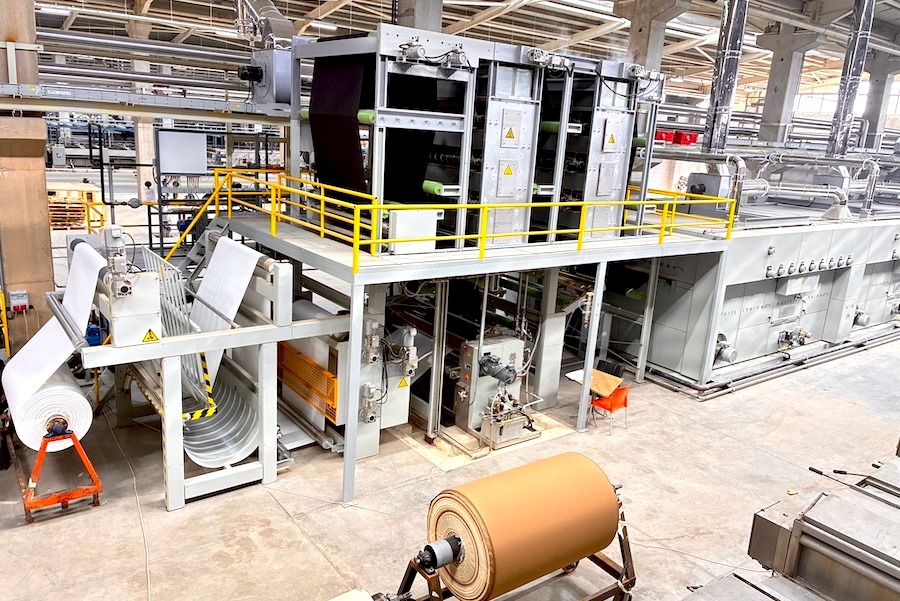
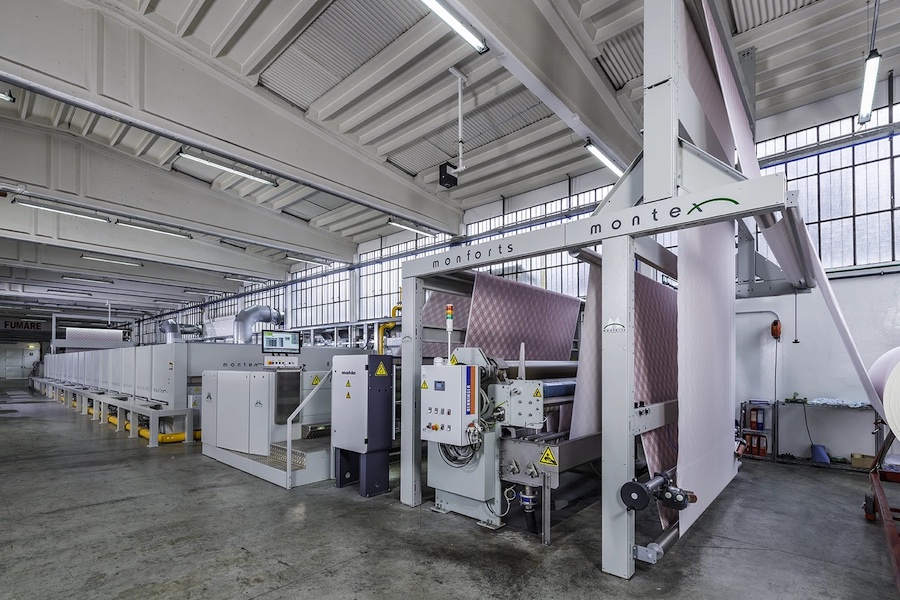
Investment in new equipment has followed the merger and consolidation of the companies at the Fourneaux site, including advanced digital printing machines, as well as the installation of a finishing line centred on the latest Monforts Montex 8500 stenter and a Matex padder.

The five-chamber Montex 8500 machine at the Fourneaux plant is equipped with newly-developed 24-inch visualisation monitors, providing total, intuitive automation and surveillance via the Monforts Qualitex 800 system.

“It’s an excellent machine,” says Hugotag Director General Philippe Magat. “The key parameters for us include homogenous drying over the length and width of the machine and precise control of the tension of the fabric, because the silk has a natural elasticity, even without the addition of elastane. The Monforts stenter allows us to completely control the tension from the fabric entry right through to the winding machines – and we have special units for winding onto small rolls too.”

“The fabrics are very delicate and require a sensitive treatment when being pinned into the stentering chain, as well as very gentle drying – without the fabrics ever touching the nozzles and with absolutely no air turbulence in the dryer.”

“The humidity of the air inside the stenter is crucial for ensuring a perfect quality fabric feel,” adds French representative for Monforts, Christophe Monel, of Monel Industrie Services.

Hugotag is finishing some very fine silk fabrics indeed – sheer muslins that can be as light as 14 gsm, along with chiffons, and heavier satins and twills. The weights of the more delicate fabrics are usually between 20-50 gsm, and produced in average widths of 90 centimetres to a maximum of 1.9 metres on the 3.2-metre wide Monforts finishing range. In haute couture fine fashion, of course, they command very high prices.

As a result of the extremely specialist nature of handling such delicate fabrics, the Monforts line has been equipped with a number of additional features, including special needle chain devices for dealing with knitted silk fabrics, a steamer unit, a computerised weft-straightening device and associated controls, and a horizontal combined chain.

The stentering chain is completely sealed – to avoid any grease or oil coming into contact with the fabrics at any time – and fitted with long-lasting lubricated bearings.

Special attention has also been paid to energy recovery, with low energy consumption IE3 motors and the integration of a full heat recovery system into the line.

Philippe Magat confirms that this is now providing Hugotag with significant energy savings.
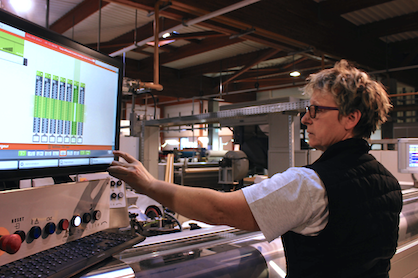

The five-chamber Montex 8500 machine at the Fourneaux plant is equipped with newly-developed 24-inch visualisation monitors, providing total, intuitive automation and surveillance via the Monforts Qualitex 800 system (c) 2018 Monforts


Historic legacy

Like its equally famous counterpart in Italy – Como – Lyon has historically been associated with silk fabric production, and all of Hugotag’s fabrics are still woven locally. Piece-dyeing was introduced in Lyon and became an industrial process in the mid-18th century and for a long time remained a speciality of the region. Screen-printing is meanwhile sometimes known as ‘a la lyonnaise’ because Lyon is acknowledged as the first region to industrialise the process during this same period.

And although there still remain other silk finishers in France, Hugotag is one of only two to carry out the ‘degumming’ of the silk fabrics using ‘Marseilles Soap’ – a chemical-free formulation based on 100% olive oil, developed long before the concept of sustainability was even known.

“It’s a very specific treatment and because the fabric is so very delicate it’s very difficult to do on an industrial machine, but we can now do it successfully,” says Philippe Magat. “More than anything, however, zero defects are our objective, and this is something the new highly-automated and computerised Monforts line is allowing us to achieve.

“We don’t need to run at high speeds, and average 15-20 metres per minute, because the priority is perfection. Our customers are very discerning and even the smallest of defects can result in returns, which we simply can’t afford to allow to damage our reputation.”

The human touch

It is reassuring to know, however, that there are still some things that highly-automated and computer-controlled machines like the Montex 8500 still can’t do – and perhaps never will.

Hugotag still relies on the keen eyes of its specialist quality fabric control inspectors who have many years of experience, rather than digital optical inspection systems that are readily-available on the market.

“At this level of quality, it’s a skill machines are simply unable to replace,” Philippe Magat concludes. “Through many years of experience I am able to spot even the smallest detail that the average eye simply can’t see – and so can the specialist team working here. Our exclusive customers would expect nothing less.”
More News from A. Monforts Textilmaschinen GmbH & Co. KG

#ITM 2026

New Monforts systems deliver round-the-clock production for Kipaş

As a valued Monforts customer for many years, Türkiye’s Kipaş Textile has just installed a new Thermex dyeing range and a Monfortex sanforizer at its new dyeing and finishing plant in Kahramanmaraş.

#ITM 2026

Monforts sees growing potential for technical textiles in Türkiye

For many years now, Türkiye has been one of the most important markets for textile finishing, coating and continuous dyeing equipment, making ITM 2026 from June 9-13 a key event for Germany’s Monforts. At the Istanbul exhibition at stand 1117D in Hall 11, the company will put the emphasis on its machines which continue to lead the field in conventional dyeing and finishing, and also highlight the strong opportunities for Turkish textile manufacturers in the growing field of technical textiles.

#Dyeing, Drying, Finishing

Monforts unveils interactive digital platform for textile finishers

Monforts has launched a new digital platform designed to give textile manufacturers faster, more intuitive access to the company’s finishing technologies, technical expertise and aftersales support worldwide.

#Techtextil 2026

Monforts to showcase advanced coating solutions at Techtextil 2026

Over the past few years Monforts has significantly advanced its technologies for coating, with the successive introductions of the MontexCoat, coaTTex and VertiDry systems combining flexibility, precision and energy efficiency for the technical textiles market.

More News on Dyeing, Drying, Finishing

#ITM 2026

SETEX turns dyeing and finishing data into daily production control

At ITM 2026, SETEX will show how textile mills can use machine, recipe, quality and energy data for more reliable daily production decisions — not as another reporting layer, but as part of the running dyeing and finishing process. With OrgaTEX X3 MES, E390x/C390x controllers, CamCOUNT and FabricInspector Portable, SETEX connects planning, machine execution and fabric-related quality insight within existing mill structures.

#Dyeing, Drying, Finishing

Tradition and Innovation – Phoenox Textiles Ltd. relies on state-of-the-art carpet back-coating line from Brückner

For more than 70 years, Phoenox Textiles Ltd. has been synonymous with quality, reliability, and inno-vation in the textile industry. Founded in 1954 in Huddersfield (Yorkshire, UK), a region with a long tradition in textiles, this family-owned business has continued to evolve without losing sight of its roots. Today, in its fourth generation under the leadership of the Mosley family, Phoenox successfully combines decades of experience with a clear, forward-looking corporate strategy.

#Dyeing, Drying, Finishing

Smart Quality Control for Technical Textiles

In the end, what matters is the result: a filter that performs reliably, a membrane that remains stable in storm conditions, a composite material with precisely defined properties. But the path to achieving this is demanding. In the production of technical textiles, numerous parameters interact – and even the smallest deviations can have major consequences.

#ITM 2026

The address for environmentally friendly dyeing and finishing systems: ITM 2026

Dyeing and finishing technologies, one of the most critical and value-added areas of the textile sector, have gained strong growth momentum on a global scale. Technologies that are pioneers of this transformation focused on sustainability, quality and efficiency will meet with sector professionals at the ITM 2026 International Textile Machinery Exhibition. Dyeing and Finishing Hall (11–12) will host the latest technologies that increase efficiency, optimize resource use and reduce environmental impact in textile finishing processes.

Latest News

#Research & Development

GenuTrace client advisory: Is your cotton supply chain UFLPA ready?

U.S. Customs and Border Protection has released updated operational guidance (CBP Publication No. 5560-0526) expanding its forced labor enforcement framework. The guidance supersedes the original 2022 UFLPA Operational Guidance and now covers all forced labor enforcement authorities — UFLPA, CAATSA, and WROs/Findings — in a single unified document. For cotton importers, the enforcement posture has not softened. It has become more structured, more documented, and more demanding. Learn more about UFLPA.

#Carpets

DOMOTEX Hannover 2028 off to a strong start with expanded portfolio

Preparations for DOMOTEX 2028 are already gaining strong momentum. Following its successful repositioning as the Home of Flooring & Interior Finishing, around 100 international manufacturers have already secured their place during the initial registration phase.

#Knitting & Hosiery

STOLL: Agreement signed for the divestiture of selected assets

In early 2025, KARL MAYER announced its strategic decision to focus on its core business areas of WARP KNITTING, WARP PREPARATION, and TECHNICAL TEXTILES. As part of this move, the flat knitting machine business under the STOLL brand was discontinued and the production site in Reutlingen was closed in October 2025.

#Research & Development

TERNAfil wins first place at PitchMiUp Night 2026 in Minden

The RWTH spin-off TERNAfil has developed MAXCarbon, a new high-performance hybrid fibre that combines the mechanical performance of carbon with the temperature and corrosion resistance of ceramic materials. For this development, TERNAfil was awarded first prize at the PitchMiUp Night in Minden on 21 May 2026.

TOP