[pageLogInLogOut]

#Digital Printing

Epson and designer Yuima Nakazato show a glimpse of a more sustainable future for fashion

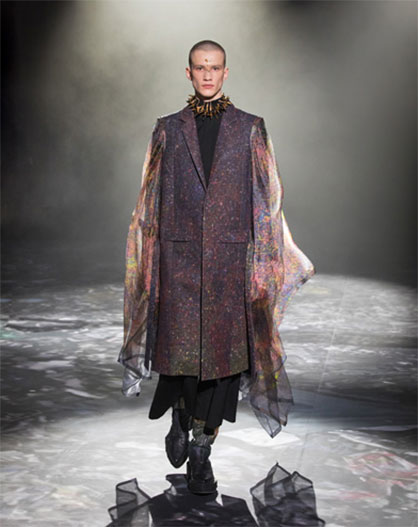
Epson has partnered with renowned Japanese fashion designer Yuima Nakazato and his eponymous YUIMA NAKAZATO brand at Paris Haute Couture Fashion Week Spring - Summer 2023 to unveil creations that are both stunning and sustainable. In addition to utilizing Epson's digital textile printing to reproduce his unique and creative worldview, YUIMA NAKAZATO realized some of its creations with the help of a new, more sustainable and potentially industry-transforming textile production process.

Partnership combines inkjet and dry fiber technologies to create stunning designs from recycled clothing

Epson's dry fiber technology, which is already used commercially to recycle office paper and which requires virtually no water, has been adapted to produce printable non-woven fabric from used garments. The new fabric production process was revealed in Paris as part of a three-year collaboration between Epson and YUIMA NAKAZATO and was used in the creation of items for the first time during the latter's runway show at the Palais de Tokyo on January 25, 2023.

The collaboration between Epson and YUIMA NAKAZATO builds on the success of the company's printing support for his couture and evolves the level of his creations to enable the low-impact production of high-quality custom garments. Both Epson and YUIMA NAKAZATO are keen to raise awareness of the water and material waste associated with excess production. The Paris Show illustrates how switching to digital textile printing using more environmentally friendly pigment inks offers the fashion industry a more sustainable and less wasteful means of textile printing.(1)

© Luca Tombolini x Yuima Nakazato


The fabric taken to create the latest YUIMA NAKAZATO fashion line was derived from material from used garments sourced from Africa, the destination for many discarded garments from elsewhere in the world. Nakazato visited Kenya where he collected around 150 kg of waste garment material destined for the "clothes mountain" of discarded textiles he encountered there. Epson then applied its dry fiber process to produce over 50 metres of new re-fiberised non-woven fabric, some of which was used for printing with pigment inks with Epson's Monna Lisa digital printing technology.(2)

Hitoshi Igarashi from Epson's Printing Solutions Division explains the importance of the technology: "Although in its early stages, Epson believes its dry fiber technology combined with pigment ink digital printing could offer the fashion industry a much more sustainable future, significantly reducing water use while allowing designers the freedom to fully express their creativity.

"Epson's Environmental Vision is committed to contributing to a circular economy, and this development could be one step towards achieving this. Dry fiber technology applied to the fashion industry offers the possibility of producing material for new clothes that have been recycled from used garments."

In a trial of distributed printing for venue decoration, Epson inkjet printers in Japan and France with remote support from Epson engineers were used to create decorations in the venue space. Both Epson and YUIMA NAKAZATO intend to continue exploring the possibilities for contributing to a more sustainable fashion industry.


© Luca Tombolini x Yuima Nakazato


1) Digital textile printing using pigment inks offers a far more sustainable approach to the fabric production process. compared with traditional analog methods. In addition to pigment inks requiring significantly less water, the digital process requires far fewer stages and is less complex. Unlike analog it requires no plate production, washing or storage, results in little disposal of used inks, and allows on-demand production that contributes to less waste.


2) Epson's Monna Lisa digital Direct-to-Fabric printers use less water compared with analog methods. Pigment inks are more eco-friendly and Epson GENESTA pigment inks are GOTS approved by ECOCERT.

More News from Epson Europe

#Digital Printing

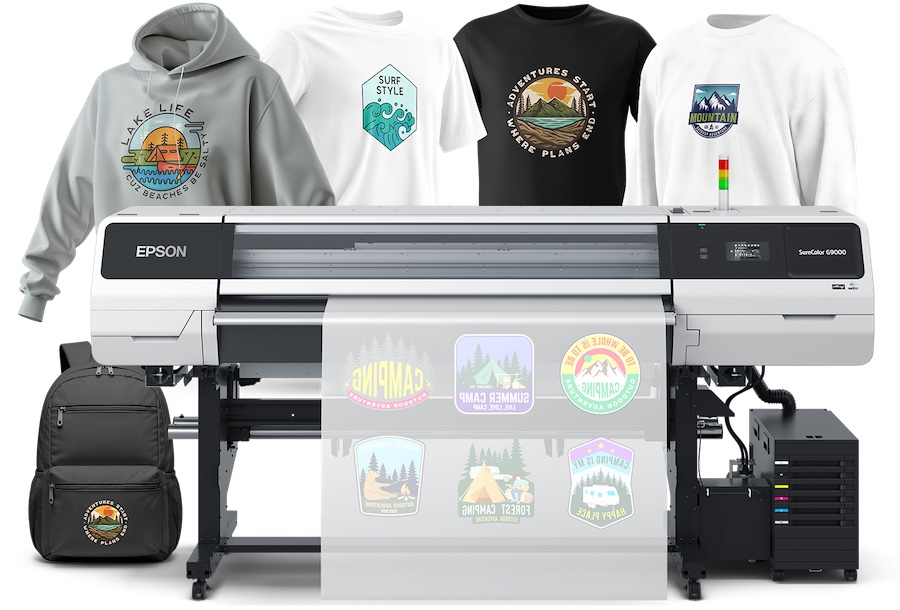
Epson launches SureColor G9000: high-production Direct-To-Film printer delivering greater productivity and reliability

Epson today announces the launch of the SureColor G9000, a new high-production Direct-To-Film (DTFilm) printer designed to meet growing global demand for flexible and efficient textile transfer printing. Expanding Epson’s DTFilm line-up alongside the SC-G6000, the SC-G9000 introduces enhanced speed, reliability and ease of maintenance for commercial garment decorators and textile producers.

#Digital Printing

Epson future proofs textile printing with Epson Textile Academy 2.0

Technology leader Epson today hosted its second Textile Academy Event at the company’s Textile Innovation Centre in Lutterworth, Leicestershire. Building on the success of its inaugural Textile Academy earlier this year, the event welcomed Textile Design BA students from Nottingham Trent University (NTU) and Loughborough University. The event features workshops designed to enhance student’s practical textile printing skills; corporate and entrepreneurial business acumen; marketing and self-branding; and environmental awareness around the textile industry.

#Recycling / Circular Economy

HKRITA and Epson develop silk-like regenerated fiber from cotton

The Hong Kong Research Institute of Textiles and Apparel ("HKRITA") and Seiko Epson Corporation ("Epson"; TSE: 6724) have succeeded in developing new regenerated cellulose fiber with a silk-like sheen from waste cotton fabric through a new production process.

#Digital Printing

Epson unveils Monna Lisa ML-16000JQ for more efficient and sustainable Jacquard fabric printing

Global technology firm Epson announces a new direct-to-fabric digital textile printer designed for jacquard fabrics. The Monna Lisa ML-16000JQ delivers direct-to-fabric double-sided printing on jacquard fabrics, meeting the needs of fashion designers looking to enhance their creativity by seamlessly integrating vibrant colours with intricate woven patterns.

More News on Digital Printing

#Digital Printing

Where every detail counts: Experiential applications of DTF and UV-DTF printing

Personalisation has moved far beyond the traditional logo on a t-shirt. Today, brands want to create complete experiences, where every detail – from clothing and accessories to décor and packaging – feels distinctive and reflective of their identity.

#Dyeing, Drying, Finishing

EFI Reggiani and Danitech Group announce strategic multi-year agreement for Mezzera textile finishing machinery

Electronics For Imaging, Inc. (EFI), through its subsidiary EFI Reggiani (Reggiani Macchine S.p.A.), together with Danitech Engineering and Solutions Srl (Italy) and Suzhou Danitech Intelligent Technology Co. Ltd (China), announces a multi-year license and manufacturing agreement covering the Mezzera and Jaeggli textile finishing machinery portfolio.

#Digital Printing

USColorworks expands digital platform with Kornit Atlas MATRIX and Atlas MAX PLUS solutions

Kornit Digital Ltd. (NASDAQ: KRNT), a global pioneer in sustainable, on-demand digital fashion and textile production, today announced that USColorworks, a North Carolina-based apparel decoration and fulfillment company specializing in custom and on-demand printing for retail and promotional markets, has expanded its Kornit digital production platform with the addition of Atlas MATRIX and Atlas MAX PLUS systems to deliver high-quality, on-demand apparel across cotton, blended fabrics and polyester.

#Digital Printing

DTF vs DTG Printing - The technologies shaping today’s custom merchandise market

From sportswear to branded tote bags, custom merchandise continues to grow in popularity across sectors, driving print shops to cater to short runs, personalisation, and rapid turnaround. As print providers look to this market, two printing technologies often stand out: Direct‑to‑Film (DTF) and Direct‑to‑Garment (DTG). Each offers its own benefits, and understanding these differences helps determine the most suitable production method for print service providers.

Latest News

#Europe

The Digital Product Passport registry is now live

On 20 July, the European Commission launched the Digital Product Passport Registry together with a testing environment, marking an important milestone in making the Digital Product Passport (DPP) a practical reality for businesses placing products on the EU market.

#Europe

EU ban on destroying unsold clothing and footwear now in force

The European Union's ban on the destruction of unsold clothing, clothing accessories and footwear has entered into force. Since July 19, 2026, large companies across the EU have been prohibited from destroying unsold textile products, while medium-sized companies will be required to comply with the same rules from 2030.

#Recycled Fibers

Eastman Naia™ brings its inside-out denim vision to Kingpins New York

Following its debut at Kingpins Amsterdam, Eastman Naia™ brings the next chapter of its denim story to Kingpins New York, taking place July 22–23. At Booth Green 7, Naia™ presents its denim proposition built around three complementary design directions: Performance Denim, Fashion Denim and Authentic Denim.

#Recycling / Circular Economy

Circ launches first denim collection with H&M featuring TENCEL™ | Circ® with REFIBRA™ technology

Circ today announced that the first men's denim collection featuring TENCEL™ | Circ® with REFIBRA™ technology is now available at H&M, marking the commercial delivery of this unique pilot project first announced in October 2025. Featuring two styles available across the UK, Scandinavia, Central Europe, Eastern Europe, South Europe, Turkey, North America, Mexico, Canada, and the Middle East, the launch brings TENCEL™ | Circ® with REFIBRA™ technology into H&M's standard men's denim assortment for the first time.

TOP