#Digital Printing
Mimaki highlights growing demand for hybrid UV printing across European markets
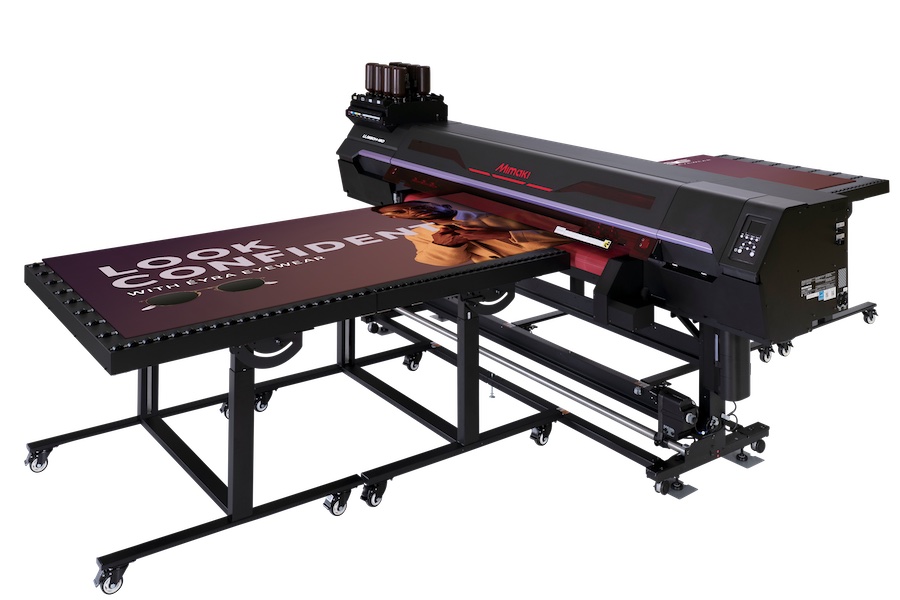
Across Europe, print service providers face a similar challenge: responding quickly to customer needs and unlocking new applications without adding complexity to the production floor. Whether the priority is bringing rigid board printing in-house or expanding the range of roll-fed materials on offer, the driver is usually the same — reducing outsourcing, improving lead times and making every investment work harder.
This is where hybrid UV printing is gaining momentum. By combining roll-to-roll and rigid media capabilities in a single system, hybrid platforms are helping print businesses rethink what's possible from one production device. To explore how this shift is taking shape, Mimaki gathered insights from its partner network in key regional markets a few months on from the launch of its advanced UV hybrid printer, the UJ330H-160.
UK & Ireland: Making rigid printing more accessible
Hybrid Services, Mimaki's distributor for the UK and Ireland, says the strongest driver behind interest in the UJ330H-160 is accessibility. Rigid media printing has traditionally been out of reach for businesses limited by space, installation constraints or the cost of a dedicated flatbed device, and the UJ330H-160 changes that.
"The small footprint has really switched people on to the fact that they can finally accommodate a flatbed printer in their print room, irrespective of size and access constraints. Being able to access through a regular single door quite literally opens the opportunity to deliver new products in-house," says Andrew Edwards, Partner Sales Manager, Sign & Graphics at Hybrid Services.
The impact isn't just logistical as producing rigid applications in-house gives print providers greater control over quality, lead times and cost. The application range is broad too, from thicker magnetic media for promotional signage to more delicate roll-fed materials like leather and window film, aided by a vacuum belt transport system that avoids the marks pinch rollers can leave.
"For the UK and Irish markets, the UJ330H-160 is not simply a hybrid printer. It's a way for more businesses to access flatbed-style opportunities from a compact, versatile and commercially accessible platform," concludes Edwards.
Italy: Versatility as a business enabler
In Italy, the conversation is strongly linked to application flexibility. Bompan, Mimaki's exclusive importer for Italy, reflects a market where print providers need solutions that adapt quickly across applications, materials and job sizes — from small projects to larger productions.
"The market is looking for new applications enabled by highly versatile technological solutions. Print providers aim to be as flexible as possible and to respond to every print requirement, from small to large projects," says Rachele Bompan, CEO at Bompan. By combining roll and rigid capabilities, the UJ330H-160 lets print businesses broaden their service offering without fragmenting production across multiple systems, including handling industrial roll-fed substrates that can be difficult, or impossible, to feed reliably on other machines.
The initial reaction in Italy has been strongly positive, with particular appreciation for the printer's quality, productivity and ease of use. "For Italian print providers, the UJ330H-160 responds to a practical need: to become more versatile, more responsive and better equipped to turn new application ideas into profitable production," concludes Bompan.
DACH: Efficiency, flexibility and production optimisation
In the DACH region, interest in hybrid printing is closely tied to efficiency and investment optimisation, according to Mimaki Deutschland GmbH.
"Customers are increasingly looking for more efficient production solutions that can handle a wider range of applications within a single system. Hybrid printing solutions like the UJ330H-160 allow print service providers to maximise productivity, optimise floor space and expand their service offering without the need for multiple dedicated devices," comments Mimaki's DACH Managing Director, Hisashi Takeuchi.
Roll-to-roll printing remains particularly important here, so the ability to keep serving that demand while adding rigid capabilities on the same platform is key. Businesses can bring more production in-house, reduce reliance on outsourcing, and manage more jobs with their existing fleet, supported by a belt feeding system that broadens the range of compatible media, including difficult-to-handle materials and borderless printing.
"For DACH print providers, the UJ330H-160 represents a smarter way to combine productivity, flexibility and investment efficiency in one hybrid platform."
Nordics: Hybrid printing for smaller signmakers
Color Systems, one of Mimaki's dealers in the Nordic region, points to a clear shift in customer preferences over the past decade.
"If we go back around 10 years, 9 out of 10 customers wanted a 'true flatbed', but over the past couple of years more and more customers have been asking for 'hybrid'," says Magnus Edfeldt, co-founder of Color Systems. More affordable printers have also opened the market to new customers, often smaller signmakers, for whom a hybrid system is particularly useful.
The appeal, Color Systems says, is that a single printer can handle a wide range of jobs, an advantage that suits smaller companies especially well, where investing in multiple dedicated machines isn't always realistic. Smaller, faster runs can be handled in-house, ready immediately with no extra post-treatment, and customer feedback has singled out the quality and durability of the ink.
Different markets, one direction
Although each region brings its own perspective, the core priorities are remarkably consistent: making rigid printing more accessible in the UK and Ireland, application versatility in Italy, production efficiency in DACH, and bringing hybrid within reach of smaller signmakers in the Nordics.
Together, these insights show hybrid UV printing evolving from a specialist option into a practical response to the changing needs of sign and graphics businesses, helping them reduce outsourcing, improve response times, explore new materials and keep greater control over production. By combining roll-to-roll and rigid media capabilities, high-quality output and reliable media handling in one platform, the UJ330H-160 gives print businesses the flexibility to adapt to different applications, markets and customer expectations. Across Europe, that flexibility is becoming one of the most valuable tools a print business can have.