[pageLogInLogOut]

#Composites

Grand Largue Composites and Sicomin enable first flax-fibre-built Class40
© 2022 Grand Largue Composites / Sicomin
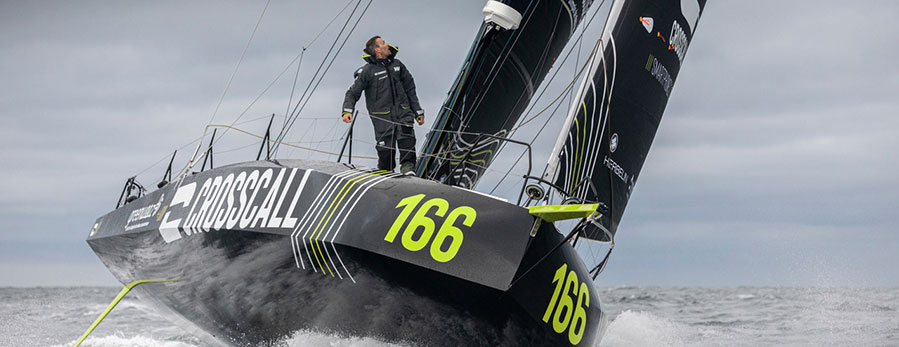
Fibres, fabrics, epoxy resins and adhesives from Sicomin have been used by Grand Largue Composites (GLC) to construct the first Class40 racing yacht to feature a significant quantity of flax-fibre reinforcements.

The yacht, called Crosscall, won the Class40 World Championships in June 2022 and is a prototype of the new Lift V2 design by Marc Lombard, one of the leading naval architects in this field.

Class40 is one of the most competitive fleets in yacht racing. The hulls of Class40 yachts must be light in weight, strong and stiff, and durable in the most extreme of conditions. Furthermore, to keep costs down, they cannot be reinforced with carbon fibres. The quality and reliability of the resins used for the infusion and lamination of the hulls are therefore of paramount importance.
© 2022 Grand Largue Composites / Sicomin


Owner of Crosscall, Aurelien Ducroz, was keen to use as much flax as possible in the construction of the yacht, but Lombard – who had to certify and warranty the structure of the boat in ocean racing use – was more cautious. A compromise therefore had to be reached.

Crosscall's cockpit was designed to be effectively non-structural, with the mainsheet, which can generate huge shock loads, supported separately. This would allow the cockpit to be made from a hybrid biaxial fabric comprising 50% flax fibres. Other parts of the boat that incorporate flax fibre include the tunnel, the engine cover, the ballast tanks and the cap. The rest of the boat is reinforced with 100% glass-fibre fabrics.

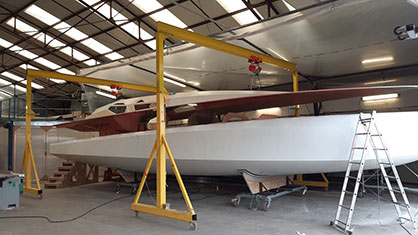
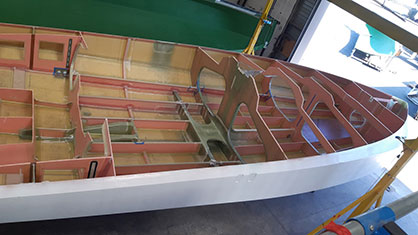
To help it realise this ambitious design, GLC, a highly skilled infusion specialist, turned to its long-time material supplier, Sicomin. The hull was moulded and infused in one piece and the deck – including the hybrid flax-fibre cockpit – was also infused as a single part. The internal structure was then laminated into the hull by hand before the hull and deck were finally bonded together.


The infusion resin selected was Sicomin’s SR 1710, a high-modulus structural epoxy. Designed specifically for use in infusion and injection processes, it has exceptionally low viscosity and its low-reactivity hardener makes it suitable for the production of large parts. Composites components made from SR 1710 possess high interlaminar shear-strength and the resin retains its mechanical properties in wet environments. 
© 2022 Grand Largue Composites / Sicomin


Sicomin’s low-toxicity SR 8200 was used to laminate the internal structures onto the skin of the hull. Ideal for hand laminating, this system includes a choice of hardeners with a wide range of reactivities, which makes it equally suitable for making large or small parts. The hull and deck were joined together with Sicomin’s Isobond SR 7100, which demonstrates extremely high fatigue strength and is very resistant to microcracking.

An epoxy bonding primer – called Undercoat EP 215 HB+ and supplied by Sicomin’s sister company, Map Yachting – was applied to the moulds first to make demoulding easier. It also serves as an undercoat in the polyurethane exterior paint system that is used instead of gelcoat to protect the epoxy hull from UV damage.

Since the launch of Crosscall, GLC has started building a second Lift V2 Class40 and a third one is now planned, both for which Sicomin will supply the materials. Managing Director, GLC, Xavier Gosselin, concludes: "We have been using Sicomin’s products since the beginning, we have never had a problem and I would not want to risk trying a different supplier."
More News from TEXDATA International

#ITM 2026

ITM 2026: The new geography of textile production

New production hubs are emerging across North Africa and Central Asia, while Türkiye is accelerating its transformation toward higher-value, technology-driven and more sustainable textile manufacturing.

#Research & Development

“Production is a product”

From technical textiles and AI-driven robotics to the limitations of textile circularity: Professor Dr Thomas Gries looks back on more than two decades of development at ITA Aachen. In the interview, he explains why production technology remains a decisive success factor, discusses international collaborations and innovation ecosystems, and shares his views on the transformation of production landscapes and the challenges facing an increasingly regulated industry.

#Knitting & Hosiery

“We need to move away from the price trap and return to a value-driven mindset.”

With its new Textile Innovation Center, KARL MAYER is sending a strong signal for innovation, collaboration, and the future of textile applications. In this interview, Karl Josef Mayer discusses new opportunities in warp knitting, the processing of staple fibres, recycling, the changing role of machinery manufacturers, and why the textile industry must once again focus more strongly on the value of textiles. by Oliver Schmidt

#Associations

“Innovation, resilience and international experience remain the great strengths of the Swiss textile machinery industry”

Geopolitical uncertainty, growing competitive pressure from China, new free trade agreements and the shift towards a circular economy are currently reshaping the global textile industry. In this interview, Cornelia Buchwalder discusses the current mood within the Swiss textile machinery sector, the industry’s distinctive innovative strength, new market opportunities in India and Asia, and the technological trends that could shape the upcoming trade fair cycle leading up to ITMA 2027.

More News on Composites

#Composites

MEL Composites supports ELA Aviation with advanced composite materials

MEL Composites is supplying advanced composite materials and process consumables to ELA Aviation for the production of its next-generation gyroplanes. The collaboration underlines MEL Composites’ growing role in advanced aerospace mobility, providing lightweight materials designed to improve aircraft performance, manufacturing efficiency and structural reliability.

#Man-Made Fibers

DYNEEMA® and NP Aerospace advance personal protection for military servicewomen

Dyneema®, owned by Avient Corporation, an innovator of materials solutions, is supplying its high-performance unidirectional (UD) materials to world-leading armor manufacturer NP Aerospace, enabling the production of armor systems designed specifically to fit the female body. With 2,000 new armor systems, including 4,000 plates, made in the United Kingdom (UK) and delivered in June 2026, this collaboration addresses a long-standing lack of high-quality personal protection specially built for female defense and security personnel.

#Composites

JEC World 2026 confirms its standing as the unmissable event for composites and their applications

JEC World 2026 confirms its position as the leading global event for the composite materials industry and its applications across multiple sectors, bringing together the entire composites ecosystem in Paris for three days of business, innovation, and collaboration. True to its Pushing the Limits motto, the 2026 edition delivered outstanding results despite travel disruptions worldwide. The numbers speak for themselves: more than 1,400 exhibitors from over 50 countries, including over 150 first-timers, presented a global panorama of products, equipment, and services across the entire composites value chain.

#Composites

KARL MAYER strengthens partnerships in the composites industry at JEC World 2026

KARL MAYER further strengthened its role as a reliable and competent partner to the composites industry at JEC World 2026. The global market leader in textile machinery manufacturing used the trade show to meet key customers, establish numerous new contacts, and engage in in-depth technical discussions.

Latest News

#Natural Fibers

Cashmere specialist joins AbTF Board of Trustees

The Aid by Trade Foundation (AbTF) is pleased to welcome Brian Yu, the chief executive officer of the Artwell Group, to its board of trustees. As CEO, Brian Yu developed Artwell into the world’s largest supplier of responsibly produced cashmere knitwear.

#Recycling / Circular Economy

HKRITA signs MoU with Jeanologia and Looptworks to establish the Green Machine Circular Textile Ecosystem

The Hong Kong Research Institute of Textiles and Apparel (HKRITA) yesterday officially signed a landmark Memorandum of Understanding (MoU) with two key global partners, Jeanologia and Looptworks, to establish the Green Machine Circular Textile Ecosystem – a first-of-its-kind collaboration to accelerate the large-scale recycling of blended textiles.

#Spinning

Object Carpet tests production of rPET BCF yarn on Neumag BCF line

In a joint project with Object Carpet GmbH, Denkendorf; the Institute for Textile Technology (ITA), Augsburg; and Next Generation Recyclingmaschinen GmbH (NGR), Feldkirchen, Austria, Barmag investigated the processing of recycled polyester for BCF yarn. The goal was to evaluate the fundamental suitability of 100% recycled carpet material for reuse in carpet yarn production to create a closed-loop system in carpet manufacturing. To date, commercial rPET BCF processes have been based solely on rPET from bottle pellets.

#ITM 2026

ITM 2026: Mayer & Cie. Global presents itself successfully at international industry trade fair

Mayer & Cie. Global has used ITM 2026 in Istanbul for its first major international appearance since the restart. Together with the Turkish representative Mayer Mümessillik, the company presented its premium circular knitting machines "Made in Germany", explained its future positioning within the group of companies and held talks with customers and representatives from numerous markets. The response to the restart was positive. The clear orientation of the company, the reliable worldwide network of representatives and the resumption of service and spare parts supply were welcomed by customers.

TOP