[pageLogInLogOut]

#Composites

COMPOSITES EUROPE generates momentum in a difficult market environment

Light and darkness are close together in the composites industry right now. This overall economic climate left its marks on COMPOSITES EUROPE, too – positively and negatively. The leading trade fair in the DACH region (the German-speaking countries) for fibre-reinforced plastics – sold mainly to customers in the automotive, aerospace, and plant and mechanical engineering industries – suffered from lower demand from both exhibitors and visitors this year.

In total, organiser Reed Exhibitions registered 310 exhibitors (prior year: 354) and 7,581 visitors (prior year: 8,148) from 64 countries, a decrease of seven per cent.

Two industries – both key buyers of glass-fibre reinforced plastics (GFRP) – created most of the trade fair’s challenges: the automotive industry, which suffers massively from declining sales and fears trade barriers, and the plant and mechanical engineering sector, where the current economy has similarly depressed the numbers and the mood. Positive signals, meanwhile, are coming from aerospace and increasing demand in the booming construction sector.

“Trade fairs are seismographs of their industries – this is true as well for COMPOSITES EUROPE, which in an economically heterogeneous environment showed its importance for bringing new ideas and innovations to market”, says Michael Freter, managing director of Reed Exhibitions Deutschland GmbH..

European GFRP market stagnates

The same conclusion is reflected in the market report presented in Stuttgart by AVK – Federation of Reinforced Plastics e.V. After years of growth, it found, the market for glass-fibre reinforced plastics in Europe has stagnated in 2019. Total production volume in 2019 is on track to remain flat compared to the prior year, at 1.141 million metric tonnes.

Construction/infrastructure and the transport sector still are the two main application areas for GFRP. The current sales crisis in the automotive sector, which responds more quickly than the construction industry, shows up directly in the market developments expected by the GFRP industry. “Due to market shifts, the future market prospects of the construction/infrastructure sector must be seen for the first time as greater than those of the transport sector”, says Dr. Elmar Witten, managing director of AVK.

„Process live“ shows progress in the process chain

A special focus of this year’s COMPOSITES EUROPE was on the digital process chain. Joining forces in group exhibits in the “Process live” area, mechanical and plant engineering companies showed how their technologies interact – and they did so while operations were ongoing in order to demonstrate the individual processes in a larger context. Three exhibitors had participated in the debut of the area last year – this year there already were 16 companies.
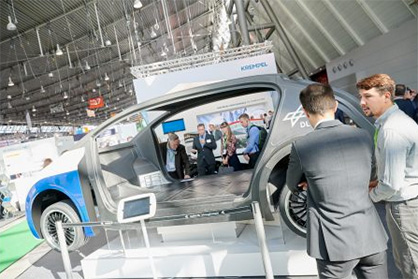

(c) 2019 COMPOSITES EUROPE


LTF – The interface between metal and fibre-reinforced composite technologies

One of the overarching emerging themes that’s captured the attention of the entire composites industry and virtually all user industries is multi-material solutions. Once again this year, the Lightweight Technologies Forum at COMPOSITES EUROPE showed how lightweight multi-material engineering can be implemented in an economic and resource-efficient way – in the automotive industry, aerospace and mechanical engineering. “In the lightweight construction landscape, COMPOSITES EUROPE and the Lightweight Technologies Forum serve as an important interface for metal and fibre-reinforced composite technologies”, says German Economics Minister Peter Altmaier, underscoring the significance of the forum.

5th International Composites Conference (ICC)

Organized by AVK on behalf of Composites Germany, the International Composites Conference (ICC) took place concurrently with COMPOSITES EUROPE for the first time. The trade fair and the conference converged thematically, too. One example were the themed guided tours of the exhibition area that complemented the conference presentations. “Bringing together the conference programme and the trade fair is an important step in our quest to align the event even more strongly with the current challenges faced by processors and the user industries of fibre-reinforced plastics”, says Dr. Elmar Witten.

Up next, the 15th COMPOSITES EUROPE will take place in Stuttgart from 10 to 12 November 2020. To celebrate this little anniversary, Reed Exhibitors are already exploring innovative ways of working with partners and exhibitors to stage the trends of the future and generate business.
More News from COMPOSITES EUROPE

More News on Composites

#Associations

Driving innovation in technical textiles, digitalisation and testing

Members of the British Textile Machinery Association (BTMA) can look back on 2025 as a year marked by notable technological advances and continued progress in global trade, despite an uncertain and volatile market.

#Composites

MEL Composites delivers advanced hull infusion for Técnico Solar Boat’s hydrogen-powered São Gabriel 01

MEL Composites has reinforced its partnership with Técnico Solar Boat through the successful hull infusion of the São Gabriel 01, an 8m long, 2.4m wide, hydrogen-powered hydrofoiling vessel. Designed to compete at the Monaco Energy Boat Challenge in July 2026, the São Gabriel 01 is the team’s most technically demanding project to date and showcases the future of sustainable marine engineering by combining advanced composite manufacturing with clean energy systems.

#Composites

Sicomin appoints CS Kompozyty as exclusive Distributor for Poland

Sicomin is pleased to announce the appointment of CS Kompozyty as its exclusive distributor for Poland. The partnership will provide Polish composite manufacturers with comprehensive access to Sicomin's broad range of performance epoxy resins, green epoxies, hardeners, and adhesive solutions, supported by local technical expertise and rapid delivery capabilities.

#Composites

JEC World 2026 reveals the list of finalists for the Innovation Awards

Each year, the JEC Composites Innovation Awards recognize collaborative, innovative, and ambitious projects that illustrate the potential of composite materials. Created in 1998, this benchmark program aims to identify, promote, and reward the most innovative composite solutions worldwide. In 28 years, the JEC Composites Innovation Awards have attracted more than 2,200 participating companies from around the world. A total of 269 companies and 811 associated partners have been recognized for the excellence of their innovations.

Latest News

#Dyeing, Drying, Finishing

Orthopac RVMC-20 plus: German Engineering for Smarter Weft Straightening

In times of rising cost pressure and growing quality demands, textile producers worldwide are searching for solutions that combine precision, efficiency, and sustainability. With its latest innovation, the Orthopac RVMC-20 plus, Mahlo once again demonstrates the strength of German engineering: improving proven technology to meet today’s challenges.

#Knitting & Hosiery

KARL MAYER and Lenzing partner to advance warp knitting with scalable cellulose fiber solutions

The Lenzing Group, a leading supplier of regenerated cellulosic fibers for the textile and nonwovens industries, together with KARL MAYER, the global market leader in warp knitting machines and warp preparation systems, debut a joint innovation project during Premiere Vision, Paris.

#Textile chemistry

RUDOLF gets the exclusive global distribution rights for Sanitized® textile technologies

With effect from today, RUDOLF officially assumes exclusive global distribution rights for Sanitized® textile technologies from SANITIZED AG. This is the next milestone in the strategic collaboration announced in 2025, with the partnership between the two companies now fully implemented and expanded worldwide.

#Europe

ICAC to support European Commission on pending PEF legislation

The International Cotton Advisory Committee (ICAC) is proud to announce that it has been included as a member of the European Commission’s Technical Advisory Board (TAB) on the Product Environmental Footprint methodology. The Commission developed the Product Environmental Footprint (PEF) to assess and communicate the life cycle environmental performance of products and organizations.

TOP



