[pageLogInLogOut]

#Carpets

A close eye on quality with the Eye Compact II

Eltex of Sweden AB, a member of TMAS, the Swedish textile machinery association, reports solid success with its Eye Compact II yarn monitoring system for carpet tufting machines, since its launch at ITMA 2019 in Barcelona last June.

“We have a very healthy order book for this new monitoring system because it meets a real need for the carpet tufting industry,” says Brian Hicks, Eltex CEO. “We have already installed a number in the USA and are currently fulfilling orders for companies in Australia, Canada, Thailand and the UK.”

The sensor units of the Eye Compact II, he explains, have been successfully miniaturised to approximately a third of the size of those with the established Compact system, allowing them to be mounted on the very latest high speed tufting machines that are graphics driven, with limited space at the puller rollers.
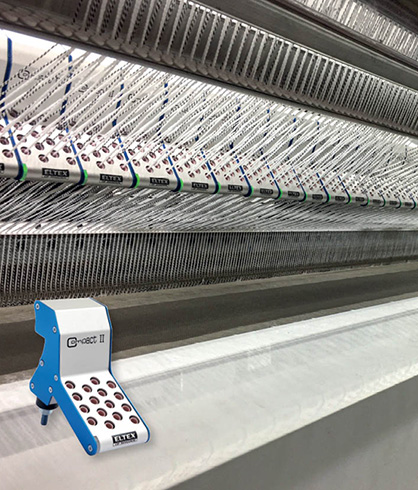
The Eltex Eye Compact II yarn monitoring system for carpet tufting. (c) 2020 TMAS


Early stage prevention

Unlike the sensor systems that are employed at later positions on tufting machines – in order to detect faults in the formed fabric – Eye Compact II technology is about prevention at an earlier stage, through the detection of missing yarns.

“There are a number of reasons why yarns can go missing, the most obvious being a bobbin simply running empty,” says Eltex Sales and Marketer Peter Wiberg. “They can also be broken as they’re fed through the creels or pulled out of position, so they are not successfully picked up by the needles.”

Critically, the sensors need to be installed after the last puller roller and before the tufting needles, because otherwise the roller could still be feeding yarns that will not been successfully taken by the needles. This is only possible with the extremely slim Eye Compact II units, which can also be positioned either above or below the rollers.


Guarantee

“Missing yarns can often go undetected by the operator, with anywhere up to eighteen hundred being fed at high speed into the tufting machine at one time,” says Wiberg. “Our system provides a 100 per cent guarantee that all of the yarns that should be in the tufted construction are being correctly fed into the primary backing. This both mitigates against expensive repairs at a later stage and also allows single operators to control multiple machines simultaneously.”

Another benefit is that the sensors can be arranged more closely together, with each of them monitoring 16 yarn positions, and their robustness ensures that once fitted, there is little the technicians or operators need to do.

Automatic

The Eye Compact II system easily learns pattern changes and displays the number of yarns involved to the operator for confirmation, and different parameters for different yarns groups can also even be set if required.

“This new sensor technology operates at a critical stage in high-end carpet production, where everything comes together in the entire manufacturing process,” Brian Hicks concludes. “The yarns and the carpet backing have already been produced and both are wasted if a fault is only identified later during the tufting stage, when it is also necessary to stop the machine. By eliminating both production waste and machine downtime, manufacturers can significantly boost both their profitability and sustainable footprint.

“All of these benefits along with the ability of a single operator to control multiple machines, mean that the new Eye Compact II provides a very quick return on investment.”

With its research and development work primarily carried out at its headquarters in Osby, Sweden, and North American sales and service operated from its subsidiary in South Carolina, the manufacturing plant of Eltex has been located at Templemore in Ireland since 1976, providing significant advantages in terms of high flexibility and logistical services to customers on both sides of the Atlantic.

“The Eltex Eye Compact II perfectly illustrates how Sweden’s long tradition and history of textile production are being combined with a good climate for innovation,” says TMAS Secretary General Therese Premler-Andersson. “The solid contribution to overall sustainable textile manufacturing that are being made by such incremental technology improvements around the world are often not fully recognised, but they are certainly appreciated by satisfied customers.”


More News from Eltex of Sweden AB

More News on Carpets

#Spinning

Object Carpet tests production of rPET BCF yarn on Neumag BCF line

In a joint project with Object Carpet GmbH, Denkendorf; the Institute for Textile Technology (ITA), Augsburg; and Next Generation Recyclingmaschinen GmbH (NGR), Feldkirchen, Austria, Barmag investigated the processing of recycled polyester for BCF yarn. The goal was to evaluate the fundamental suitability of 100% recycled carpet material for reuse in carpet yarn production to create a closed-loop system in carpet manufacturing. To date, commercial rPET BCF processes have been based solely on rPET from bottle pellets.

#Carpets

DOMOTEX Hannover 2028 off to a strong start with expanded portfolio

Preparations for DOMOTEX 2028 are already gaining strong momentum. Following its successful repositioning as the Home of Flooring & Interior Finishing, around 100 international manufacturers have already secured their place during the initial registration phase.

#ITM 2026

Vandewiele Group presents integrated textile innovations at ITM 2026

At ITM 2026 in Istanbul, the Vandewiele Group will showcase a broad portfolio of weaving, carpet and textile machinery technologies under the theme “Textile Innovations Together”. From 9 to 13 June 2026, the Group will present solutions from its brands Vandewiele, Savio, IRO and BMSvision in Hall 7 / Booth 710A.

#Dyeing, Drying, Finishing

Tradition and Innovation – Phoenox Textiles Ltd. relies on state-of-the-art carpet back-coating line from Brückner

For more than 70 years, Phoenox Textiles Ltd. has been synonymous with quality, reliability, and inno-vation in the textile industry. Founded in 1954 in Huddersfield (Yorkshire, UK), a region with a long tradition in textiles, this family-owned business has continued to evolve without losing sight of its roots. Today, in its fourth generation under the leadership of the Mosley family, Phoenox successfully combines decades of experience with a clear, forward-looking corporate strategy.

Latest News

#Recycling / Circular Economy

Reju opens its first R&D Center in the U.S. in Conshohocken, Pennsylvania

Reju, the company specializing in textile regeneration, today announced the opening of a Research and Development (R&D) Center in Conshohocken, Pennsylvania, the company's first proprietary research center in North America. Located within Technip Energies' existing Advanced Materials and Catalysts research center, the lab will allow Reju to accelerate the rollout of its recycling technologies and develop its next-generation circular solutions.

#Weaving

Itema reaffirms its commitment to the Syrian textile industry at NasTex 2026

From July 18th to 21st, Itema will exhibit at NasTex at the Damascus Fairground (Hall 11 – Stand C02), marking its return to one of the Middle East’s historically significant textile markets. Itema will showcase advanced weaving technology designed to support the competitiveness and technological evolution of Syrian manufacturers and announces a new partnership with Growfast Agency as the sole agent of Itema in Syria.

#Knitting & Hosiery

KARL MAYER's HKS 2-SE Expands Possibilities for Premium Stretch WARP KNITS

Warp knitted fabrics with a woven look are more in demand than ever in the fashion and apparel industries. Stretch WARP KNITS, in particular, impress with their freedom of movement, breathability, and virtually wrinkle-free wear – thereby opening up new style worlds such as smart casual or business casual. When it comes to the highly efficient production of premium-quality stretch WARP KNITS, the HKS 2-SE has long been the machine of choice. KARL MAYER’s best-selling tricot machine produces standard elastic fabrics characterized by high gauges, smooth, delicate surfaces, and a soft hand feel.

#Textiles & Apparel / Garment

Catalyst Club launches in Florence: Where conversations become catalysts for change

The first chapter of Catalyst Club debuted in Florence, bringing together creative directors, entrepreneurs, manufacturers, journalists and innovators from across the fashion and textile industry for an evening of dialogue, exchange and connection.

TOP