[pageLogInLogOut]

#Weaving

Celebrating 60 years at Eltex of Sweden AB
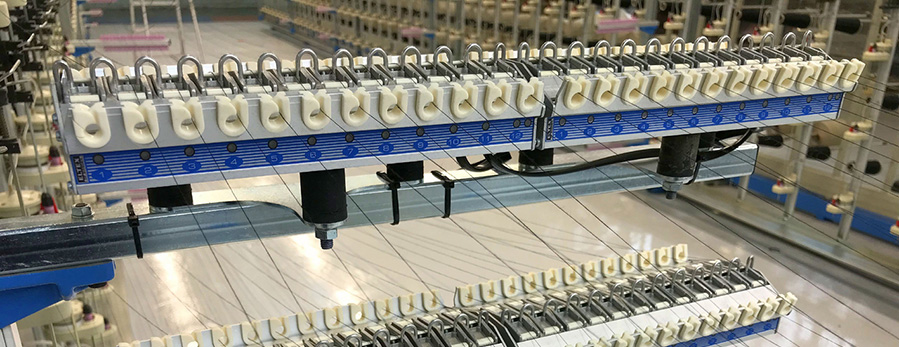
(c) 2024 Eltex of Sweden - The Eltex EyETM not only eliminates problems when warping, but also in the subsequent weaving or tufting processes.
As a pioneer in the adoption of electronic sensors by the weaving machinery industry, Eltex of Sweden is marking its 60th anniversary this month.

That the company’s timeline aligns with the acceleration of weaving machine production speeds from around 150-200 picks per minute back in the 1960s to up to 1,200 picks per minute today is no coincidence – Eltex sensor technology has made a significant contribution to enabling today’s fault-free, high-speed production.

Modest beginnings

The electronic detection of broken or missing weft yarns during production was the problem Eltex founders Åke Rydborn and Ragnar Henriksson set out to solve with the development of the world’s first electronic weft-stop-motion.

Its potential was instantly recognised on its introduction at the 1963 ITMA exhibition in Hannover, Germany, leading to the foundation of the company in a modest 12-square-metre workshop in Älmhult, Sweden, in February 1964.

By 1968 the company was operating from a modern 3,000-square-metre plant and beginning to establish a global presence, introducing the first all-in-one printed circuit board (PCB) for its sensor systems in 1971.

“There were no electronics experts in the mills back then and only a few working for the machine builders themselves,” remembers Alf-Gunnar Sibbeson, who has worked for Eltex for many years from 1971 onwards. “As a consequence our servicing was very much in demand, because if problems occurred, nobody else was able to solve them.”

Expansion

As exports increased, further Eltex operations were established in the USA and Ireland and the company expanded its product range, for a time in its history, to include energy control devices, temperature and humidity loggers, food handling safety systems, and military grade battery chargers.

Further textile milestones in parallel to advances in weaving technology included optical arrival detectors for air-jet weaving machines at the beginning of the 1980s, and the QTV system for warp preparation, which introduced digital stop-motion control to the industry at the start of the 1990s.

In 2009, the company branched out into carpet tufting, first with the CoTS clamp-on tube sensor for tufting machines, followed by the Compact sensor for tufting machines in 2013 which was an instant success. In 2019 the Compact II further cemented the company’s position in this sector.

Newly developed Eltex EyETM and ACT-R

Most recently, Eltex has launched the Eltex EyETM system for the continuous monitoring of yarn tension on warp beams. Not only does it eliminate problems when warping, but also in the subsequent weaving or tufting processes. Eltex EyETM monitors the yarn tension on all positions in real-time and a minimum and maximum allowable tension value can be set. If any yarn’s tension falls outside these values the operator can be warned or the machine stopped.

The Eltex ACT and ACT-R units meanwhile go beyond yarn tension monitoring to actually control yarn tension. This extends the application range greatly. The plug and play system automatically compensates for any differences in yarn tension that arise, for example from irregularities in yarn packages.
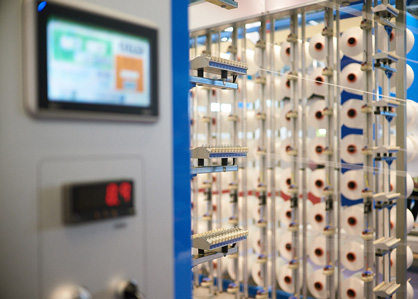

Eltex has launched the Eltex EyETM system for the continuous monitoring of yarn tension on warp beams.
Ragnar Henriksson founded the company from a modest 12-square-metre workshop in Älmhult, Sweden, in 1964.


Resilience and dedication

“In today’s highly optimised textile production environments, yarn tension has become an important parameter in eliminating faults and ensuring premium quality at all times,” says Eltex CEO Brian Hicks. “As we celebrate our 60th anniversary and continue on our journey, I’d like to thank all staff for their resilience and dedication, and also our customers and suppliers for the fruitful partnerships we’ve established together over the years. At Eltex, we will continue to focus on customer service, adapt to changing landscapes and work to pioneer technological advancements.”

Eltex has been owned by Brian Hicks, Seamus O’Dwyer and Jonathan Bell since 2007, following a management buy-out and the subsequent formation of Eltex Global Holdings in Ireland. Today, its head office, Eltex of Sweden AB, is in Osby, Sweden where it provides research and development, administration and global sales for the group. Eltex Manufacturing in Ireland is now the group’s primary production facility and Eltex US, Inc. provides sales and service for North America.
More News from Eltex of Sweden AB

More News on Weaving

#Weaving

Itema announces strategic partnership with Ivy Decarb to accelerate decarbonization in weaving process

Itema is pleased to announce the strategic partnership with Ivy Decarb, the digital platform helping textile companies measure and reduce their carbon footprint.

#Exhibitions & Events

Groz-Beckert showcases textile innovation at ShanghaiTex 2025

From December 16 to 19, 2025, the global textile industry will gather at ShanghaiTex at the Shanghai New International Expo Center (SNIEC), where Groz-Beckert will present its latest highlights and innovations across its five product areas – Knitting, Weaving, Nonwovens, Sewing, and Spinning – at Hall N3, Booth A05.

#Weaving

Vandewiele Group: Innovation across the textile value chain at ICFE Istanbul 2026

At the 2026 Istanbul Carpet & Flooring Expo (ICFE), Vandewiele Group presents its latest advancements spanning the entire textile value chain. From spinning and weaving to tufting, carpet manufacturing and digital finishing, the Group demonstrates how integrated innovation can boost performance, efficiency and sustainability across all stages of production. As a global technology leader, Vandewiele continues to develop solutions that strengthen processes, enhance product quality and enable smarter, greener manufacturing.

#Research & Development

Small tolerances, big impact and a recyclable alternative to elastane

ITA Master's student Janne Warnecke investigated tension differences over the fabric width in the weaving process and thereby contributed to quality assurance; ITA Bachelor's student Jasmin Roos found a basis for the development of recyclable yarns and textiles. For these developments, they were awarded the Walter Reiners Foundation's Promotion and Sustainability Prizes on 27 November. Peter D. Dornier, Chairman of the Walter Reiners Foundation, presented the awards at the Aachen-Dresden-Denkendorf International Textile Conference (ADD-ITC) in Aachen, Germany.

Latest News

#Spinning

First PA66 spinning plant with EvoQuench successfully commissioned

With the successful commissioning of a multi-digit PA66 spinning line for microfiber yarns, Chinese textile company Shandong Nanshan Fashion Technology Co., Ltd. has added yarn production to its textile value chain.

#Knitting & Hosiery

SHIMA SEIKI returns to ShanghaiTex

Leading flat knitting solutions provider SHIMA SEIKI MFG., LTD. of Wakayama, Japan, together with its Hong Kong and Chinese market subsidiary SHIMA SEIKI (HONG KONG) LTD., will exhibit at the ShanghaiTex 2025 exhibition (Booth No.: Hall N3, Booth A20) held in Shanghai, China this month. This marks the return of SHIMA SEIKI to ShanghaiTex after a 14-year hiatus, its last exhibit at the show having been in 2011.

#Research & Development

Fraunhofer CCPE presents the “Monomaterial Design Set” – Innovative solutions for circular product design

Composite materials made from different types of plastic often extend the lifetime of products but make recycling more difficult in the circular economy. That is why Fraunhofer CCPE has developed the “Monomaterial Design Set”. This new approach helps to reduce the variety of plastics used in durable products and offers circular solutions for designers and product developers.

#Man-Made Fibers

arena introduces renewable LYCRA® EcoMade fiber in its latest swimwear collection

Italian swimwear specialist arena has unveiled a new collection that brings sustainability and performance even closer together. Launched on December 4, the line features swimsuits made from recycled nylon and renewable LYCRA® EcoMade fiber — the first time the bio-based spandex has been used commercially in swimwear.

TOP