[pageLogInLogOut]

#Europe

Hong Kong export growth set to slow to 8% in 2022 - COVID-19 volatility and spiking logistics costs impact sentiment

The Hong Kong Trade Development Council (HKTDC) forecasts that Hong Kong exports will grow by 8% in value in 2022, down from the 25% expansion experienced in 2021. An uneven recovery, lingering threats from the COVID-19 pandemic, global supply chain disruptions and logistics bottlenecks, as well as rising concerns over inflation, are expected to restrain growth, HKTDC Director of Research Nicholas Kwan said.

In the most recent HKTDC Export Index survey, more local exporters (87%, up 20.4 percentage points from the previous quarter) said the pandemic had negatively affected their business. Soaring transport costs (60.2%), disruptions to logistics and distribution (53.2%) as well as difficulties in sourcing raw materials/parts and components (41.4%, up 16.8 percentage points) were cited as major impacts. More than 70% of Hong Kong exporters said they expect 2022 sales will decrease (42.6%) or just be on par (29.1%) with sales this year.

COVID-19 remains biggest threat

In the first 10 months of 2021, Hong Kong exports surged 26.7% year-on-year, albeit from a low base. “The remarkable growth outshone the global average, demonstrating the resilience of the city’s export sector. Nonetheless, lingering pandemic and market uncertainties are likely to cast a shadow on the local export performance in the coming year,” Mr Kwan said.

He added that the impact of COVID-19 (32.5%) remains local exporters’ top concern, followed by a stuttering economic recovery (15.7%) and borders remaining closed (11.6%)

From ‘just-in-time’ to ‘just-in-case’

Mr Kwan said COVID-19-related delays in shipments and issues related to port closures and congestion have adversely impacted the global supply chains in many areas. While 71.3% of respondents reported delivery delays, 39.8% experienced production schedule disruption and 38.4% passed extra shipping costs on to customers. Many exporters (62.4%) expect logistics costs to continue rising in the first quarter of 2022, with 39.8% anticipating an increase in the range of 10-30%.

He said manufacturers may reserve more buffer time for production in the pandemic recovery period. “Take the automobile industry as an example, where companies are switching from a ‘just-in-time’ strategy, with semiconductor chips, parts and components only delivered as needed, to embracing a ‘just-in-case’ strategy where they stock up on inventory to combat logistics bottlenecks.”

New products, new markets

On the bright side, the Regional Comprehensive Economic Partnership (RCEP) agreement takes effect on 1 January 2022. “With its phased tariff elimination, the RCEP is set to further develop and integrate regional supply chains, as well as encourage production specialisation in Asia. This will provide a fresh impetus for Hong Kong to fortify its role as an international trading hub,” Mr Kwan said.

Considering business strategies in 2022, almost half of the exporters surveyed (46.4%) indicated they planned to develop other product categories, with some opting to develop domestic markets in Mainland China (33.8%) or diversify sales to other overseas markets (30.5%).


Toy sector bearish

Meanwhile, the HKTDC Export Index dropped 1.8 points to 37.2 in the final quarter of 2021, “indicating that growing market uncertainties triggered by COVID-19 variants may continue to undermine local exporters’ confidence in the near term,” said HKTDC Assistant Principal Economist (Greater China) Alice Tsang.

Machinery (44.1, up 0.3 points) was the most promising sector, jewellery (40.7. up 0.8) and clothing (39.6, up 3.5) improved, while toys, down 19.0 points to 25.0, was the least optimistic sector. Exporters were equally cautious on major markets. Mild growth was expected in the Association of Southeast Asian Nations (ASEAN) bloc (45.8, up 1.3) and Japan (48.7, up 0.8), while the mainland market remained stable (47.6, down 0.2) and the United States fell 1.4 points to 42.9. 
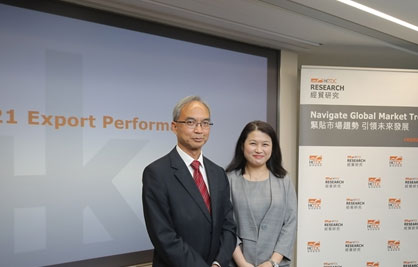
Hong Kong Trade Development Council Director of Research Nicholas Kwan and Assistant Principal Economist (Greater China) Alice Tsang announced the HKTDC Export Index for the fourth quarter of 2021 and gave the HKTDC’s prediction for export growth in 2022 at a press conference today (16 December) © 2021 HKTDC


The Procurement Index and the Employment Index were more or less the same as the previous quarter, at 36.9 and 44.0 respectively. The Trade Value Index (57.0) remained in expansionary territory.

A total of 500 local traders from six major industry sectors including clothing, electronics, jewellery, machinery, timepieces and toys were interviewed for the HKTDC Export Index survey in mid-November. Readings above 50 indicate a positive sentiment, while below 50 is negative.
More News from TEXDATA International

#ITM 2026

ITM 2026: The new geography of textile production

New production hubs are emerging across North Africa and Central Asia, while Türkiye is accelerating its transformation toward higher-value, technology-driven and more sustainable textile manufacturing.

#Research & Development

“Production is a product”

From technical textiles and AI-driven robotics to the limitations of textile circularity: Professor Dr Thomas Gries looks back on more than two decades of development at ITA Aachen. In the interview, he explains why production technology remains a decisive success factor, discusses international collaborations and innovation ecosystems, and shares his views on the transformation of production landscapes and the challenges facing an increasingly regulated industry.

#Knitting & Hosiery

“We need to move away from the price trap and return to a value-driven mindset.”

With its new Textile Innovation Center, KARL MAYER is sending a strong signal for innovation, collaboration, and the future of textile applications. In this interview, Karl Josef Mayer discusses new opportunities in warp knitting, the processing of staple fibres, recycling, the changing role of machinery manufacturers, and why the textile industry must once again focus more strongly on the value of textiles. by Oliver Schmidt

#Associations

“Innovation, resilience and international experience remain the great strengths of the Swiss textile machinery industry”

Geopolitical uncertainty, growing competitive pressure from China, new free trade agreements and the shift towards a circular economy are currently reshaping the global textile industry. In this interview, Cornelia Buchwalder discusses the current mood within the Swiss textile machinery sector, the industry’s distinctive innovative strength, new market opportunities in India and Asia, and the technological trends that could shape the upcoming trade fair cycle leading up to ITMA 2027.

More News on Europe

#Europe

Textile ETP launches bioeconomy strategy for Europe’s textile industry

On 22 September 2026, Textile ETP's Circular & Biobased Textiles Innovation Hub published its strategy for the biobased and circular transformation of Europe's textile and apparel industry.

#Europe

European textile industry calls for €10 handling fee on ultra-fast-fashion imports

The introduction of the €3 customs duty on low-value imports marks an important milestone in Europe’s efforts to address the challenges created by the rapid growth of ultra-fast-fashion imports. Together with the abolition of the €150 customs duty exemption, it demonstrates that policymakers are willing to act when market distortions become impossible to ignore. However, the European textile and clothing industry considers this a first step rather than the final destination.

#Europe

The Digital Product Passport registry is now live

On 20 July, the European Commission launched the Digital Product Passport Registry together with a testing environment, marking an important milestone in making the Digital Product Passport (DPP) a practical reality for businesses placing products on the EU market.

#Europe

EU ban on destroying unsold clothing and footwear now in force

The European Union's ban on the destruction of unsold clothing, clothing accessories and footwear has entered into force. Since July 19, 2026, large companies across the EU have been prohibited from destroying unsold textile products, while medium-sized companies will be required to comply with the same rules from 2030.

Latest News

#Textile processing

YKK India holds groundbreaking ceremony for new plant in Southern India

YKK held a groundbreaking ceremony on September 25, 2026, to mark the start of construction of YKK India Private Limited's new plant in southern India. Approximately 40 participants, including Jin Deguchi, Managing Director of YKK India, attended the ceremony.

#Digital Printing

EFI and Agfa’s DPS Business to combine andform a global, full-service industrial inkjet company

Electronics for Imaging, Inc. (“EFI”), a leading industrial inkjet business and portfolio company of Siris, and Agfa-Gevaert (“Agfa”) today announced a definitive agreement to combine Agfa’s Digital Printing Solutions business (“Agfa DPS”) with EFI. An affiliate of Siris will hold a 60% interest and Agfa will hold a 40% interest in the jointly held company, which will bring together the operating capabilities of EFI and Agfa DPS under a governance structure whereby Siris and Agfa will act as equal partners.

#Knitting & Hosiery

KARL MAYER invites the Global Textile Industry to celebrate its 90th anniversary at its German Headquarters in 2027

KARL MAYER is turning its anniversary year 2027 into a milestone for the textile sector. To mark its 90th anniversary, the industry leader is inviting customers, partners, and experts from around the world to a unique event series in September aimed at pushing boundaries, unlocking new opportunities, and jointly setting the course for a new era in textiles – just as KARL MAYER has done throughout its history. The company’s headquarters in Obertshausen, near Frankfurt, is the place to be.

#Associations

ITMF names three winners of the Sustainability & Innovation Award 2026

Three projects from the UK, Korea and China have been selected as winners of the ITMF Sustainability & Innovation Award 2026. The projects address textile-to-textile recycling, chemical recycling for automotive textiles and a regenerative approach combining silk production with ecological restoration.

TOP