[pageLogInLogOut]

#Associations

Launch of the TCLF skillbridge project
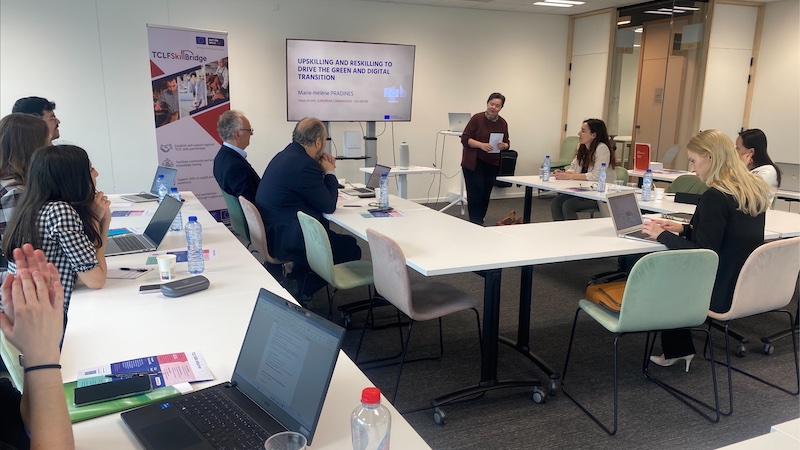
EURATEX together with COTANCE and CEC hosted the TCLF SkillBridge Stakeholder Event, an important step towards forming regional skills partnerships by bringing together various stakeholders from industry, education, and public sectors.
© 2024 EURATEX
© 2024 EURATEX


Co-financed by the European Commission, TCLF SkillBridge aims to establish and nurture regional partnerships between TCLF industries, regional authorities, and local universities and VET providers. The project will target up to 25 European regions with a strong concentration of textile, clothing, leather or footwear industries. This regional focus will allow the development of specific action plans related to reskilling and upskilling, which meet the needs of each target region. The project will support the creation of such partnerships, facilitate community exchanges for knowledge sharing, and provide support to SMEs, enabling them to upskill and reskill their workforce in tune with the evolving demands of the industry.

The TCLF SkillBridge project complements 2 other initiatives – AEQUALIS4TCLF and METASKILLS4TCLF – which have already been launched under the Erasmus+ Programme. As a result, the industry has now a coherent set of instruments across the EU to address the skills challenges.

During the event today, stakeholders from the Emilia Romagna Region, ATEVAL, and Verband der Deutschen Lederindustrie e.V. gave insights in their experiences in skills collaborations in their regions. An interactive session then followed, where stakeholders discussed how to successfully establish such regional partnerships under the Pact for Skills.

Dirk Vantyghem, EURATEX Director General was excited to host the event as coordinator of the TCLF SkillBridge project: “This project confirms the importance of working at regional level, close to the SMEs and understanding the specificities of each region. We hope TCLF SkillBridge will act as a trigger to mobilise relevant stakeholders to co-invest in their TCLF industries.”

In this relation, Carmen Arias, Secretary General in the European Footwear Confederation (CEC), added: “By investing in education and training that align with the region's economic priorities, policymakers can ensure that workers have the skills and knowledge needed to succeed in the evolving labour market. As CEC, we will continue helping these industries build a competitive advantage and position themselves in the global market.”

COTANCE Secretary General, Gustavo González-Quijano: "In the SkillBridge project, COTANCE is leading the charge by offering tailored mentorship to TCLF stakeholders aimed at guiding their regional skills partnerships towards developing educational strategies for higher levels of sustainability and competitiveness in their respective industries. Working closely with partners across Europe, we are united in our mission to drive the EU leather, textiles, clothing, and footwear sectors towards a greener, more resilient and innovative future”.
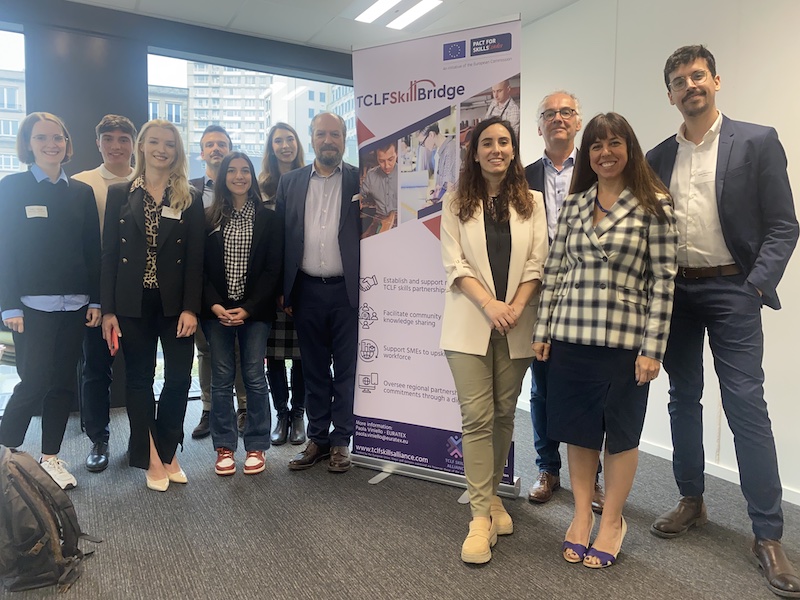
New European initiative to promote TCLF skills development at regional level © 2024 EURATEX


More News from European Apparel and Textile Confederation (EURATEX)

#Europe

European textile industry calls for €10 handling fee on ultra-fast-fashion imports

The introduction of the €3 customs duty on low-value imports marks an important milestone in Europe’s efforts to address the challenges created by the rapid growth of ultra-fast-fashion imports. Together with the abolition of the €150 customs duty exemption, it demonstrates that policymakers are willing to act when market distortions become impossible to ignore. However, the European textile and clothing industry considers this a first step rather than the final destination.

#Associations

Towards pragmatic and harmonised labelling in the EU

EDANA, alongside 14 European associations, urges the European Commission and Member States to adopt a pragmatic approach for the future harmonised packaging labels, in line with the EU’s agenda for the EU Single Market, simplification and competitiveness. The system should rely on text-free pictograms, available in achromatic or monochromatic versions matching the packaging palette, with the possibility of using digital labelling as a core element. Our associations represent manufacturers of consumer goods across Europe.

#Associations

Textile PRO Forum calls for greater harmonisation of textile EPR systems across Europe

The Textile PRO Forum has published a new analysis highlighting the need for greater harmonisation of textile Extended Producer Responsibility systems across Europe. The document, Toward harmonised Textile EPR Systems in Europe: analysis and recommendations, presents the results of work carried out by Workstream 1 of the Textile PRO Forum, led by Dr. Eng. Viola Corbellini, Strategic Development and Innovation Expert at Erion Textiles, and Eng. Luca Campadello, General Director at Erion Textiles. The workstream focused on reducing administrative burden for textile producers by identifying areas where procedures could be better aligned across countries.

#Associations

Mario Jorge Machado re-elected President of EURATEX

The EURATEX General Assembly has re-elected Mario Jorge Machado as President of EURATEX, renewing its confidence in his leadership at a crucial moment for the European textile and clothing industry. The sector is facing rising costs, global competitive pressure and an increasingly challenging transition towards sustainability and digitalisation.

More News on Associations

#Raw Materials

Cotton Brazil Dialogues 2026 concludes with 50 international participants immersed in Brazilian cotton production

The Cotton Brazil Dialogues concludes its 2026 edition after a series of technical visits to farms, cotton gins and reference centers, as well as workshops focused on Brazilian cotton production. A total of 50 participants from 14 countries took part in the field trips. The initiative is led by the Brazilian Association of Cotton Growers (Abrapa) and the National Association of Cotton Exporters (Anea), with support from the Brazilian Trade and Investment Promotion Agency (ApexBrasil).

#Associations

Business situation weakens slightly, but the industry stays cautiously optimistic

The International Textile Manufacturers Federation (ITMF) has published the results of its 39th Global Textile Industry Survey (GTIS), conducted from 14 to 22 July 2026 among companies along the entire global textile value chain. Worldwide, 10% of participants rated their business situation as good, 53% as satisfactory and 37% as bad — a balance of -26pp, down from -17pp in May but still well above the 2023 lows. All regions are now in negative territory, from South Asia at -3pp to North & Central America at -58pp.

#Associations

IVGT membership: expertise that pays off

For energy-intensive textile companies, government compensation mechanisms are an important economic factor. The IVGT successfully supports its member companies in applying for state aid and thereby regularly contributes to significant financial relief.

#Associations

Italian textile machinery orders show quarterly recovery in Q2 2026

In the period between April and June 2026, order intake for Italian textile machinery manufacturers showed mixed but encouraging signals for the second half of the year. The order index at constant prices stood at 46.6 points (taking 2021=100 as the base year), showing a slight decrease of 3% compared to the same quarter of 2025. This trend was largely due to the contraction recorded in the domestic market, which fell by 25% compared to the corresponding period of the previous year.

Latest News

#Nonwovens

25 years in the room: EDANA’s OUTLOOK™ returns to Cascais to shape a changing industry

The market does not wait, and it does not grant easy answers. Across the absorbent hygiene, personal care, and wipes sectors, business is undergoing a period of intense, necessary adjustment. New European rules on packaging, single-use items, product safety, and end-of-life are forcing companies to drop old assumptions about materials and performance. At the same time, producers must keep their goods safe, reliable, and affordable for the babies and aging adults, who rely on them every day.

#Recycling / Circular Economy

Recover™ names Enes Adak and Fehmi Yüksel as Co-CEOs to accelerate its next growth phase

Recover™, a leading materials science company and global producer of consistent high-quality, recycled cotton fibers and circular material solutions at scale, today announced the appointment of Enes Adak and Fehmi Yüksel as Co-Chief Executive Officers. This leadership transition marks an important step in Recover’s evolution as the company enters its next stage of development.

#Research & Development

ADD-ITC 2026 highlights strong industry participation

The Aachen-Dresden-Denkendorf International Textile Conference (ADD-ITC) 2026 will place a strong focus on the exchange between textile research and industry when it takes place on November 26–27, 2026, at the International Congress Center Dresden. According to the preliminary conference program, more than two-thirds of all presentations will be contributed by companies or jointly presented by industry and research institutions.

#Recycling / Circular Economy

Arc'teryx introduces System 0™, a new framework for the future of product design and circularity

Arc'teryx Equipment, the global design company specializing in technical high-performance apparel and equipment, today introduced System 0™, a new framework that reimagines how products can be designed, manufactured, used, repaired, and ultimately regenerated. System 0 represents the next evolution for sustainability in the outdoor industry, as it embeds circular thinking across an entire product lifecycle while maintaining the uncompromising performance standards that define the Arc’teryx brand.

TOP