[pageLogInLogOut]

#Associations

The business situation continues to stagnate, casting a shadow on year-end expectations

The May 2024 ITMF Global Textile Industry Survey (GTIS) indicates a continued stagnation in the textile business climate, with a marginal improvement of the economic situation due to more companies deeming business “satisfactory”. On the other hand, business expectations have stagnated in positive territory for a year, reflecting optimism rather than actual improvement, as the entire supply chain suffers from a lack of orders and high costs that affect profit margins.

The balance between “good” and “poor” order intake has improved slightly, and expectations for order intake in six months are trending upwards. Since summer 2023, order backlog has fluctuated around two months on average, rising slightly from 1.9 months in March 2024 to 2.1 months in May, though it is too early to interpret this as a positive trend. The reported average capacity utilization rate increased marginally to 71% in May 2024, after declining from a peak of 80% at the end of 2021. Survey participants expect better capacity utilization in six months.
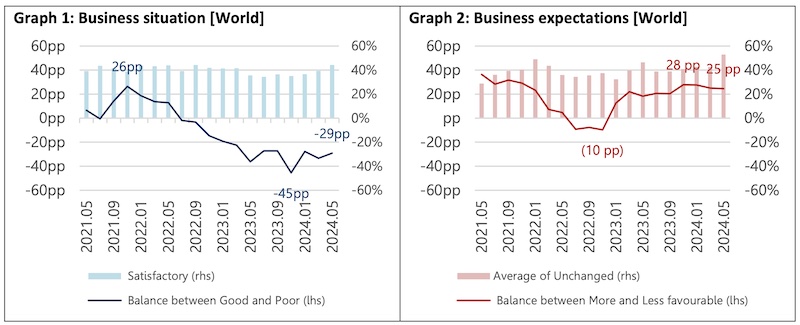

Source: 8th-26th ITMF Global Textile Industry Survey (26th: 17-27.05.2024) © 2024 ITMF


Weak demand remains the main concern since September 2022, though its importance has decreased in the last six months. Other concerns include high raw material prices, geopolitics, high energy prices, and a lack of workers and talents. Globally, 58% of respondents did not experience any order cancellations in May 2024, slightly down from 59% in March. Africa and Europe had relatively low order cancellations, while the Americas experienced more, with spinners and finishers/dyers/printers reporting the highest levels.

In May 2024, 59% of companies reported average inventory levels. North America registered the highest levels among regions, and spinners among segments. Inventories at brands and retailers remain high but are slowly decreasing. The prolonged negative business cycle often forces companies to produce at a loss or lower capacity utilization, with no significant change expected in 2024.

For more information, please see www.itmf.org


More News from International Textile Manufacturers Federation (ITMF)

#Associations

SIMTA joins ITMF as Corporate Member

In the past two decades SIMTA has established itself as producer of specialized machinery for the textile industry. In short period of time, SIMTA became an important supplier of precise rollers for top OEMs. Afterwards SIMTA started manufacturing overhead cleaners, bobbin transport systems, and other textile ancillaries. In the meantime, SIMTA is a leader in this space in collaboration with the German automation technology partner Jacobi.

#Associations

Mr. Juan Parès (Spain) elected as new ITMF President

On October 24th, 2025, during the ITMF Annual Conference & IAF World Fashion Convention 2025 in Yogyakarta, Indonesia, the Committee of Management of the ITMF elected the members of the ITMF Board for the period 2025-2027.

#Associations

ITMF and IAF conclude successful Joint Convention 2025 in Yogyakarta, Indonesia

The International Textile Manufacturers Federation (ITMF) and the International Apparel Federation (IAF) have successfully concluded their second joint convention, held this year in Yogyakarta, Indonesia. In close collaboration with the host Indonesian Textile Association (API), the event gathered over 400 delegates from around the world from across the entire textile and apparel value chain.

#Associations

Winners of the ITMF International Collaboration Award 2025

The winners of the ITMF International Collaboration Awards 2025 will present their project at the upcoming ITMF & IAF Conference 2025 which will be held from 24 - 25 October in Yogyakarta, Indonesia and will be co-hosted by Indonesia Textile Industry Association (API).

More News on Associations

#Associations

European Business Coalition welcomes provisional application of EU–Mercosur Agreement and calls for Swift and full implementation

With the European Commission’s decision to provisionally apply the EU–Mercosur Interim Trade Agreement, a process spanning more than 25 years now moves decisively into its implementation phase.

#Associations

EDANA joins industry coalition urging a strong internal market legal basis for the New Circular Economy Act

EDANA has joined 67 European industry associations in a joint industry statement calling on the European Commission and co-legislators to anchor the forthcoming New Circular Economy Act (CEA) in the Internal Market legal basis (Article 114 TFEU).

#Associations

EDANA warns of consequences of misclassification of PET spunbond imports

EDANA would like to remind its members and industry stakeholders of the legal requirement to comply with the EU rules on customs classification when importing nonwovens from third countries outside the EU. In this regard, it was recently discovered that there appears to be a high level of customs misclassification occurring in our industry. This could have dangerous and costly consequences for importers.

#Associations

Engineering depth and diversity for composites

Airbond is the latest member of the British Textile Machinery Association (BTMA) to receive recognition for contributions to the composites industry. The engineering firm based in Pontypool, South Wales, has just received the Make UK Energy and Sustainability Award for its Lattice 3D Printing project.

Latest News

#INDEX 2026

EDANA unveils nominees for INDEX™26 Awards: Highlighting the next generation of nonwoven excellence

EDANA is proud to unveil the highly anticipated nominees for the INDEX™26 Awards, the nonwoven industry’s highest accolade for technical and sustainable excellence. Out of a record-breaking field of entries, these finalists represent the cutting edge of material science—from bio-based hygiene fibers and PFAS-free protective textiles to revolutionary water-filtration machinery. Each nominee has been selected by a jury of industry experts for their ability to solve critical global challenges, including the transition to a circular economy and the pursuit of enhanced consumer performance.

#Raw Materials

Lenzing Group positions bio‑based materials as a strategic asset for Europe’s economic security

The Lenzing Group, a leading supplier of regenerated cellulose fibers for the textile and nonwovens industries, hosted a high‑level roundtable in Brussels to discuss how bio‑based materials can strengthen Europe’s economic security and support the shift toward a fossil‑free future. Organized in cooperation with Euractiv, the event brought together representatives of the European Commission, the UK Mission to the EU, academia, civil society, and industry.

#Natural Fibers

Beyond Cotton: Natural Fibres in the Spotlight at the Bremen Cotton Conference - Branded by DNFI

Climate targets, fragile supply chains, and rising regulatory requirements are fundamentally changing the perspective of the textile industry - the focus is increasingly shifting toward the base material. Not only cotton, but natural fibres are gaining significant importance: they stand out not only because of their outstanding functional properties, but also because they make a valuable contribution to the bioeconomy and responsible product development.

#Textiles & Apparel / Garment

Coats to showcase innovative reinforcement and filler materials for leather goods and accessories at APLF 2026

Coats, a world-class Tier 2 manufacturer and trusted partner for the apparel and footwear industries, will be promoting four advanced materials from its ‘Lifestyle Solutions’ portfolio at APLF 2026 in Hong Kong in March. Each innovation has been specifically engineered to help luxury and premium brands elevate the craft, durability, sustainability and creative expression required in the manufacturing of handbags, purses, and other high-end designer accessories.

TOP