[pageLogInLogOut]

#Associations

A new Swedish meeting place for sustainable textile production

© 2022 TMAS
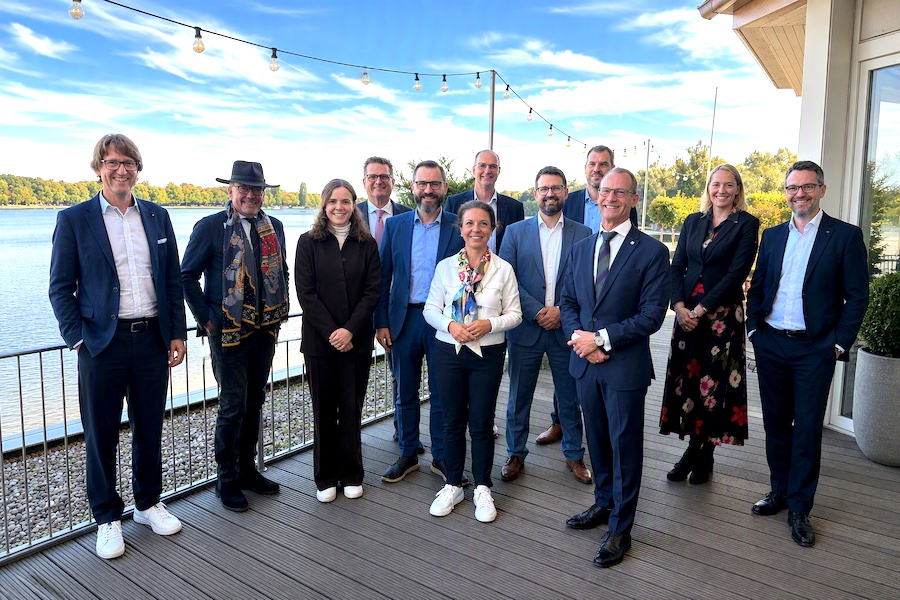
Last week, the University of Textiles in Borås, Sweden, launched a new meeting place for sustainable textile production - Svenska Textilmaskinsmässan (The Swedish Textile Machinery Expo). During two exciting days, Swedish manufacturers of textile machines, representatives of international machinery brands and the Swedish textile industry gathered to exchange experiences with the issue of sustainability in focus.

— We felt that there was a need for a physical meeting place for the textile industry in Sweden where people can meet to exchange experiences and ideas. For us, it is important to have a close collaboration with the industry and to make sure that our students and researchers have access to the best available technique on the market, says Anneli Bentzlin, head of the textile labs at the University of Textiles in Borås.

Therese Premler Andersson, Secretary General of the Textile Machinery Association of Sweden (TMAS), is very positive about the initiative:

– It has been several decades since this type of meeting opportunity existed in the industry in Sweden. For our members in TMAS, it is extra fun to show off Swedish technology in Sweden. For many years, Swedish machine builders have contributed with energy-efficient and resource-efficient technical solutions and expertise to the textile industry globally. Here, we get the opportunity to convey experience and competence from projects all over the world to the Swedish market. I am also convinced that if we are to be able to solve the sustainability challenge, the industry and academia need to work even more closely together, and the fair is an excellent opportunity to make new contacts.

Interest in sustainable local production in Sweden is growing

New requirements regarding sustainability and transparency mean that many companies are forced to review their production. With new technology, automation and machines at the forefront, conditions are great for moving home all or parts of production previously located abroad.

– There are several factors that contribute to the increasing interest. The pandemic was a wake-up call for many. It became clear that everyone needs to review their supply chains to be less vulnerable. But even beforet, we saw a higher awareness that sustainable production by definition should take place closer to the end customer. Not least, we now also have technical solutions that enable more flexible production with a higher degree of digitization and automation. It is a necessity to achieve cost efficiency, says Therese Premler Andersson.

The industry faces several challenges

Despite the fact that technology has advanced rapidly, there are still major challenges within the industry that need to be resolved in order to be able to move more production back to Europe. Therese Premler Andersson emphasizes the importance of daring to test new ideas and to provide ongoing training of staff to secure the right skills:

– We need to get started and test new ways and ideas to evolve and become better. The technology already exists. Better support and reduced financial risk for larger projects could contribute.

The willingness to invest in automation among brands has previously been low as production has been moved to regions where labor was cheap. Now, however, a change is noticeable, but the textile companies need support to be able to make the investments that a move entails.


-“All “production will not be possible to move “home” and it does not need to be done “at home” either. However, it should be produced in a more sustainable way wherever the production takes place.

The Secretary General of TMAS also sees lack of skills as one of the major challenges facing the industry:

– In order to be able to make investments locally, we need to invest in education, both within the textile area as well as automation and digitization. The lack of skills will be an obstacle if we do not get young people interested in the industry and use the skills that we have in Sweden in the textile area from, for example, from immigrants from Syria and Ukraine.

Great interest

The organizers and the industry are very satisfied with the first Swedish Textile Machinery Expo. Anneli Bentzlin sees this as the start of a recurring event:

– It has been two days filled with exciting and rewarding meetings! The interest in the Swedish Textile Machinery Expo has been great, both from Swedish and international machine manufacturers and textile producers. The word has really spread, which is incredibly fun! We see the Swedish Textile Machinery Expo as the starting point for a recurring tradition, Anneli Bentzlin sums up.

This article is a translation of an interview made University of Textiles in Borås and first published here.

https://www.hb.se/textilhogskolan/om-textilhogskolan/aktuellt/nyheter/nyhet/136339/

https://www.youtube.com/watch?v=kkxqLIuVmX0&feature=emb_logo

More News from Textile Machinery Association of Sweden

More News on Associations

#Associations

Sustainability: European industry calls on EU to keep Single-Use Plastics Directive unchanged

A broad coalition of European industry associations, including EDANA, Euratex and Plastics Europe, has urged EU institutions to maintain the current legal framework of the Single-Use Plastics Directive (SUPD). In a joint statement, the organisations argue that reopening the Directive at this stage would create legal uncertainty, increase regulatory complexity and undermine investment, while its implementation across the European Union is still incomplete.

#Associations

Textile machinery: Italian technology charts the course for revival

Operating in a scenario characterized by geopolitical instability, slowing industrial investments, and new protectionist pressures. This is the main challenge for the Italian textile machinery industry that emerged during the General Assembly of ACIMIT (Association of Italian Textile Machinery Manufacturers), held today in Milan at the Shareholders’ Hall of Palazzo Edison.

#Recycling / Circular Economy

New skills for a circular textile economy

Based on the results of a comprehensive analysis, the Erasmus+ project Skills4Circularity is developing three practical training modules covering recycling technologies, eco-design for the circular economy and sustainable manufacturing. The content of the first module, Recycling Technologies, has now been developed and validated together with industry representatives. The module provides participants with knowledge of regulatory requirements, material sorting and the preparation of textile waste for recycling.

#Associations

Bangladesh: Italian textile machinery mission stops in Dhaka and Chittagong

Technological upgrading and the transition toward higher value-added production are driving the new Italian industrial mission to Bangladesh. This year, the mission will split between the country’s two main manufacturing hubs, where Italian manufacturers will meet the leaders of the local textile supply chain in two strategic stages: July 7th in Dhaka and July 9th in Chittagong.

Latest News

#Recycled Fibers

Recover™ and Ünteks Group partner to scale recycled cotton in knitwear

Recover(TM), a global producer of low‐impact, high‐quality recycled cotton fiber, announces a new partnership with Ünteks Group, a vertically integrated textile manufacturer based in Turkey. The collaboration focuses on the development of circular knit fabrics and garments, combining Recover’s recycled cotton fiber with Ünteks Group’s integrated capabilities across knitting, dyeing, printing, and garment production.

#Spinning

STEELTOP®: A new benchmark in flat tops for spinning preparation

Modern carding generations achieve higher production performance, placing significantly greater stress on flat tops. Higher cylinder speeds and increased fiber density, combined with tighter carding gaps, create more demanding operating conditions. At the same time, poorer raw material quality and the increased use of recycled materials further intensify these challenges. With STEELTOP®, Trützschler introduces a new full steel flat top series developed for these demanding modern carding processes.

#Textile processing

YKK develops concept EXCELLA® zipper tape using nonwoven fabric partially derived from used clothing

YKK Corporation has developed a concept version of its premium EXCELLA® zipper series made from nonwoven fabric sheets created by fiberizing used clothing and other textile materials. Based on a proposal by fashion designer Yuima Nakazato, this item was created as a result of collaboration between Nakazato, Seiko Epson Corporation and YKK. The concept zipper was incorporated as a material component for pieces in the newest YUIMA NAKAZATO Couture Collection, “INFERNO,” which was unveiled in Paris, France on July 8, 2026.

#Textiles & Apparel / Garment

Texworld Apparel Sourcing Paris highlights evolving global sourcing landscape

From 31 August to 2 September 2026, Texworld Apparel Sourcing Paris will bring together more than 1,000 international exhibitors at Paris-Le Bourget Exhibition Centre. This edition reflects the new global balance of textile and apparel sourcing, highlighting a strong diversity of sourcing countries — some unexpected.

TOP