[pageLogInLogOut]

#Associations

Producer association initiative agrees to focus on commercial compliance to improve purchasing practices

The Manufacturers Payment and Delivery Terms Initiative has taken an important step yesterday, concluding its phase 1 during its second Global Working Group Meeting. This initiative has been started by the STAR Network- which is supported by GIZ FABRIC- and by the International Apparel Federation (IAF). It is supported by the Better Buying Institute and the OECD and a range of experts.

It is an initiative of now 13 participating manufacturing associations in the apparel and textile industries from 9 countries, together representing close to 70% of initial global apparel exports. The number of participating associations is set to grow further in the coming months.

The main deliverable of phase 1 is a white paper that will be released towards the end of April, after it has received input from the Initiative’s Advisory Board, in which major stakeholders representing buyers, government, MSIs and academia are well represented. Even though full details will be shared when the white paper is published later, today’s meeting demonstrated that the participating associations clearly agree on the following key principles that form the foundation of this paper:

First, this initiative has started from the recognition that even though buyer’s own initiatives to improve purchasing practices are important, they are not sufficient. While buyer purchasing practices have been increasingly scrutinized over the last decade for the impact they have on economic, social and environmental sustainability, in the past years it has become very clear to manufacturers that their vulnerability has increased and that they must play a stronger role in setting standards for purchasing practices that support mutually beneficial and sustainable partnerships.

Second, the initiative’s participants agree to make ‘commercial compliance’ the core principle of this initiative. In the context of the buyer-supplier relations in the fashion and textile industries, the initiative is defining ‘commercial compliance’ as purchasing practices that do not cross the boundary of misuse of buying power to the obvious and avoidable detriment of the manufacturer. In phase 2 of the initiative the united manufacturers associations will build structures for the enforcement of ‘commercial compliance’, which will inevitably include instruments to achieve transparency.


Finally, the white paper’s main body will consist of three tables, one listing ‘red lines’ for purchasing practices not to cross, one listing a range of recommendations for improving purchasing practices and one listing recommendations for further research. The list of ‘red lines’ clearly sets the bar for ‘commercial compliance’. “Publication of the red lines in a few weeks’ time will enable us to put the principle of commercial compliance into practice. The list of recommendations for improvement of purchasing practices and for research meanwhile will form the foundation for a structural dialogue that we are setting up in phase 2” says Matthijs Crietee, Secretary General of the IAF “This will be a dialogue on the improvement of purchasing practices involving the world’s main apparel manufacturing associations, buyers and organisations representing them.” The research list includes such topics as an international arbitration mechanism, the transfer of ownership of goods and research aimed at modernizing performance indicators that measure the value of end-to-end contributions to profitability.

The work on the Manufacturer’s Payment and Delivery Terms Initiative is continuing with the publication of the white paper in late April and with the start of phase 2 in May of this year. The initiative had initially started with nine associations of the STAR Network and already expanded with four additional associations of the IAF joining.

More News from INTERNATIONAL APPAREL FEDERATION (IAF)

#Textiles & Apparel / Garment

IAF Position on tariffs

The International Apparel Federation (IAF) represents the apparel manufacturing community across more than 40 countries—a global industry comprising hundreds of thousands of companies and millions of employees. Apparel and textiles are among the most globalized industries, historically foundational to industrial development around the world.

#Associations

IAF and ITMF unite global fashion and textile leaders

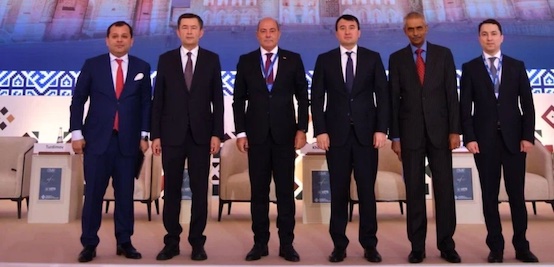
The joint ITMF Annual Conference and IAF World Fashion Convention was held on September 8-10 in the historic city of Samarkand, Uzbekistan. This year’s convention, co-organized by the International Apparel Federation (IAF) and the International Textile Manufacturers Federation (ITMF), and hosted by Uztextileprom, the Uzbekistan Textile and Garment Industry Association, and the Chamber of Commerce & Industry, Uzbekistan highlighted the crucial interdependence of our sectors.

#Associations

Partnership ITC and IAF: Full supply chain profitability

The International Trade Centre (ITC) and the International Apparel Federation (IAF) announce a partnership to stimulate innovation towards “full supply chain profitability” for apparel manufacturers and brands. The first phase of collaboration is research to be previewed at the 38th IAF World Fashion Convention, Philadelphia, October 23-24. Applying learning in autos and electronics, a joint study articulates how material suppliers and garment manufacturers create ‘smart flexibility’ by postponing production commitments closer to actual demand, unlocking capital from unneeded inventory and excess production. Smart Flexibility is a new approach that uses a mix of process and data tools enabling suppliers to create additional value for brands and manufacturers alike that supersedes the benefits of lowest cost global sourcing.

#Industry 4.0 / Digitalization

Global coalition calls for digital labeling

The American Apparel & Footwear Association (AAFA), the International Apparel Federation (IAF), and 128 additional organizations from all corners of the globe, today delivered a letter to supranational, national, and local authorities around the world to modernize domestic textile, garment, footwear, and related accessories labeling requirements and legally allow more sustainable and economic, digital labels for required labeling information.

More News on Associations

#Associations

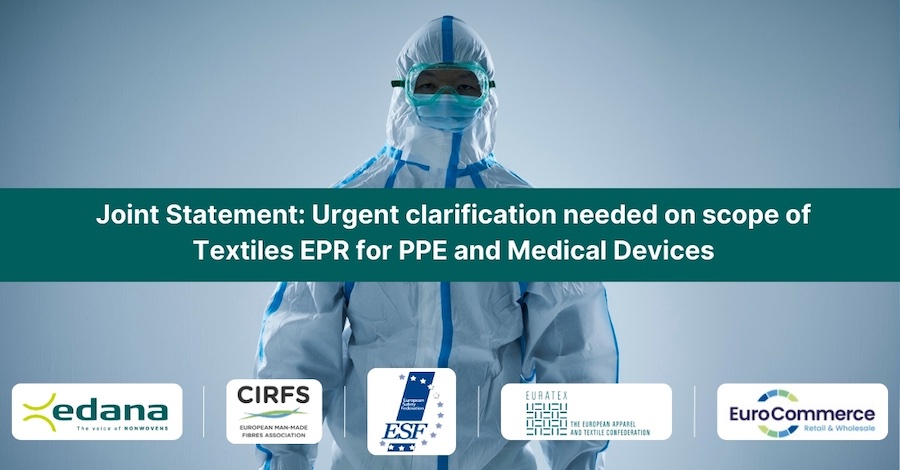
Joint Statement: Urgent clarification needed on scope of Textiles EPR for PPE and Medical Devices

EDANA, the voice of nonwovens, alongside fellow industry associations CIRFS (European Man-Made Fibres Association), EURATEX (The European Apparel and Textile Confederation), ESF (European Safety Federation), and EuroCommerce (Retail & Wholesale), has issued a joint statement raising critical concerns regarding the transposition of Directive (EU) 2025/1892, the targeted revision of the Waste Framework Directive.

#Associations

Young researchers recognised for cutting-edge work in recycling, fibre technology and textile mechanics

At the Aachen-Dresden-Denkendorf International Textile Conference held in Aachen at the end of November, Peter D. Dornier, Chairman of the Walter Reiners Foundation of the VDMA, honoured five successful young engineers. Promotion and sustainability prizes were awarded in the categories bachelor/project theses and diploma/master theses. Academic theses that develop solutions for resource-saving products and technologies, for example, are eligible for the sustainability awards.

#Europe

Level playing field at stake: Europe’s textile industry demands decisive action

Yesterday, the European Parliament took a welcomed and necessary step by voting a resolution calling for stronger market surveillance, reinforced customs controls and faster enforcement of the Digital Services Act in case of infringements. For Europe’s textile and clothing manufacturers, this is the first political acknowledgement that the system is broken — and that enforcement must finally match the scale of the problem.

#Natural Fibers

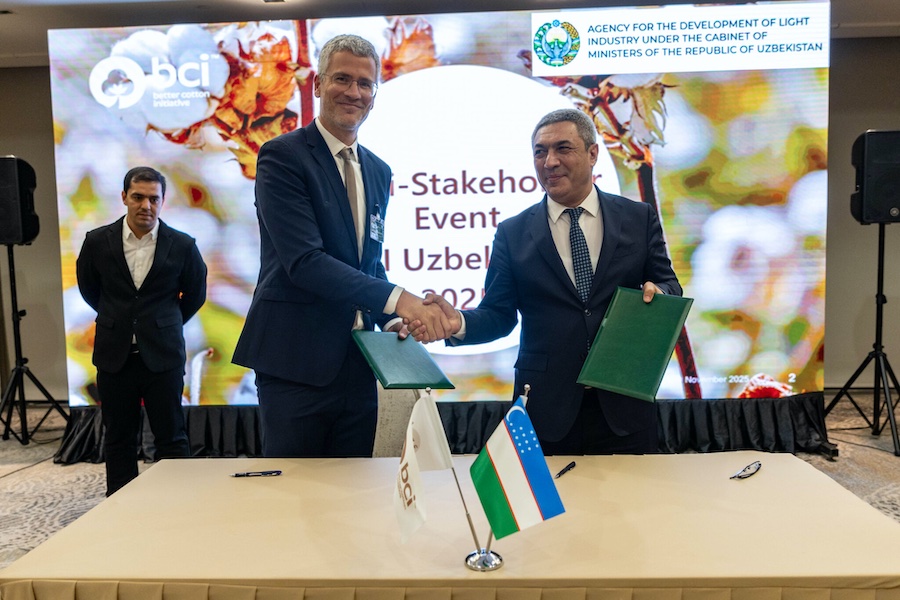
Better Cotton Initiative partners with Uzbek government agency to offset certification costs

The Better Cotton Initiative (BCI) has today announced a strategic agreement with Uzbekistan’s Light Industry Agency to increase financial support for cotton farming clusters adopting sustainable agricultural practices.

Latest News

#Spinning

First PA66 spinning plant with EvoQuench successfully commissioned

With the successful commissioning of a multi-digit PA66 spinning line for microfiber yarns, Chinese textile company Shandong Nanshan Fashion Technology Co., Ltd. has added yarn production to its textile value chain.

#Knitting & Hosiery

SHIMA SEIKI returns to ShanghaiTex

Leading flat knitting solutions provider SHIMA SEIKI MFG., LTD. of Wakayama, Japan, together with its Hong Kong and Chinese market subsidiary SHIMA SEIKI (HONG KONG) LTD., will exhibit at the ShanghaiTex 2025 exhibition (Booth No.: Hall N3, Booth A20) held in Shanghai, China this month. This marks the return of SHIMA SEIKI to ShanghaiTex after a 14-year hiatus, its last exhibit at the show having been in 2011.

#Research & Development

Fraunhofer CCPE presents the “Monomaterial Design Set” – Innovative solutions for circular product design

Composite materials made from different types of plastic often extend the lifetime of products but make recycling more difficult in the circular economy. That is why Fraunhofer CCPE has developed the “Monomaterial Design Set”. This new approach helps to reduce the variety of plastics used in durable products and offers circular solutions for designers and product developers.

#Man-Made Fibers

arena introduces renewable LYCRA® EcoMade fiber in its latest swimwear collection

Italian swimwear specialist arena has unveiled a new collection that brings sustainability and performance even closer together. Launched on December 4, the line features swimsuits made from recycled nylon and renewable LYCRA® EcoMade fiber — the first time the bio-based spandex has been used commercially in swimwear.

TOP