[pageLogInLogOut]

#Associations

The European textile and clothing industry presents its strategy for the future
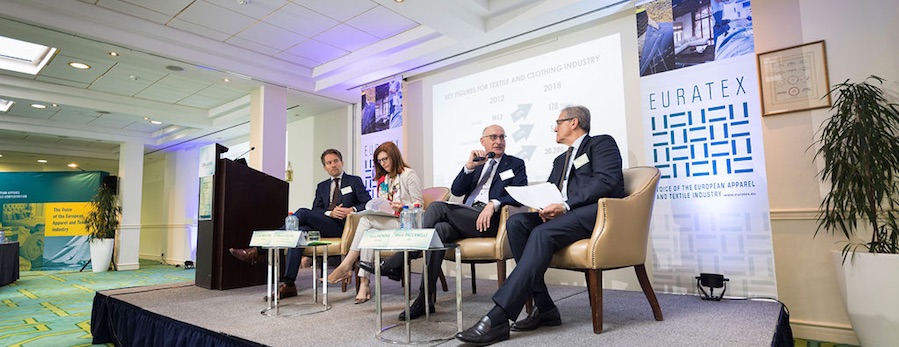
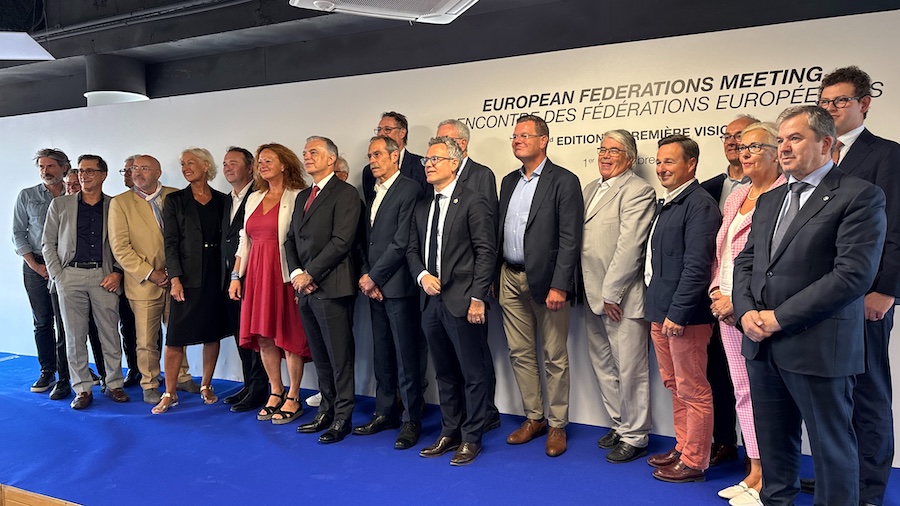
EURATEX General Assembly 2019 (Archive photo) (c) 2020 EURATEX
The European textile and clothing industry is ready to transform the crisis into an opportunity, and become more digital, sustainable and agile. Endorsed by the last General Assembly, the renewal will be driven by the “strategy for recovery from the COVID-19 era” together with five flagship initiatives in critical areas. To guide the sector towards its renaissance, the GA re-elected Alberto Paccanelli as President.

European textiles and clothing companies proved to be essential to managing the pandemic, as a great number converted to or increased the production of PPE. But this strategic role goes beyond the past events, as, without textile materials, no cars, clothes, machines or buildings can be built. The last months highlighted then the necessity for the whole sector and its value chain to undergo a renewal process and enter the future more competitive and greener. The textile industry is ready for this challenge and developed a recovery strategy.

EURATEX’s plan requires considerable resources and a coherent set of measures, both on short term and on a structural basis. While the European Commission and Member States already put in place some quick recovery moves, such as the re-opening of shops and companies and the guarantee of well-functioning markets and supply chains, it is now time to define the long-term vision. Europe should endorse the strategic importance of the European T&A sector, promote the development of an integrated ecosystem with the EU and its neighboring countries, invest on innovation and skills, and turn circularity into a source of competitiveness. The deployment of these durable measures must be now.

“This crisis showed the importance of our industry and now, more than ever, it’s essential to develop the competitiveness of the European ecosystem. The “EU Next Generation” package can play an important role and support the textile and clothing industry in its renaissance”, said Alberto Paccanelli, who was re-elected EURATEX President. The General Assembly also appointed EURATEX Vice- Presidents, Jean-François Gribomont, Gregory Marchant, Hadi Karasu and Bodo Bölzle. 

Recovery strategy:

https://euratex.eu/wp-content/uploads/Post-Corona-Strategy-Final.pdf


To make the strategy tangible and concrete, EURATEX developed, on the basis of the above, five flagship initiatives:

  • The impact of this type of crisis can be avoided by organising guaranteed supplies and building resilient value chains in Europe for critical PPE and other textile products.
  • The textile and clothing workforce is growing older, as 35% of it is over 50 years old. SMEs should upskill their existing workforce to meet a rapidly transforming industry and attract well-qualified young workers and professionals. 
  • We should invest in innovative and sustainable textiles through dedicated Public Private Partnership (PPP) at EU level. These PPP will pool and accelerate research, innovation, pilot testing and demonstration in critical areas, like digital manufacturing and supply chains.
  • EURATEX wants to establish 5 recycling hubs in Europe near textile and apparel districts and therefore make raw materials by collecting, sorting, processing and recycling post-production and post-consumption textile wastes.
  • Goods blocked by national authorities at the borders should not happen in the future. It is fundamental to ensure free and fair trade for our companies. A first step should be to promote the Pan Euro Med as an integrated ecosystem, and exploit market opportunities resulting from other EU FTAs. 


More News from European Apparel and Textile Confederation (EURATEX)

#Associations

Europe is losing its textile industry

EURATEX has released its latest Economic Update on the performance of the European textile and apparel industry in 2025. For the third consecutive year, the sector recorded negative results across all key indicators — production, turnover and employment — confirming a continued erosion of competitiveness across Europe.

#Associations

European Business Coalition welcomes provisional application of EU–Mercosur Agreement and calls for Swift and full implementation

With the European Commission’s decision to provisionally apply the EU–Mercosur Interim Trade Agreement, a process spanning more than 25 years now moves decisively into its implementation phase.

#Europe

Antwerp Declaration community urges EU leaders to deliver emergency measures as Europe’s competitiveness crisis deepens

EURATEX, representing the European textile and fashion industry, joins the Antwerp Declaration Community’s call on EU Heads of State and Government to adopt emergency measures that restore industrial competitiveness and deliver tangible results for Europe’s manufacturing base in 2026.

#Europe

FITA, ABIT and EURATEX underline strategic importance of Mercosur – EU Partnership Agreement for the textile and apparel industry

The Argentine Textile Industry Federation (FITA), the Brazilian Textile and Apparel Industry Association (ABIT), and the European Apparel and Textile Confederation (EURATEX) continue to monitor the process of internalizing the Mercosur-European Union Partnership Agreement. This agreement is essential for the competitiveness of our industries, on both sides of the Atlantic.

More News on Associations

#Associations

Italian textile machinery sector faces weak start to 2026 despite domestic growth

In the first quarter of 2026, order intake for Italian textile machinery manufacturers recorded a decrease of 5% compared to the same period in 2025, reflecting a still challenging start to the year. The decline affected foreign markets (-7%), while the domestic market showed growth (+21%).

#Techtextil 2026

Young talents honoured – 60 years Walter Reiners Foundation

At the Techtextil trade fair in Frankfurt at the end of April, Peter D. Dornier, chairman of the VDMA’s Walter Reiners Foundation, presented awards to five successful young engineers. Promotion and sustainability awards were presented in the categories of bachelor’s/project theses and diploma/master’s theses. Academic theses are eligible for the sustainability awards if, for example, they develop solutions for resource-efficient products and technologies.

#Associations

BTMA backs global growth while investing in future UK leaders

As one of a number of new initiatives launched this year, the British Textile Machinery Association (BTMA) is launching the UK-India Textile Machinery Coalition. The UK-India Free Trade Agreement, signed in July 2025, has implications that extend across sourcing, competitiveness and long-term trade dynamics, believes BTMA CEO Jason Kent.

#Raw Materials

China projected to increase cotton production, yields, and imports in 2026/27

World cotton production in the 2026/27 season is projected at 25.9 million tonnes, exceeding global consumption of 25.2 million tonnes, according to the May 2026 issue of Cotton This Month. That means both production and consumption are expected to remain close to current season levels, while global cotton trade is projected to decline by 2.7% to approximately 9.6-9.7 million tonnes.

Latest News

#INDEX 2026

ANDRITZ at INDEX ’26: Driving sustainability with next-generation nonwoven technologies

From May 19-22, ANDRITZ Nonwoven & Textile is presenting its innovative solutions for the nonwoven & textile industry in Geneva, Switzerland. ANDRITZ will focus on technologies for sustainable and durable nonwovens, converting, sustainable fiber processes, textile recycling, and life-cycle services on booth 2114 in hall 02.

#INDEX 2026

INDEX™26: World’s leading nonwovens exhibition presents groundbreaking product launches, exclusive seminars and immersive experiences

From 19 to 22 May 2026, 620 exhibitors from 44 countries will gather in Geneva at Palexpo for INDEX™26. The exhibition aims to demonstrate how the future of technical materials will increasingly be shaped by collaborative supply chains and integrated innovation across the nonwovens industry. This year’s edition focuses not only on individual technological advances, but also on how cooperation throughout the value chain can enhance the performance, sustainability and value of nonwoven solutions.

#INDEX 2026

The LYCRA Company launches LYCRA® ADAPTIV fiber for nonwovens, advancing comfort and fit in disposable hygiene at INDEX™ 26

The LYCRA Company, a leader in innovative and sustainable fibers for apparel and personal care, today announced the official global launch of LYCRA® ADAPTIV fiber for nonwovens at INDEX™ 26, in Geneva, Switzerland, May 19–22. This breakthrough stretch fiber, already trusted by leading global apparel brands, now ushers in a new era of comfort, fit, and performance for baby diapers, disposable hygiene products, adult incontinence, and feminine care.

#INDEX 2026

Innovations for today – solutions for tomorrow: Trützschler Nonwovens at INDEX™ 2026

From 19 to 22 May, Trützschler Nonwovens will present itself at booth 1641 as a long-term partner to its customers. The focus will be on new products for all nonwoven processes, further developments of the digital working environment T‑ONE, and an expanded service portfolio.

TOP