[pageLogInLogOut]

#Associations

TMAS welcomes two technology groundbreakers
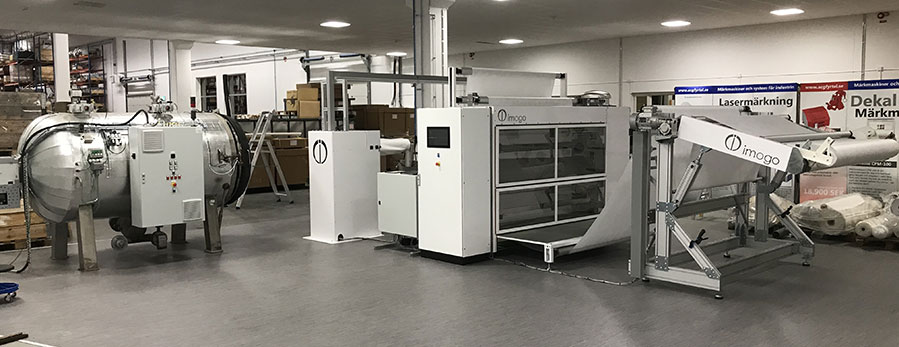
Imogo’s new showroom will open in January 2020 in Borås, Sweden (c) 2019 imogo
Swedish textile machinery association TMAS is welcoming two new companies – both at the forefront of sustainable and Industry 4.0-enabled technologies – to its membership.

A new benchmark for embroidery

The first is Coloreel, the developer of a thread coloring unit which enables the instant and high-quality coloring, fixation, washing and lubrication of thread to take place simultaneously to the actual embroidering of a fabric, representing a bold and entirely new approach to this traditional field.

Based on a CMYK ink system, Coloreel’s advanced colorization software and instant thread coloring technology allows a single needle to carry out what previously required multiples of them, and with much more consistent stitch quality.

Designed to work with any existing industrial embroidery machine without modification, the stand-alone Coloreel unit provides complete freedom in the creation of unique embroideries, imposing no limitations on the number of customized colors employed in designs. It allows set-up and lead times to be reduced as well as significant flexibility in production schedules, while eliminating the need for large thread inventories.

With fewer trims required for color changes, the Coloreel unit can also reduce the total production time required for complex designs by up to 80%, as well as instant reaction to the specific color requirements of customers.

“Our system is allowing customers to achieve color effects that have never been seen before – and at a new level of efficiency,” says Magnus Hellström, VP Sales & Marketing at Coloreel. “We are setting the new benchmark for the embroidery industry and we are pleased to join TMAS to help us spread the word.”

Coloreel’s system is allowing customers to achieve color effects that have never been seen before (c) 2019 Coloreel


Sustainable fabric dyeing

Meanwhile, the second new TMAS member, imogo, has been working to provide much more sustainable fabric dyeing than has until now been possible.

In January 2020 the company will open up its new showroom in Borås, Sweden, in order to fully demonstrate to customers how its patent-pending FlexDyer® process provides opportunities for major savings in water, energy, chemicals and dyes, as well as in maintenance and labor.

Its combination of high-speed spray application and a special autoclave fixation step enables flexible output at considerably reduced costs, and what makes it truly flexible is the range of fiber types and blends it can accommodate.

Imogo’s Mini-Max spray test unit for the achievement of offline ‘right first time’ results for the company’s industrial scale Dye-Max will also be installed at the Borås showroom.

Dye-Max spray dyeing technology can slash the use of fresh water, wastewater, energy and chemicals by as much as 90% compared to conventional jet dyeing systems.


“The Dye-Max application unit is based on a closed chamber containing a series of spray cassettes with precision nozzles for accurate and consistent coverage,” explains imogo’s founding partner Per Stenflo. “This works in combination with our patented pro speed valve that controls the volume to be applied.”
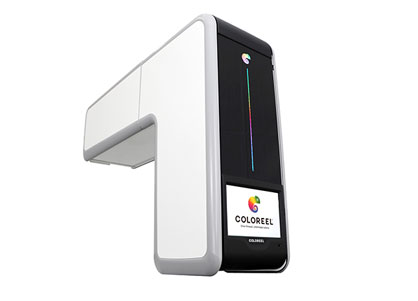
The stand-alone Coloreel unit provides complete freedom in the creation of unique embroideries (c) 2019 Coloreel


The savings in treatment water the Dye-Max achieves are due to the extremely low liquor ratio of 0.3-0.8 liters per kilo of fabric and at the same time, the low liquor ratio and the spray process require considerably less auxiliary chemicals to start with.

All of the water is used in the process, which also greatly reduces the production of wastewater, with only 20 liters being required for wash at changeovers. The low liquid content in the fabric meanwhile minimizes the energy required for fixation.

The Dye-Max has a working speed of up to 50m/min with the practical speed determined by the fabric weight and application volume.

The Spray Applicator can also be incorporated in existing lines to replace a padder, both for dyeing and applying finishing chemistry, in order to increase their productivity and reduce the environmental footstep of existing processes.

Awards

Both new TMAS companies have already received awards for their technologies. Coloreel has claimed the SKAPA prize – Sweden’s largest innovation award – as well as recognition from Texprocess. Imogo has been selected as one of Hello Tomorrow’s Deep Tech Pioneers, received a Vinnova innovation grant and been awarded the Seal of Excellence by the European Commission for its FlexDyer project.

“We are happy to welcome these two exciting companies to our industry and the TMAS association,” says TMAS Secretary General Therese Premler-Andersson. “Both are making important contributions to the industry’s sustainable future with completely new technologies on the market. They improve efficiency and quality and reduce waste in their production processes – benefits that are in line with the expectations for the textile production of the future.

“It is no coincidence that these newcomers are from Sweden. Our focus on sustainable solutions goes a long way back and is boosted by a very good innovation climate. These are interesting times, with big Swedish companies such as IKEA and HM pushing for sustainable production methods and materials, and this ensures we at TMAS are constantly on our toes to stay on top with innovation.”
More News from Textile Machinery Association of Sweden

More News on Associations

#Associations

Sustainability: European industry calls on EU to keep Single-Use Plastics Directive unchanged

A broad coalition of European industry associations, including EDANA, Euratex and Plastics Europe, has urged EU institutions to maintain the current legal framework of the Single-Use Plastics Directive (SUPD). In a joint statement, the organisations argue that reopening the Directive at this stage would create legal uncertainty, increase regulatory complexity and undermine investment, while its implementation across the European Union is still incomplete.

#Associations

Textile machinery: Italian technology charts the course for revival

Operating in a scenario characterized by geopolitical instability, slowing industrial investments, and new protectionist pressures. This is the main challenge for the Italian textile machinery industry that emerged during the General Assembly of ACIMIT (Association of Italian Textile Machinery Manufacturers), held today in Milan at the Shareholders’ Hall of Palazzo Edison.

#Recycling / Circular Economy

New skills for a circular textile economy

Based on the results of a comprehensive analysis, the Erasmus+ project Skills4Circularity is developing three practical training modules covering recycling technologies, eco-design for the circular economy and sustainable manufacturing. The content of the first module, Recycling Technologies, has now been developed and validated together with industry representatives. The module provides participants with knowledge of regulatory requirements, material sorting and the preparation of textile waste for recycling.

#Associations

Bangladesh: Italian textile machinery mission stops in Dhaka and Chittagong

Technological upgrading and the transition toward higher value-added production are driving the new Italian industrial mission to Bangladesh. This year, the mission will split between the country’s two main manufacturing hubs, where Italian manufacturers will meet the leaders of the local textile supply chain in two strategic stages: July 7th in Dhaka and July 9th in Chittagong.

Latest News

#Nonwoven machines

A Penteadora starts up ANDRITZ textile recycling and needlepunch nonwoven lines in Portugal

A Penteadora SA has successfully started up a complete mechanical textile recycling line and a needlepunch nonwoven line supplied by ANDRITZ at its production site in Unhais da Serra, Portugal. This investment enables A Penteadora to expand its industrial capabilities and develop a new generation of solutions based on pre- and post-consumer recycled textiles. The input materials originate from its own production waste and other textile waste streams. Both lines are fully operational, and the first products are expected to reach the market in July.

#Recycling / Circular Economy

ReHubs elects new Board of Directors to lead the next phase of ReHubs’ strategy to recycle 2.7 million tonnes of textile waste annually by 2035

ReHubs has elected its new Board of Directors, marking an important milestone as the industry alliance continues to accelerate the industrial scale-up of textile-to-textile recycling across Europe. The election took place during the ReHubs Annual Event in Brussels on June 23rd, held alongside the Textile Recycling Expo and Future Fabrics Expo. The newly elected Board combines expertise from across the textile value chain, reflecting ReHubs' collaborative approach to solving the industry’s textile waste crises.

#Dyeing, Drying, Finishing

Ferraro S.p.A. acquires the “Finishing” business unit of Cibitex S.r.l.

Ferraro S.p.A. and Cibitex S.r.l. are pleased to announce the completion of the agreement pursuant to which Ferraro S.p.A. has acquired the “Finishing” business unit of Cibitex S.r.l., specialized in the development and manufacturing of technological solutions for textile finishing.

#Recycling / Circular Economy

Reju opens its first R&D Center in the U.S. in Conshohocken, Pennsylvania

Reju, the company specializing in textile regeneration, today announced the opening of a Research and Development (R&D) Center in Conshohocken, Pennsylvania, the company's first proprietary research center in North America. Located within Technip Energies' existing Advanced Materials and Catalysts research center, the lab will allow Reju to accelerate the rollout of its recycling technologies and develop its next-generation circular solutions.

TOP