#Dyeing, Drying, Finishing
Monforts MXL helps bed sheets remember
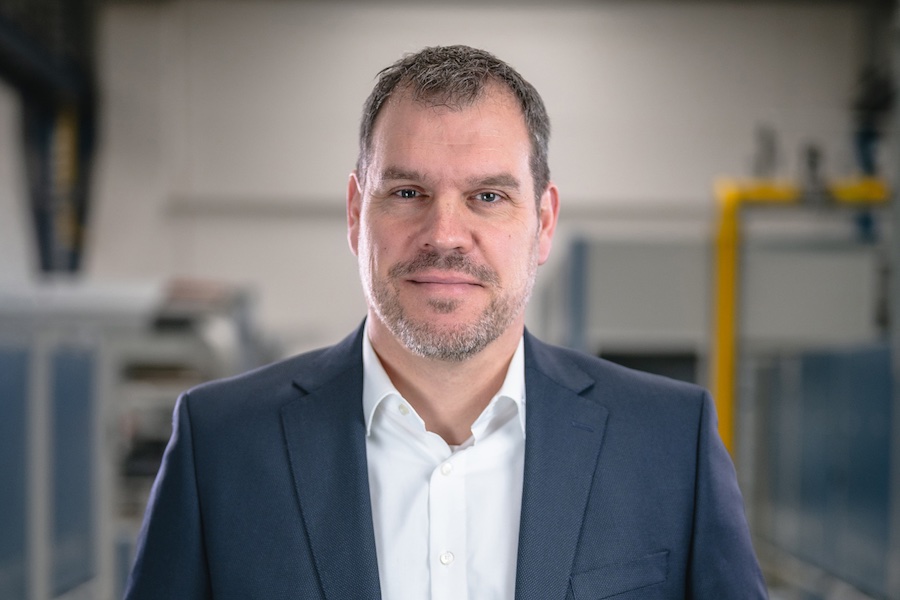
“Wrinkle-resistant bed sheets which require limited ironing – if at all – are allowing manufacturers to differentiate with easy care products in a very competitive market,” says Peter Tolksdorf, Monforts’ Head of Product Management for Dyeing and Application. “As a consequence we are having notable success in selling our MXL range, and particularly in India.”
Crosslinking involves the resin finishing of cellulose material, usually cotton, to significantly reduce a fabric’s propensity to wrinkling. Upon application, the reactive resins penetrate into the fabric and catalyse the fibres during heating and curing.
“This creates a dry dimensional structure which in a sense has a degree of shape memory and even if wrinkled will return to its original form,” Mr Tolksdorf explains. “It’s also possible to achieve exactly the opposite of this, and provide products with permanent creases, in trousers, for example.”
“The Monforts MXL process,” he added, “differs significantly from both conventional dry crosslinking methods and other technologies for moist crosslinking, bringing a number of benefits – not least a vast reduction in processing times, in addition to greater flexibility and increased safety compared to other systems.”
With dry crosslinking, the fabric is opened in the stenter and all chemicals are applied by padder, the fabric is then dried in the stenter and cured.
“This can be appropriate for 90% of cotton products, but the resulting fabrics are not entirely wrinkle-free and the results vary significantly depending on the cotton quality,” said Mr Tolksdorf. Conventional moist crosslinking is somewhat different, in employing chemicals which cannot be applied at high temperature. As a consequence, the process is carried out at around 80°C to protect and support the reaction at low temperature and then dried down to defined residual moisture. Afterwards the fabrics have to go through a 24-hour batch curing process.
“The disadvantages here are the lengthy process time and the limited opportunity for variation in the treatment of fabric,” Mr Tolksdorf said. “In addition, there’s a very narrow temperature band for optimising parameters which adds an element of risk, and the fabric must be thoroughly washed off afterwards.”
With the MXL process the complete process and drying are carried out simultaneously at a higher temperature of 100°C and relative humidity of 30%.
“Basically, MXL reduces the processing time required from twenty hours to just three minutes,” said Mr Tolksdorf. “Because of the very special climate that’s created, the process is much less risky, since the residual moisture is consistent from start to finish, and very good control can be achieved with the unit’s measurement system.
“The process is extremely precise and reproducibility is guaranteed. It can also be with aromatic and wellness treatments to provide further product differentiation.”
“For the mills, it also leads to process simplification and improved logistics.”