[pageLogInLogOut]

#Textile chemistry

Novozymes Q1 in line with expectations; 2015 outlook adjusted for currencies

Novozymes, the world’s largest producer of industrial enzymes, today announced its first quarter results for 2015. Sales in the first quarter of 2015 grew by 8% organically and by 18% in DKK compared with Q1 2014. EBIT grew by 6%, and the EBIT margin was 27.4%.
Adjusting for the one-time impact from The BioAg Alliance in Q1 2014, EBIT grew by ~20%, and the EBIT margin expanded by ~1 percentage point compared with Q1 2014. The EBIT margin expansion was mainly due to currencies. Net profit grew by 2%, and free cash flow before acquisitions came in at DKK 610 million.

The 2015 outlook is adjusted for currencies only. Organic sales growth is expected at 7-9%. Currencies are expected to provide further tailwind, and sales in DKK are now expected to increase by 16-18% compared with 13-15% at previous guidance. The expectation for EBIT growth is increased by 3 percentage points to 15-17%, and the EBIT margin is adjusted to ~27%. The expectation for net profit growth is increased to 11-13%, up from 10-12%. Expectations for net investments, cash flow and ROIC are unchanged.

“First-quarter sales and earnings were good and, overall, in line with our expectations at 8% organic sales growth and an EBIT margin above 27%”, says CEO Peder Holk Nielsen. “We see good developments within the agriculture and food markets but also detect a growing uncertainty in Household Care and Bioenergy, as customers navigate volatile currency, grain and energy markets. We're positive about the year as a whole and, due to the appreciation of the US dollar, we increase our outlook.”
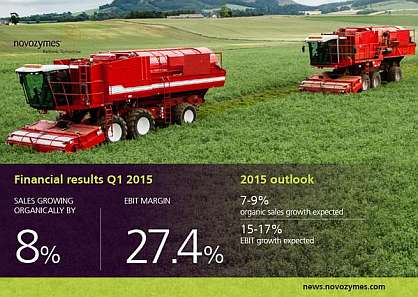
Pic: The results as a graphic

More News from Novozymes A/S

More News on Textile chemistry

#Textile chemistry

DyStar Group announces Board transition to drive innovation

DyStar, a leading specialty chemical company with a heritage of more than a century in product development and innovation, announced today the appointment of Ruan Cunfan to its Board of Directors, effective 20 February 2026.

#Textile chemistry

Jeanologia urges industry to accelerate PP Spray phase-out following ZDHC Watchlist update

Potassium permanganate has officially entered the Chemical Watchlist of the ZDHC Foundation, signaling increased scrutiny and potential phase-out of one of the most hazardous chemicals still used in denim finishing. The inclusion confirms an industry shift that Jeanologia anticipated more than a decade ago.

#Textile chemistry

RUDOLF gets the exclusive global distribution rights for Sanitized® textile technologies

With effect from today, RUDOLF officially assumes exclusive global distribution rights for Sanitized® textile technologies from SANITIZED AG. This is the next milestone in the strategic collaboration announced in 2025, with the partnership between the two companies now fully implemented and expanded worldwide.

#Denim

organIQ seek: smart alternative to potassium permanganate

CHT Group announces new technical findings within its organIQ seek platform that significantly advance the transition toward permanganate-free denim bleaching. Through extensive industrial testing and application research, CHT confirms that organIQ seek can now be used with remarkable effectiveness as a substitute for potassium permanganate in spray bleach, while remaining aligned with sustainability expectations and cost realities in the European market. At the COLOMBIATEX in Medellín as well as at the Exintex in Puebla and the Kingpins Show in Amsterdam the CHT Group will present organIQ seek as an alternative to potassium permanganate.

Latest News

#Techtextil 2026

Gebr. Otto highlights versatility at Techtextil with regional supply chains, yarn innovations and new hygiene segment

At this year’s Techtextil, Gebr. Otto places its versatility at the center of its presentation. In addition to spinning, twisting and dyeing – traditionally focused on fine cotton – textile processors will also find a competent development partner for technical specialty solutions. The Dietenheim-based spinning mill has now built up a decade of experience in the production of technical yarns, particularly from aramids. A new hygiene segment has also been established, where yarns for medical and hygiene products are currently being produced. In the future, this department could also develop textile products for the food sector. Gebr. Otto will once again be present at the BW-i joint stand, booth D81, hall 12.1. What is wound onto the spool is determined by the customer: Gebr. Otto develops according to specific customer requirements and transforms its own ideas into yarn innovations.

#Europe

Commission presents proposal for EU Inc. - unlocking the full potential of the Single Market for Europe's entrepreneurs

Today, the European Commission presented its proposal for EU Inc., a new single set of corporate rules, building the cornerstone and starting point for the EU's 28th regime. EU Inc. is an optional, digital-by-default European corporate framework. It will make it easier for businesses to start, operate and grow across the EU – incentivising them to stay in Europe, and encourage those who once looked elsewhere to return.

#Man-Made Fibers

OnceMore® from Södra brings end-to-end traceability for circular Man-made Cellulosic Fibers (MMCF) using TextileGenesis

OnceMore® from Södra, the world’s first large-scale process for recycling blended fabrics into high‐quality dissolving pulp, will begin using TextileGenesis, a Lectra company, to strengthen traceability from raw material to retail across the value chain. OnceMore® produces dissolving pulp made from blended textile waste and wood sourced from responsibly managed Swedish forests. By integrating TextileGenesis, OnceMore® supports the growing need for verified data and secure, transparent tracking throughout increasingly complex supply chain.

#Sustainability

Experts publish APAC policy priorities

Cascale today announced the publication of its APAC Policy Priorities Paper, developed by the Asia-Pacific (APAC) Policy Member Expert Team (MET) to identify key regional sustainability challenges and provide practical, aligned recommendations for policymakers and industry stakeholders across Asia-Pacific.

TOP