#Textile chemistry
Clariant Innovation Center Cornerstone Laid at Industriepark Höchst for 500 New Research Jobs
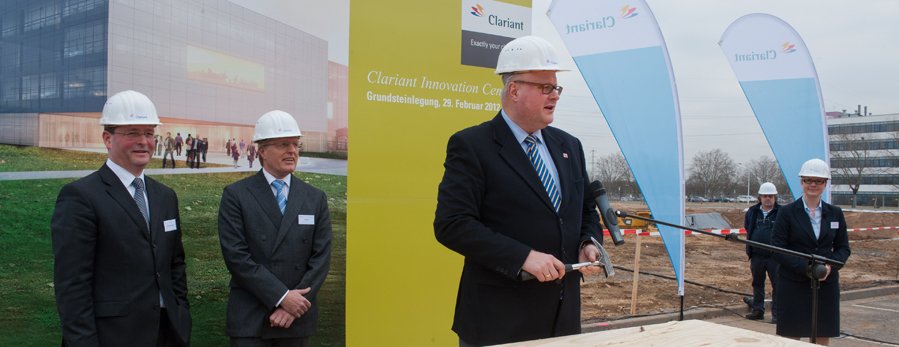
+ Finance Minister Thomas Schäfer: Investment brings major benefits
+ Christian Kohlpaintner: 100 million euros to provide optimal conditions for sustainable, successful research
Over the nex t several months, the Swiss specialty chemicals corporation will build an innovative office and laboratory facility of roughly 36,000 square meters (approximately 387,000 square feet) on a site that will soon provide jobs for some 500 researchers. The concept for the building, which aims to offer an optimal working environment through its open architectural design, was developed by the Düsseldorf-based architectural firm of HPP.
“Innovation is the foundation of the future, both for individual companies and society as a whole,” said Christian Kohlpaintner, whose responsibilities at Clariant include Research and Development. “I hope that the bright and transparent rooms will not only be the birthplace for new ideas that flourish and grow, but also provide the environment for an inspiring exchange between our researchers and technicians, as well as with their partners in the fields of science and industry,” added Dr. Kohlpaintner. He also emphasized Clariant’s targeted research policy: “We want to develop products and procedures that yield sustainable benefits and represent true progress.” He underscored that a major focus in the future will be on megatrends, such as functional materials, energy efficiency and renewable raw materials.
Quoting scientist and statesman Benjamin Franklin, Dr. Thomas Schäfer stated: “Investing in knowledge still pays the highest return.” He said that the construction of a research and innovation center would benefit all parties involved: the company, whose future is visibly taking shape; the industry park, which will strengthen its reputation as knowledge and ideas factory; and the region and State of Hessen, which will gain from the new jobs for highly qualified professionals.
“Investments of this kind and magnitude also demonstrate the courage, determination and willingness to shape the future,” said Dr. Schäfer. Clariant’s global research activities will, in the future, be centered in Höchst, Germany.
“We have selected Höchst as the location because it already provides a maximum of research and development resources, including technical schools and institutions of higher education,” explained Dr. Ulrich Ott. “In addition, Frankfurt offers a number of infrastructure advantages, such as an attractive industry park, the proximity to various business partners and universities, as well as excellent connections to the transportation network.”
The building design by the HPP architectural firm of Düsseldorf, Germany, is based on an open concept for an office and laboratory building. This approach is meant to enhance chemical research and development of application-specific laboratories and technical marketing functions for different business units. In addition to Analytics, the new facility will be the location of the New Business Development and Intellectual Property Management units as well as the Patent department. An objective of bringing together different disciplines is to enhance Clariant’s R&D pipeline and further improve the company’s innovation capabilities.
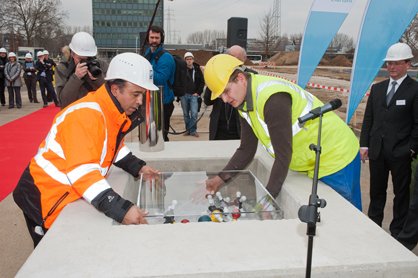
The cornerstone also symbolizes this. Right next to it is a sealed stainless steel tube containing various legal and other documents – building certificate, construction permit, construction drawings and a local newspaper – as well as a three-dimensional model of the DEPAL molecule that was also driven into the ground. DEPAL is the acronym for diethyl phosphinic acid aluminum salt – the chemical name of Clariant’s successful flame retardant, which is the basis for the company’s Exolit® OP products. The molecule will remain visible to the visiting public under a glass panel in the floor of the building.