[pageLogInLogOut]

#Recycling / Circular Economy

From design to recycling: Navigating ESPR product requirements for a circular economy – policy roundtable
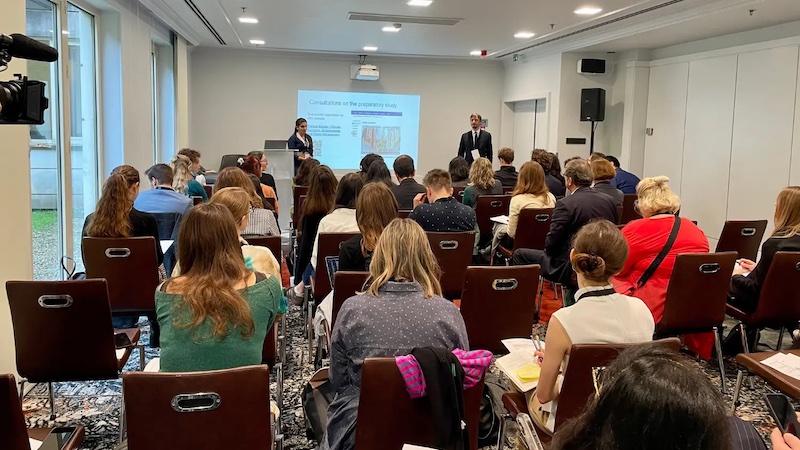
T-REX Project hosted a policy roundtable on the Ecodesign for Sustainable Products Regulation (ESPR) in Brussels. The event encouraged an open exchange on key issues between stakeholders including brands, manufacturers, policymakers, and other key players in the textile industry ecosystem.
© 2024 T-Rex
© 2024 T-Rex


The event kicked off with opening remarks from Drishti Masand from adidas, and Blanca Saez Lacave, Project Adviser for Horizon Europe at REA, followed by an introduction to the project from Melisa Saygivar from adidas.

Antonio De Sousa Maia, Legal and Policy Officer at the EU Commission, set the policy context with an in-depth overview of ESPR and the Delegated Act for Textiles.

Our consortium partners Anja Kossel-Scharf (adidas) and Doris Hondtong (Arapaha) introduced the T-REX Project Design Guidelines for textile-to-textile recycling which are currently under development within the project.

Three panel discussions then set the scene for in-depth workshops addressing key issues relating to the successful implementation of ESPR.

The first panel discussion centred around defining recyclability with insights shared from Carsten Wentink (EU Commission), Gudrun Messias (adidas), and Marieke Koemans Kokkelink (Erdotex), moderated by Coline Morise (Fashion for Good).

The following panel addressed the challenges associated with setting recycled content targets as Rannveig van Iterson (Ohana Public Affairs, on behalf of Textile Exchange), Daniela Antunes (Fulgar) and Tobias Schwab (BASF), exchanged their views and insights on the topic moderated by Drishti Masandi.

The final panel brought together Katarzyna Sulisz (FESI), Tom Duhoux (VITO), and Hasna Kourda (Save Your Wardrobe) to discuss insights around the issue of product repairability and durability, moderated by Kirsi Niinimäki (Aalto University).

The roundtable participants exchanged insights and brainstormed solutions in interactive workshops on defining recyclability and setting recycled content targets. These discussions touched on topics such as the criteria that make a textile “recyclable”, the challenges of material composition, and various recycling technologies and their different approaches to recycling.

Workshop participants also addressed the challenge of setting ambitious targets for recycled content while considering the limited supply, feedstock traceability, and the pros and cons of setting recycled content targets at the material portfolio level vs product-specific targets.

The roundtable concluded with closing remarks from Lutz Walter, Secretary General at Textile ETP, highlighting the importance of continued collaboration in the space.

Stay tuned for an upcoming white paper Aalto University will shortly release revealing the key insights and takeaways from the workshops.


More News from T-Rex

More News on Recycling / Circular Economy

Latest News

#Heimtextil 2026

Mimaki demonstrates versatile, simple TRAPIS textile printing at Heimtextil 2026

Mimaki’s textile pigment transfer printing system, TRAPIS, is able to print on a diverse range of fabrics - unlike traditional processes - including natural fibres and synthetic fabrics. The full solution will be shown on Mimaki’s booth (Hall 3.0 Stand A97), as the company returns to Heimtextil to showcase its advancements in sustainable, high quality and efficient textile printing.

#ITM 2026

The Technology Hub for global denim trends: ITM 2026

The ITM 2026 International Textile Machinery Exhibition, to be held at the Tüyap Fair and Congress Center in Istanbul from June 9–13, 2026, brings together groundbreaking technologies in denim production. From smart production systems to eco-friendly raw materials, from digital washing solutions to laser effect technologies, innovations that will shape the future of denim will be showcased for the first time at ITM 2026.

#Natural Fibers

38th International Cotton Conference Bremen: Let´s Talk about Cotton!

The 38th International Cotton Conference Bremen, to be held on 25-27 March 2026 in Bremen’s parliament building on market square, once again sends a powerful signal for professional excellence and international dialogue. The focus is on the latest market trends and technical innovations throughout the entire value chain – from agriculture and quality assurance to processing and the circular economy. With its high-calibre speakers, the conference remains an indispensable forum for anyone involved in shaping the cotton industry scientifically, technically, or economically.

#Research & Development

More safety and comfort for protective clothing thanks to auxetic fabrics

When everyday materials are pulled, they stretch or elongate in the direction of the pull and become narrower in cross-section. We can also observe this property in two-dimensional textiles. Auxetic structures behave differently here. They have the striking property of not changing under tensile stress or even increasing their width or thickness. These properties are advantageous, for example, in protective textiles or textile filter media. The DITF are researching auxetic fabrics for various applications.

TOP