[pageLogInLogOut]

#Yarn & Fiber

No mosquitoes, bedbugs and mites
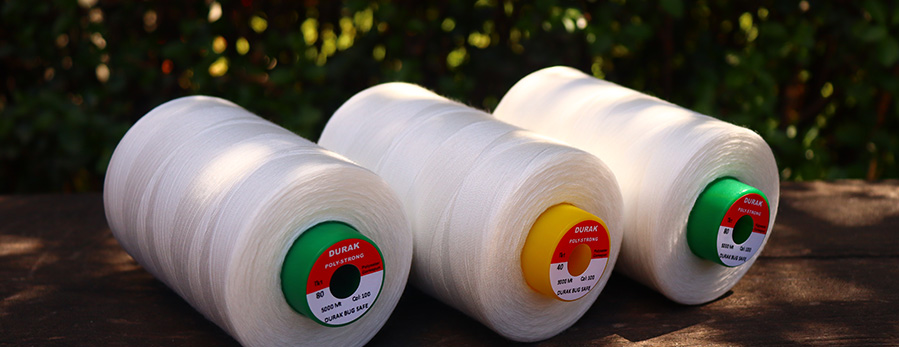
(c) 2024 Durak Tekstil - Durak Bug Safe thread
Durak Bug Safe thread, the latest development of Durak Tekstil, offers a healthy and sustainable option for keeping invisibly small insects and pests away from textile products without containing harmful chemicals.

Durak Tekstil, manufacturer of industrial sewing and embroidery threads, eliminates the problem of insects and flies in many applications, especially in bed and home textile products, with the Bug Safe thread it has developed. Bug Safe thread, free of any chemicals harmful to humans and the environment in addition to its protective feature against insects, contributes to the protection of the ecosystem and the environment by repelling these creatures instead of killing them.

Almost invisible to the naked eye, these insects and pests need moist and warm environments to live and reproduce. Organic particles such as human and pet skin residues and food crumbs penetrate the inner layers of furniture, carpets, bedding and even toys, creating a favourable environment for these creatures. Durak Tekstil has developed the Durak Bug Safe thread with intensive R&D studies to keep invisibly small creatures such as mosquitoes, bed bugs and mites, which are risky for health and comfort, away from textile products and usage areas. This new solution, free of prohibited permethrin chemicals, prevents the settlement and reproduction of these creatures in textile products, especially in seam areas. Durak Bug Safe thread, with a special and natural odour component, has proven its success in various textile applications such as bedding, furniture, carpets and curtains with its insect-repellent feature. Developed primarily for sewing purposes, the thread can also be preferred for mosquito-repellent embroidery applications.

More in-depth and long-lasting insect protection

Durak Tekstil Board Member and Marketing Director Yi?it Durak said that people can encounter insects and pests in all areas of life and stated that a lot of methods are used in textile products in this regard: “People can create favourable environments for insects with both food residues and their own sheds. An average adult sheds 1.5 grams of skin per day, which can be enough for one million dust mites to live. External odour and chemical treatments such as sprays can be used to control them on textile surfaces such as beds, sofas, carpets and curtains; however, their effectiveness is short-term and narrow in scope. Holes and nooks and crannies created during the sewing of textiles can become ideal environments for these pests to live and lay eggs, and solutions such as sprays are not effective here. In these solutions, which may contain prohibited components, the killed pests still remain on the textile surfaces. Therefore, we need a different solution to make our living space more sterile and comfortable. While developing the Durak Bug Safe thread, we focussed on exactly this need. As a healthy and sustainable solution, Durak Bug Safe, instead of killing pests, keeps them away from textile surfaces and repels them.”

Reminding that permethrin chemical components, a kind of prohibited pesticide, are widely used in anti-insect products, Durak emphasised that this poses risks for both the environment and human health. Durak continued his words as follows; “Our main priority was not to use banned chemicals while developing a healthier and sustainable solution for textiles that we directly contact such as mattresses, sofas and carpets. While developing the Durak Bug Safe thread, we used a special fragrance of natural volatile geranium and lemongrass essential oils without permethrin for insect and pest repellency. Thus, we obtained a shield that creates an insect-free area. While protecting our personal comfort and health, we did not harm the ecosystem.”

Independent test laboratory registered the success of Durak Bug Safe

Yigit Durak explained that they cooperated with an independent test laboratory in Germany during the development process of the Durak Bug Safe thread and stated that in addition to the certification of the technical competence of the thread, the tests on living organisms were also carried out within the framework of ethical principles. He expressed; “The qualitative measurements made on the samples we have prepared have proved the repellency level of our thread for mites, bedbugs and mosquitoes. It has been reported that we have obtained successful results in the preliminary tests for OEKO-TEX. When the tests are completed, we will receive the OEKO-TEX Class 1 certificate.”

Durak Bug Safe thread, which does not allow insects to live and reproduce in sewing and embroidery application areas, was developed in light colour, but it can be produced in any colour according to customer demand. The new thread, which maintains its insect-repellent function up to 50 washes, provides lifetime protection as long as it is not washed. Durak Bug Safe thread offers new opportunities and new market opportunities to manufacturers with its suitability for various textile applications.

He noted that the Durak Bug Safe thread will become an assertive product in both local and global markets, saying that especially geographies in humid and hot climatic conditions come to the fore. Durak also expressed that they appeal to numerous different segments from toys to furniture, carpets to clothing products, and underlined that they have developed a suitable solution for protective clothing for those working in the agricultural sector and outdoor products such as tents. Durak concluded; “While developing and protecting the living spaces of humans, we need to respect the living spaces of other living things as a part of the ecosystem. We are pleased to launch our Durak Bug Safe thread with insect/pest deterrent/repellent feature that increases the hygiene in our living space while increasing the comfort of the users.”



More News from TEXDATA International

#ITM 2026

ITM 2026: The new geography of textile production

New production hubs are emerging across North Africa and Central Asia, while Türkiye is accelerating its transformation toward higher-value, technology-driven and more sustainable textile manufacturing.

#Research & Development

“Production is a product”

From technical textiles and AI-driven robotics to the limitations of textile circularity: Professor Dr Thomas Gries looks back on more than two decades of development at ITA Aachen. In the interview, he explains why production technology remains a decisive success factor, discusses international collaborations and innovation ecosystems, and shares his views on the transformation of production landscapes and the challenges facing an increasingly regulated industry.

#Knitting & Hosiery

“We need to move away from the price trap and return to a value-driven mindset.”

With its new Textile Innovation Center, KARL MAYER is sending a strong signal for innovation, collaboration, and the future of textile applications. In this interview, Karl Josef Mayer discusses new opportunities in warp knitting, the processing of staple fibres, recycling, the changing role of machinery manufacturers, and why the textile industry must once again focus more strongly on the value of textiles. by Oliver Schmidt

#Associations

“Innovation, resilience and international experience remain the great strengths of the Swiss textile machinery industry”

Geopolitical uncertainty, growing competitive pressure from China, new free trade agreements and the shift towards a circular economy are currently reshaping the global textile industry. In this interview, Cornelia Buchwalder discusses the current mood within the Swiss textile machinery sector, the industry’s distinctive innovative strength, new market opportunities in India and Asia, and the technological trends that could shape the upcoming trade fair cycle leading up to ITMA 2027.

More News on Yarn & Fiber

#Sustainability

The first widely accessible Life Cycle Assessment study for cashmere production published by Textile Exchange.

Crucial new data to better understand, measure, and address the impacts of cashmere production has been made available to the fashion, textile, and apparel industry through a new Life Cycle Assessment (LCA) published by Textile Exchange.

#Yarn & Fiber

R-Evenge chooses Q-NOVA® yarn by Fulgar for its line of technical socks dedicated to wellness

Q-NOVA®, Fulgar’s sustainable polyamide 6.6 yarn, has been selected by R-Evenge for the development of its collection of technical socks dedicated to wellness, fitness, and water-based activities.

#Yarns

Yarn Expo Shenzhen 2026 closes doors, advancing sustainable and innovative sourcing in South China

Yarn Expo Shenzhen 2026 served as a strategically positioned mid-year sourcing platform for the Greater Bay Area, highlighting Shenzhen’s role in connecting regional demand, supply and innovation exchange across the textile value chain. During the three-day fair, over 20,000 visits were drawn from 74 countries and regions[1], as exhibitors and buyers engaged with new developments in greener, performance-led, and value-added yarn and fibre solutions. Held in conjunction with Intertextile Shenzhen Apparel Fabrics and PH Value, the fair underscored the benefits of closer synergy and new materials across yarn, fabric and apparel platforms for the South China market.

#Yarns

Yarns and technologies in symbiosis: Biella Yarn presents Fall/Winter 2027/2028 collection “New Romance_”

Biella Yarn, the flat knitting brand of Suedwolle Group, launches new Fall/Winter 2027/2028 collection, inspired by the symbiosis of yarns and technologies – elements that blend, adapt and evolve together, forming something new without losing their origin. The name “Neu Romance_” reflects the emotional and neurological dimension of the yarns: a connection that engages the senses, experienced through material, touch and interaction. The collection is further brought to life through design collaborations, featuring selected yarns used in different design approaches.

Latest News

#Spinning

Rieter sees Barmag integration on track as orders and sales rise

The first half of 2026 was shaped by the successful completion of the largest acquisition in Rieter’s history. The Man-Made Fiber Division enables entry into the growth segment of man-made fibers and sustainably strengthens Rieter’s market position in the Asia region. The expanded Group is now the world’s leading system supplier for the processing of natural and man-made fibers. In the first half of the year, initial cost savings in material costs and operating expenses have already been realized. The targeted synergies are expected to amount to at least CHF 20 million by the end of the 2028 financial year. Due to the completion of the acquisition on February 2, 2026, the first half of the year for the Man-Made Fiber Division only amounts to five months.

#Knitting & Hosiery

Groz-Beckert at Igatex 2026

From October 15 to 18, 2026, Groz-Beckert will present its latest innovations and solutions across the product areas of Knitting, Weaving, Sewing and Spinning at Igatex in Pakistan (Hall 1, Booth A-1-08).

#Natural Fibers

Better Cotton Initiative multistakeholder event in US unpacks regenerative agriculture potential

The Better Cotton Initiative (BCI), in collaboration with Texas-based partner, Quarterway Cotton Growers, will expand upon its annual US field event to relay the vast potential of regenerative agriculture through an immersive experience of tours and demonstrations.

#Sustainability

bluesign appoints Hanane Taidi as CEO to lead next phase of global impact

bluesign, which partners with the textile industry to reduce adverse impact across the value chain, appoints Hanane Taidi as Chief Executive Officer, marking a pivotal moment as the company builds on its leadership amid rapid industry change.

TOP