[pageLogInLogOut]

#Yarn & Fiber

NatureWorks’ Ingeo PLA manufacturing expansion attracts Rrecord financing from Krungthai Bank PCL of Thailand
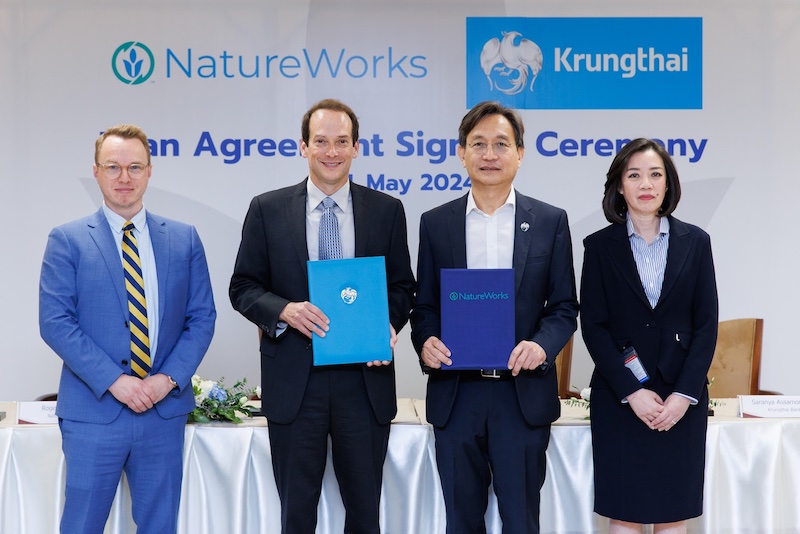
NatureWorks, a leading manufacturer of polylactic acid (PLA) biopolymers made from renewable resources, today announced the historic financial support from Krungthai Bank PCL to optimize the capital structure for the new fully-integrated Ingeo™? PLA manufacturing facility in Thailand. The financing from Krungthai Bank, Thailand’s third largest bank, amounting to $350M USD (12,600M Baht Equivalent), is one of the singular largest loans in the bank’s decades-long history and shows confidence in NatureWorks’ market leadership and global economic impact. Today, the companies participated in a signing ceremony to celebrate this milestone.
Executives from NatureWorks and Krungthai Bank PCL finalized new financing for NatureWorks’ new fully integrated Ingeo PLA manufacturing facility in Thailand which is on track to open in 2025. Pictured from left: Roger Kempa, Interim CFO, NatureWorks; Erik Ripple, President & CEO, NatureWorks; Suratun Kongton, Chief Wholesale Banking Officer, Krungthai Bank; Saranya Assamongkol, EVP, Sector Head, Corporate Banking Sector 7, Krungthai Bank © 2024 NatureWorks


In alignment with its ESG values and sustainable finance solutions, Krungthai Bank funded NatureWorks’ newest manufacturing facility for Ingeo PLA biopolymer, a biobased material used in plastic and fiber applications. The funding will support the construction of the plant and its ongoing operations. NatureWorks was chosen because of its market leadership in defining bioplastic technologies and how those solutions will move Thailand's Bio-Circular-Green (BCG) economy forward. BCG leverages technology and Thailand's biological diversity to enable a more sustainable, innovation-driven, and values-based economy.

“This backing from Krungthai Bank not only validates our strategic global positioning within Thailand and the Asia Pacific region but propels us toward continued expansion to support the worldwide bioeconomy,” said Erik Ripple, President and CEO of NatureWorks. “The funding will enable us to expand our international customer access to fully biobased, low-carbon biomaterials that feature unique performance attributes valued by global downstream packaging and fiber markets.”

NatureWorks’ second facility will be located at the Nakhon Sawan Biocomplex, the first bio-complex in Thailand established in accordance with the BCG Economic Model. The area has a strong agricultural base that can provide an abundant, locally available feedstock in the form of sugarcane. NatureWorks chose the site for its proximity to where sugarcane is grown, with established infrastructure for processing sugarcane into a sugar feedstock for the fermentation process, and the availability of desired utilities for the plant’s operation.

“Thailand is a regional and global leader in driving the development of a global bioeconomy, and commercial banks play a crucial role in driving this transition,” said Suratun Kongton, Chief Wholesale Banking Officer of Krungthai Bank. “We’ve provided NatureWorks with the financing because it is a world leader in manufacturing biomaterials, meets the requirements to drive our country’s BCG model forward, and aligns with our commitments to address climate change and facilitate the transition to a circular economy. NatureWorks is also creating additional high-value downstream opportunities for existing sugarcane farmers in the Nakhon Sawan region.”

“This investment is monumental for NatureWorks, Cargill, and GC as it moves our joint commitment to environmentally friendly bio-chemicals and biomaterials forward at a time where global demand is increasing,” said Narongsak Jivakanun, NatureWorks Board Chair, CEO of PTT Global Chemical Public Company Limited (GC). “With this infusion of financial support from Krungthai Bank for NatureWorks’ new PLA manufacturing facility, NatureWorks will continue to be competitive in the biomaterials market, pioneering new frontiers for bioplastic applications and advancing biobased solutions with sufficient capacity to capture customer needs across the growing Asia Pacific bioeconomy.”

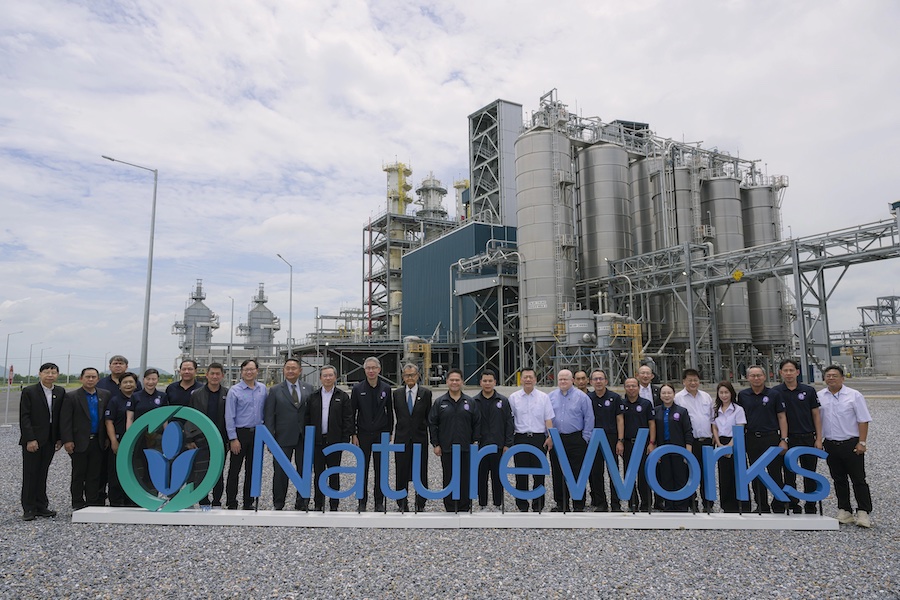
The new manufacturing facility is designed to be a fully-integrated PLA complex, including production sites for lactic acid, lactide, and polymer. With an annual capacity of 75,000 tons of Ingeo biopolymer, it will produce the full portfolio of Ingeo grades and support the rapid market growth across many markets in the Asia Pacific region, including 3D printing, nonwovens for hygiene, compostable coffee capsules, tea bags, flexible packaging, and compostable food serviceware. Ingeo biopolymers produced at this site will be made from sugarcane sourced from farms within a 50-kilometer radius of the Nakhon Sawan site. Construction is on track to support projected start-up activities and full production in 2025.



More News from NatureWorks

More News on Yarn & Fiber

#Yarn & Fiber

R-Evenge chooses Q-NOVA® yarn by Fulgar for its line of technical socks dedicated to wellness

Q-NOVA®, Fulgar’s sustainable polyamide 6.6 yarn, has been selected by R-Evenge for the development of its collection of technical socks dedicated to wellness, fitness, and water-based activities.

#Yarns

Yarn Expo Shenzhen 2026 closes doors, advancing sustainable and innovative sourcing in South China

Yarn Expo Shenzhen 2026 served as a strategically positioned mid-year sourcing platform for the Greater Bay Area, highlighting Shenzhen’s role in connecting regional demand, supply and innovation exchange across the textile value chain. During the three-day fair, over 20,000 visits were drawn from 74 countries and regions[1], as exhibitors and buyers engaged with new developments in greener, performance-led, and value-added yarn and fibre solutions. Held in conjunction with Intertextile Shenzhen Apparel Fabrics and PH Value, the fair underscored the benefits of closer synergy and new materials across yarn, fabric and apparel platforms for the South China market.

#Yarns

Yarns and technologies in symbiosis: Biella Yarn presents Fall/Winter 2027/2028 collection “New Romance_”

Biella Yarn, the flat knitting brand of Suedwolle Group, launches new Fall/Winter 2027/2028 collection, inspired by the symbiosis of yarns and technologies – elements that blend, adapt and evolve together, forming something new without losing their origin. The name “Neu Romance_” reflects the emotional and neurological dimension of the yarns: a connection that engages the senses, experienced through material, touch and interaction. The collection is further brought to life through design collaborations, featuring selected yarns used in different design approaches.

#Recycling / Circular Economy

The textile industry in transition

Recycling, traceability, eco-design and digitalisation are among the key future challenges facing the European textile industry. The Erasmus+ project Skills4Circularity, involving 21 partners from twelve countries, is investigating the skills required to address these challenges. As the German industry partner, the Industry Association for Finishing – Yarns – Fabrics – Technical Textiles (IVGT) is bringing the industry’s perspective to the project.

Latest News

#Research & Development

ALADIN paves the way for circular and demand-driven textile production in Europe

Textile production can be organized sustainably by utilizing short supply chains and preventing overproduction. This can already be achieved today by intelligently connecting and efficiently utilizing existing infrastructure. At the same time, production becomes circular when innovative technologies and materials are used that enable high-quality recycling. The ALADIN research project, launched in May 2026 and co-funded with five million euros under the EU Horizon Europe program, is creating the conditions for this.

#Nonwovens

Katharina Obergruber appointed to the Management Board of Sandler AG

The Supervisory Board of Sandler AG has appointed Katharina Obergruber to the company’s Management Board. Effective September 1, 2026, the Board will consist of Philipp Ebbinghaus (CEO), Dr. Ulrich Hornfeck (currently CCO, future COO), and Katharina Obergruber (CCO). Katharina Obergruber, currently Chief Sales Officer Hygiene and member of the Management Team of Sandler AG, will assume responsibility for all sales activities as Chief Commercial Officer. She will assume this role from Dr. Ulrich Hornfeck, who will focus primarily on production and supply chain topics.

#Recycling / Circular Economy

Ence and ShareTex begin initial testing of the ATENEA innovation project to promote textile recycling in Spain

Ence and ShareTex are making progress on the Atenea R&D project, which aims to develop a complete value chain for textile recycling in Spain. Specifically, the goal of the ATENEA project—which is funded by the Center for Technological Development and Innovation (CDTI)—is to connect all the necessary stages for the recovery of textile waste, from collection and management, through recycling and transformation into new raw materials, to their incorporation into new textile products.

#Recycling / Circular Economy

DePoly Inaugurates its Showcase Plant in Monthey Switzerland

What if used plastic bottles, PET packaging material and polyester textiles could become raw materials just as high performing as virgin resources? That is the ambition of DePoly, a circular materials company based in Sion, Switzerland which inaugurated its Showcase Plant in Monthey on July 6th & 7th. The first depolymerization facility of its kind and scale in Switzerland, this industrial Showcase Plant represents a major milestone in the company's growth and its journey toward commercialization.

TOP

