#Yarn & Fiber
6 nominations for the Cellulose Fibre Innovation of the Year 2023
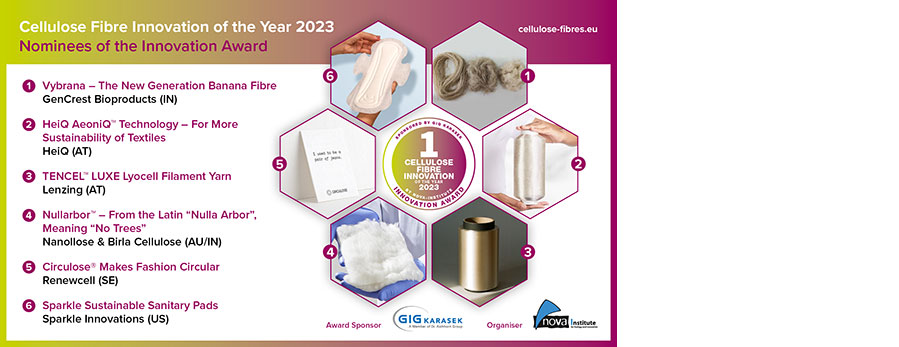
For the third time, nova-Institute awards the “Cellulose Fibre Innovation of the Year” award in the frame of the “Cellulose Fibres Conference 2023” (8-9 March 2023). The conference advisory board nominated six remarkable products, including cellulose fibres from textile waste, banana production waste and bacterial pulp, a novel technology for producing lyocell yarns and a hygiene product. The innovations will be put to the vote of the conference audience on the first day of the event, with the awards ceremony taking place in the evening. The innovation award “Cellulose Fibre Innovation of the Year 2023” is sponsored by GIG Karasek (AT).
Cellulose fibres show a steadily expanding range of applications. At the same time, markets are driven by technological developments and political framework conditions, especially bans and restrictions on plastics and increasing sustainability requirements for textiles. The European Commission has made the thorough transition towards sustainability and circularity for different industries and especially the textile sector a main focus. All nominees will therefore introduce innovative pathways towards more sustainable technologies and products.
Here are the six nominees
Vybrana – The new generation banana fibre – GenCrest Bioproducts (India)
Vybrana is a Gencrest’s Sustainable Cellulosic Fibre upcycled from agrowaste. Raw fibres are extracted from the Banana Pseudo stem at the end of the plant lifecycle. The biomass waste is then treated by the Gencrest patented Fiberzyme technology. Here, cocktail enzyme formulations remove the high lignin content and other impurities and help fibre fibrillation. The company's proprietary cottonisation process provides fine, spinnable cellulose staple fibres suitable for blending with other staple fibres and can be spun on any conventional spinning systems giving yarns sustainable apparel. Vybrana is produced without any use of heavy chemicals and minimized water consumption and in a waste-free process where balance biomass is converted to bio stimulants Agrosatva and Bio Fertilizers & organic manure.
http://www.gencrest.com
HeiQ AeoniQ™ – technology for more sustainability of textiles – HeiQ (Austria)
HeiQ AeoniQ™ is the disruptive technology and key initiative from HeiQ with the potential to change the sustainability of textiles. It is the first climate-positive continuous cellulose filament yarn, made in a proprietary manufacturing process and the first to reproduce the properties of polyester and nylon yarns in a cellulosic, biodegradable, and endlessly recyclable fibre.
HeiQ AeoniQ™ can be manufactured from different cellulosic raw materials such as pre- and post-consumer textile waste, biotech cellulose, and non-valorized agricultural waste, such as ground coffee waste or banana peels. It naturally degrades after only 12 weeks in the soil. Each ton of HeiQ AeoniQ™ saves 5 tons of CO2 emissions. The first garments made with this innovative cellulosic filament fiber were commercially launched in January 2023.
https://www.heiq.com
TENCEL™ LUXE – lyocell filament yarn – Lenzing (Austria)
TENCEL™ LUXE is LENZING’s new versatile lyocell yarn that offers an urgently needed sustainable filament solution for the textile and fashion industry. A possible botanical alternative for silk, long-staple cotton, and petrol-based synthetic filaments, is derived from wood grown in renewable, sustainably managed forests, and produced in an environmentally sound, closed-loop process that recycles water and reuses more than 99 % of organic solvent. Certified by The Vegan Society, it is suitable for a wide range of applications and fabric developments, from finer high fashion propositions to denim constructions, seamless and activewear innovations, and even agricultural and technical solutions.
http://www.tencel-luxe.com
Nullarbor™ – Nanollose & Birla Cellulose (Australia/India)
In 2020, Nanollose & Birla Cellulose started a journey to develop and commercialize tree-free lyocell from bacterial cellulose, called Nullarbor™. The name derives from the Latin “nulla arbor” which means “no trees”. Initial lab research at both ends led to a joint patent application with the patent “production of high-tenacity lyocell fibres made from bacterial cellulose”.
Nullarbor is significantly stronger than lyocell made from wood-based pulp; even adding small amounts of bacterial cellulose to wood pulp increases the fibre toughness. In 2022, the first pilot batch of 260kg was produced with 20 % bacterial pulp share. Several high-quality fabrics and garments were produced with this fibre. The collaboration between Nanollose & Birla Cellulose now focuses on increasing the production scale and amount of bacterial pulp in the fibre.
http://www.nanollose.com http://www.birlacellulose.com
Circulose® – makes fashion circular – Renewcell (Sweden)
Circulose® made by Renewcell is a branded dissolving pulp made from 100 % textile waste, like worn-out clothes and production scraps. It provides a unique material for fashion that is 100 % recycled, recyclable, biodegradable, and of virgin-equivalent quality. It is used by fibre producers to make staple fibre or filaments like viscose, lyocell, modal, acetate or other types of man-made cellulosic fibres. In 2022, Renewcell, opened the world’s first textile-to-textile chemical recycling plant in Sundsvall, Sweden – Renewcell 1. The plant will eventually reach 120,000 tons of annual capacity.
http://www.renewcell.com
Sparkle sustainable sanitary pads – Sparkle Innovations (United States)
Globally, around 300 billion period products are discarded every year, resulting in millions of tons of non-biodegradable waste. Since most conventional sanitary pads contain up to 90 % plastics, they do not biodegrade for around 600 years. Sparkle has designed sustainable, plastic-free, biodegradable and compostable Sparkle sanitary pads. From product to packaging, they are made up of around 90 % cellulose-based materials with top sheet, absorbent core, release paper, wrapping paper and packaging made of cellulose-based fibres. Whether Sparkle pads end up in a compost pit, are incinerated or end up in a landfill, they are a more sustainable alternative compared to conventional pads that contain large amounts of plastics, complex petro-chemical based ingredients and artificial fragrances. When tested according to ISO 14855-1 by a leading independent lab in Europe, Sparkle pads reached over 90 % absolute biodegradation within 90 days in commercial composting conditions.
https://sparkle.life/