[pageLogInLogOut]

#Weaving

Jakob Müller Group implements strategy 2030 with concrete measures
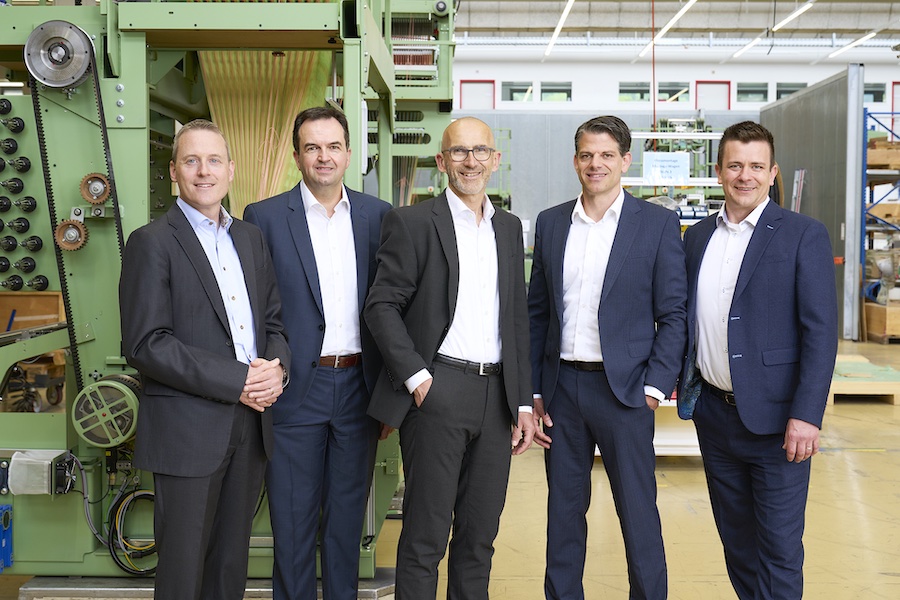
The Jakob Müller Group (JMG), a global leader in narrow fabric machinery, is pushing forward with the implementation of its JMG 2030 strategy. This strategy aims to solidify the company's market leadership, respond more agilely to the dynamic industry landscape, and align even more closely with customer needs.
JMG’s Group Management Team (from left to right): Fabian Voser (COO), Hanspeter Weilenmann (CFO), Andreas Conzelmann (CEO), Stephan Bühler (Owner), Bertram Wendisch (CTO); Benedikt Rentsch (CCO) will assume his new position as of March 1, 2025 © 2025 Jakob Müller Group


The current measures focus specifically on the company's core competencies and include, among other things, simplified corporate structures, adjustments and expansions of the product portfolio, a new acquisition, and targeted customer initiatives. With this, JMG strengthens its position in the market and lays the foundation for sustainable growth for the long-standing Swiss company.

The Swiss industrial landscape is changing – as is the global textile machinery industry, for which JMG manufactures machines and system solutions. As part of its JMG 2030 strategy, the world's leading machine manufacturer has now presented a series of measures designed to secure its market leadership and enable long-term growth.

JMG is investing specifically in strengthening customer focus and modernizing both its product portfolio and global internal processes. This includes the creation of innovative customer collaboration platforms, the expansion of the product portfolio in the volume segment, the optimization of the service offering, as well as the simplification of corporate and management structures.

Focus on core competencies and operational excellence

As part of its strategic realignment, JMG will increasingly focus on its core segments of Weaving, Label Production Systems, Warp Crochet Knitting, as well as Dyeing and Finishing. At the same time, the Winding & Making-up and Warping Systems segments at the JMG site in Schwelm, Germany, will be discontinued, with essential technologies and products being transferred to other areas. In addition, the Finishing segment will be relocated from Kadan, Czech Republic, to JMG’s sister company Benninger in Pune, India. These measures will lead to structural adjustments at the locations in Germany and the Czech Republic, where production will be gradually reduced.

"Even though these decisions were not easy for us, they are necessary to secure the future viability of the Jakob Müller Group. Our resources must be specifically directed where we see the greatest growth potential," says owner Stephan Bühler. Andreas Conzelmann, CEO of JMG, adds: "By focusing on our core segments, we are strengthening our innovative power and competitiveness – and ensuring that we can continue to offer our customers the best solutions in the future."

Unifying JMG’s brand identity and strengthening the global market position

COMEZ, the leading manufacturer of crochet and warp knitting machines in Italy, will be fully integrated into JMG and will operate under the name Jakob Müller Italy in the future. With investments in research and development – including the acquisition of MEI International, a renowned Italian manufacturer of label weaving machines – JMG will drive next-generation solutions and expand its product portfolio to include innovative air-jet technology. Further information regarding the acquisition of MEI will be provided in a separate announcement.

Sustainably improving customer experiences

Creating outstanding customer experiences is at the heart of the JMG 2030 strategy. The strategic investments in innovation and operational excellence enable JMG to offer state-of-the-art solutions, faster turnaround times, and an enhanced customer experience. A key element of this customer-centric approach is the opening of the new Customer Center and of the LAB1887 in Frick, Switzerland, in late summer 2025. This innovation factory serves as a development center where customers, together with JMG, can explore new technologies and develop novel applications for narrow fabrics.

"Our JMG 2030 strategy underscores our company’s commitment to long-term stability, sustainable growth, and maintaining our position at the forefront of the narrow fabric industry," says Andreas Conzelmann. "The changes we are implementing will enable us to become a more agile, customer-focused company – ready to seize future opportunities."




More News from

#Functional Fabrics

“Action helps us change what we do!”

DAY 0 takes place deliberately before PERFORMANCE DAYS begins. It is conceived as a space for reflection, dialogue and active engagement — a moment to pause before the fair, rethink established systems and address sustainability not as a trend, but as a fundamental transformation challenge. Under the guiding metaphor “Turn the Tap Off”, DAY 0 focuses on root causes rather than symptoms, systemic change rather than isolated solutions, and collective responsibility rather than individual silos.

#Textiles & Apparel / Garment

Pets in fashion: functional and sustainable textiles find new market at Intertextile Apparel

China’s pet economy is booming, especially amongst younger generations, and pet apparel – from designer outfits to functional garments – was a RMB 3.5 billion (over USD 500 million) market in 2024, growing more than 20% annually¹. To help exhibitors harness this trend, Intertextile Shanghai Apparel Fabrics – Spring Edition 2026 will launch the Pet Boutique, presenting a range of innovative, sustainable materials that prioritise both functionality and comfort for pets.

#Sustainability

VAUDE eliminates PFAS from all products

PFAS (per- and polyfluoroalkyl substances) are now detectable worldwide – in drinking water, soil and the human body. These so-called “forever chemicals” are considered hazardous to health and potentially carcinogenic, as they do not break down and remain in the environment permanently. Despite these risks, PFAS are still used in a wide range of products. More than 15 years ago, VAUDE made a strategic decision to gradually eliminate PFAS from all product categories.

#Man-Made Fibers

Lenzing AG to become majority owner of TreeToTextile AB and accelerates industrialization of new fibers

The Lenzing Group is taking another strategic milestone by acquiring a controlling majority in the Swedish innovation company TreeToTextile AB. This step strengthens Lenzing’s position as a leading provider of sustainable, wood‑based specialty fibers and expands its innovation pipeline with a highly scalable, patent‑protected technology platform. The transaction is executed through the issuance of new shares.

More News on Weaving

#Composites

Breaking new ground in Technical Textiles: Stäubli at JEC World 2026

Stäubli, a global leader in industrial and mechatronic solutions, will showcase its cutting-edge weaving machinery solutions for technical textiles at JEC World 2026, from 10 to 12 March in Paris-Nord Villepinte.

#Weaving

Groz-Beckert launches comprehensive Reed Portfolio in Ichalkaranji to advance weaving excellence in India

Groz-Beckert, the world’s leading provider of industrial machine needles, precision parts, and systems for the textile industry, hosted an exclusive customer event titled “Advancing Weaving Excellence – Reed Portfolio Launch” in Ichalkaranji, one of India’s most prominent weaving hubs.

#Weaving

Lindauer Dornier announces leadership transition in weaving machine business

After more than ten successful years at Lindauer DORNIER GmbH, Mr Wolfgang Schöffl will leave the family-owned company at the end of the year to enter well-deserved retirement.

#Research & Development

More safety and comfort for protective clothing thanks to auxetic fabrics

When everyday materials are pulled, they stretch or elongate in the direction of the pull and become narrower in cross-section. We can also observe this property in two-dimensional textiles. Auxetic structures behave differently here. They have the striking property of not changing under tensile stress or even increasing their width or thickness. These properties are advantageous, for example, in protective textiles or textile filter media. The DITF are researching auxetic fabrics for various applications.

Latest News

#Raw Materials

Better Cotton Initiative marks certification anniversary with progress update and accreditation

One year since becoming a certification scheme, the Better Cotton Initiative (BCI) has announced that more than 3,000 supply chain actors have been certified. At farm level, more than 30% of farms and producer units supplying BCI Cotton have received a positive audit outcome.

#Raw Materials

Cotton Incorporated appoints Bev Sylvester as Chief Marketing Officer

Cotton Incorporated announces the appointment of Bev Sylvester as chief marketing officer. In this newly created role, Sylvester will oversee Cotton Incorporated’s marketing strategy, brand positioning, consumer engagement and global outreach to increase demand for cotton and strengthen its relevance in the marketplace.

#Composites

Alliance for European Flax-Linen & Hemp expands bio-materials presence at JEC World 2026

The Alliance for European Flax-Linen & Hemp is pleased to announce its participation at JEC World 2026, featuring a significantly expanded presence and an enhanced offering for the global composites industry.

#Europe

FITA, ABIT and EURATEX underline strategic importance of Mercosur – EU Partnership Agreement for the textile and apparel industry

The Argentine Textile Industry Federation (FITA), the Brazilian Textile and Apparel Industry Association (ABIT), and the European Apparel and Textile Confederation (EURATEX) continue to monitor the process of internalizing the Mercosur-European Union Partnership Agreement. This agreement is essential for the competitiveness of our industries, on both sides of the Atlantic.

TOP